

Barefoot Shoes for the Gym: The Performance Athlete’s Guide to Ground-Up Power

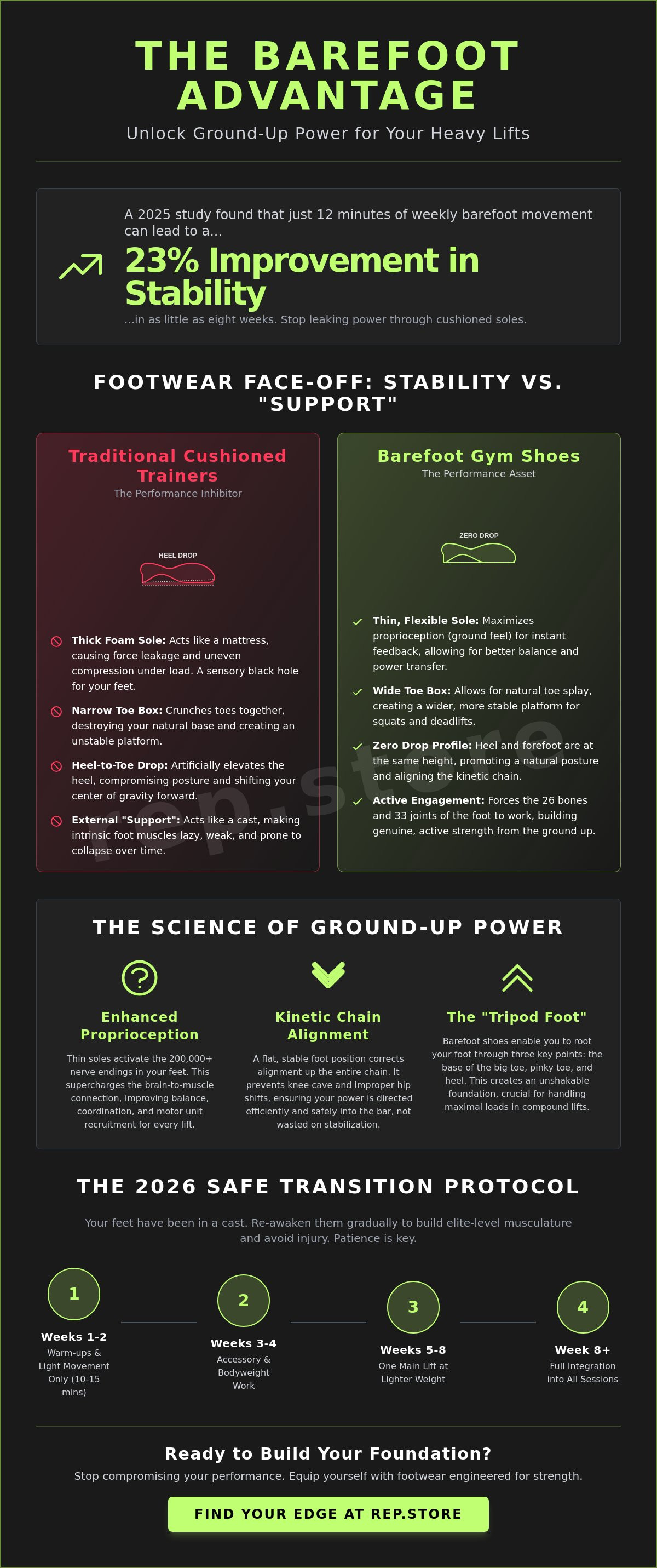
Your cushioned trainers are likely the reason your heavy lifts have hit a plateau. A 2025 study in the Journal of Pediatric Exercise Science revealed that just 12 minutes of barefoot movement per week can improve stability by 23% in as little as eight weeks. You've likely felt that frustrating instability during a heavy squat or the foot fatigue that sets in halfway through a session in the UAE's most intense strength gyms. It's a common struggle; you're told you need more support, yet your balance feels compromised by thick foam and narrow toe boxes.
Choosing the right barefoot shoes for gym training is not about following a minimalist trend; it's about reclaiming the 200,000 nerve endings in your feet to maximize sensory feedback. We'll show you how to transform your lifting stability and build genuine foot strength without sacrificing style. You'll discover the 2026 protocol for a safe transition and the specific footwear, including Vivobarefoot, that turns your feet into a high-performance foundation for every rep.
Key Takeaways
- Master the "Zero Drop" concept to align your posture and reclaim the natural power of an unshod foot.
- Unlock the science of proprioception to improve your brain-to-muscle connection and optimize every heavy lift.
- Use barefoot shoes for gym sessions to stabilize your kinetic chain and fix alignment issues at the knee and hip.
- Implement the 2026 transition protocol to safely build elite-level foot musculature while avoiding common injuries.
- Find your competitive edge with the Vivobarefoot Motus Strength, the gold standard for high-intensity training in the UAE.
What Are Barefoot Shoes for the Gym? (The Technical Definition)
Stop treating your footwear as a fashion statement. In the high-stakes environment of a Dubai strength facility, your shoes are either an asset or a liability. Barefoot shoes are engineered to let the foot function as if it were completely unshod; they strip away the "safety net" that actually holds your performance back. While many athletes use the terms interchangeably, the technical definition of minimalist shoes often allows for a small degree of cushioning or a slight heel drop. True barefoot shoes for gym use demand zero compromise. This means a "Zero Drop" profile where the heel and forefoot sit at the exact same height, mirroring your natural stance on the earth. Barefoot shoes are a precision training tool designed to maximize proprioception and ground force production by eliminating the artificial barrier between the athlete and the gym floor.
The Three Pillars of Minimalist Gym Footwear
- Wide Toe Box: A standard shoe crunches your toes together. This destroys your base. A wide toe box allows for natural toe splay, creating a wider, more stable platform for heavy squats and deadlifts.
- Thin Soles: Thick foam is a sensory black hole. Thin soles maximize the feedback from the floor to your brain. This is proprioception. When you can feel the ground, your central nervous system can better coordinate balance and power.
- Flexibility: Your foot isn't a block of wood. It needs to bend, twist, and react. Barefoot footwear allows the foot to move through its full, natural range of motion without restriction.
Why 'Support' is Often a Performance Inhibitor
The fitness industry has sold a lie: that your arches need constant "support." External arch support acts like a cast; it makes the intrinsic muscles of the foot lazy and weak. Over time, this leads to collapsed arches and chronic instability. Traditional cushioned shoes also mask poor lifting mechanics. They allow you to shift your weight incorrectly without immediate feedback, which often leads to injury once the loads get heavy enough. Your foot is the body's primary shock absorber. When you encase it in foam, you lose the natural spring and stability that 26 bones and 33 joints were designed to provide. Transitioning to barefoot shoes for gym sessions forces your body to stop relying on foam and start relying on biology. It's a shift from passive protection to active performance.
The Science of Barefoot Training: Unlocking Ground-Up Power
Power isn't generated in the quads or the glutes; it's transferred through the feet. If your foundation is a squishy, foam-filled trainer, your force production is leaking. Think of it as trying to jump off a mattress versus a concrete floor. When you use barefoot shoes for gym sessions, you're removing the dampening effect of traditional midsoles. This creates a direct line of force from your muscles into the platform. A 2025 systematic review in the Journal of Sport and Health Science confirmed that minimalist conditions significantly improve proprioceptive feedback. This isn't just about "feel"; it's about your brain's ability to recruit motor units more efficiently because it actually knows where your center of gravity is.
Your kinetic chain starts at the ground. If your foot collapses because of poor shoe structure, your knee caves. If your knee caves, your hip shifts. This misalignment is the "silent killer" of heavy lifts in many Dubai training facilities. By allowing the foot to sit flat, you're forcing the knee and hip into a more advantageous mechanical position. Forbes has highlighted that the best barefoot shoes focus on this structural integrity, helping athletes maintain a neutral spine under load. You can't fix a 150kg squat if your ankles are rolling in 2cm of EVA foam.
Stability for Heavy Compound Lifts
Squishy soles are dangerous. Under a heavy load, foam compresses unevenly, which creates micro-instabilities that your nervous system has to fight. You should be focused on the lift, not on staying upright. Barefoot shoes allow you to create a "Tripod Foot." This involves rooting three points of contact: the base of the big toe, the base of the pinky toe, and the heel. This tripod creates a rigid, stable base that won't shift. Additionally, being closer to the floor reduces the "moment arm" during deadlifts. Every millimeter of stack height you remove is a millimeter less you have to pull the bar, which can be the difference between a PR and a failed attempt. You can find high-performance gear to support this level of training at REP Store.
Muscle Recruitment and Hypertrophy
Barefoot training turns your feet into an active part of the movement. You have intrinsic muscles in your feet that act as a "core" for your lower body. Most modern shoes leave these muscles dormant. When you switch to barefoot shoes for gym sessions, these muscles are forced to fire to maintain your arch and balance. This increased activation doesn't stop at the ankle. Because you can access a full range of motion at the ankle joint without a raised heel, your calves and tibialis muscles work harder. This leads to better lower leg development and improved athletic longevity. It's about building a body that performs as well as it looks.
Barefoot vs. Traditional Gym Shoes: Which Wins for You?
Choosing the right footwear in a Dubai gym shouldn't be a guessing game. It's a calculation of stability, versatility, and protection. Traditional gym shoes prioritize external support, often using rigid plastic or high-density foam to "correct" your movement. Barefoot shoes for gym training flip the script. They prioritize internal control. While a standard trainer might have a stack height of 20mm or more, minimalist options keep you within 3mm to 5mm of the floor. This reduction in stack height doesn't just improve your balance; it demands and develops superior ankle mobility. If you're performing a mix of heavy lifting and high-intensity metcons, the choice depends on your specific performance bottlenecks.
Barefoot Shoes vs. Weightlifting Shoes (Lifters)
Olympic weightlifting shoes are specialized tools. They feature a raised, rock-solid heel designed to assist with deep squats by compensating for limited ankle dorsiflexion. You should choose a weightlifting shoe when your session is strictly focused on snatches, cleans, or heavy squats where a vertical torso is non-negotiable. However, for 90% of your other gym work, lifters are overkill. Barefoot shoes are superior for general strength training, lunges, and accessory work because they don't provide an artificial crutch. They force your muscles to stabilize the joint naturally, leading to more resilient movement patterns that carry over to real-world athletics.
Barefoot Shoes vs. Standard Cross-Trainers
The standard cross-trainer, like the popular R.A.D One, is built for the hybrid athlete. These shoes offer a blend of responsiveness and cushioning that makes them effective for jumping and short runs. But there's a trade-off. Even the best cross-trainers dull the sensory input from the floor. Modern barefoot shoes for gym use have evolved past the "toe shoe" era. Brands like Vivobarefoot now produce sleek, durable designs that can handle the abrasion of rope climbs and the lateral stress of box jumps without looking out of place in a premium UAE fitness club. They offer a raw, unadulterated connection to the ground that no cushioned trainer can replicate. If your goal is to build a bulletproof foundation from the ground up, the minimalist path is the only logical choice.
How to Transition to Barefoot Shoes (The 2026 Protocol)
Switching to barefoot shoes for gym training is a physiological overhaul, not just a gear change. Your Achilles tendon has likely spent years in a shortened state due to traditional trainers with elevated heels. Forcing it into a zero-drop environment under heavy load without preparation is reckless. It leads to tendonitis and sets your progress back by months. The 2026 Protocol demands a disciplined, incremental approach. Start by wearing your new shoes for 15 to 20 minutes during non-strenuous activities. The 2026 ACSM guidelines now recommend "proprioceptive priming" as a prerequisite for this transition. This involves structured barefoot protocols to enhance motor control before you ever step under a barbell. If you feel sharp, localized pain in the heel or arch, back off immediately. If it's just dull muscle fatigue in the calves, your tissues are adapting correctly.
A 4-Week Transition Plan for Athletes
- Week 1: Use your minimalist shoes only for warm-ups and accessory work. Keep your main compound lifts in your traditional trainers to manage the sudden change in mechanical stress.
- Week 2: Introduce low-volume lifting sessions. Perform your squats or deadlifts at 50% of your usual working weight to monitor how your foot stability holds up under light loads.
- Week 3: Transition to full training sessions but keep a backup pair of traditional shoes in your gym bag. If your arches feel "collapsed" or fatigued mid-workout, swap them out to avoid overtraining the small muscles of the foot.
- Week 4: Full integration. Assess your foot strength and balance. By this stage, your central nervous system should be fully calibrated to the increased sensory input from the floor.
Essential Foot Mobility Drills
You must prepare the hardware before running the software. Toe yoga is non-negotiable for anyone using barefoot shoes for gym sessions. Learn to lift your big toe independently while keeping the other four pinned to the floor. This builds the neurological control needed for the stable tripod base discussed earlier. Next, use a lacrosse ball to roll the plantar fascia for 120 seconds per foot daily. This breaks up tissue adhesions and improves blood flow to the intrinsic muscles. Finally, prioritize ankle dorsiflexion stretches. Without an artificial heel lift, your ankles must reach a greater range of motion to hit depth in a squat. Neglecting this will lead to your heels lifting off the floor, destroying your leverage and power output.
Ready to rebuild your foundation? Secure your pair of high-performance barefoot shoes at REP Store and start the protocol today.
Vivobarefoot and Beyond: Finding Your Fit in Dubai
Dubai's fitness scene is elite. You don't settle for average equipment, so don't settle for average footwear. Vivobarefoot has emerged as the undisputed gold standard for performance minimalist footwear. Their designs aren't just about being thin; they're about anatomical integrity. Finding the right barefoot shoes for gym sessions requires more than an online order and a prayer. Because your feet have likely been compressed for decades, your actual size might surprise you. A wide toe box only works if your toes actually have room to splay. If the fit is off by even a few millimeters, the performance benefits of ground-up power vanish. You need to feel the connection to the floor before you commit to the purchase.
Top Recommended Barefoot Models for 2026
The Vivobarefoot Motus Strength is the "tank" of the minimalist world. It's specifically engineered for high-impact gym use, featuring lateral reinforcement that handles heavy cleans and lateral lunges without compromising the barefoot feel. It's the premier choice for athletes who refuse to choose between protection and connection. For those focused on agility, speed, and HIIT, the Vivobarefoot Primus Lite offers a lighter, more breathable alternative. It feels like a second skin. While the Motus provides more structure for heavy lifting, the Primus Lite maximizes sensory feedback for dynamic, multi-directional movement. Comparing these models in person is the only way to understand how they interact with your specific foot shape and arch height.
Why Shop at REP Store Dubai?
We don't stock every brand on the market. We curate. At REP Store, we only sell the gear we use for our own 5:00 AM sessions. Our expert staff understands the "Everyday Performance" mindset. They won't just hand you a box; they'll analyze your stance and ensure your transition to barefoot shoes for gym training is successful. Having a physical location at the REP Store Dubai Hills Mall gives you an immediate advantage. You can test the ground feel on a solid surface and get a professional fitting that eliminates the risk of sizing mistakes. Your reputation as a serious athlete starts with the foundations you build in the real world. Stop guessing. Come in, get fitted, and start training with total control over your movement.
Build Your Foundation from the Ground Up
Your cushioned trainers are a performance bottleneck. By switching to barefoot shoes for gym training, you're upgrading your biological hardware. You've seen the data: 12 minutes of barefoot work per week can improve stability by 23% in just two months. A zero-drop profile and wide toe box are the only ways to reclaim the 200,000 nerve endings in your feet for maximum force production. Following the 2026 transition protocol ensures you build this elite-level strength without the risk of injury. It's a shift from passive support to active, ground-up power.
Don't leave your progress to chance with online sizing guesses. REP Store is the authorized Vivobarefoot retailer in the UAE, offering a selection curated by athletes for athletes. Visit us at Dubai Hills Mall for an expert fitting session to ensure your footwear matches your unique anatomy. It's time to stop relying on artificial foam and start relying on your own biology. Your next PR starts at the floor.
Shop the Vivobarefoot Collection at REP Store and reclaim your natural stability today.
Frequently Asked Questions
Are barefoot shoes good for heavy lifting like squats and deadlifts?
Barefoot shoes are superior for heavy lifting because they provide a non-compressible, stable base. Traditional foam-based trainers compress unevenly under loads exceeding 100kg, which creates dangerous micro-instabilities. By using a zero-drop shoe, you maximize your tripod stability and reduce the moment arm during deadlifts by staying as close to the platform as possible.
Can I wear barefoot shoes if I have flat feet?
Yes, wearing these shoes is often the most effective way to correct flat feet by strengthening dormant intrinsic muscles. A 2025 systematic review concluded that minimalist footwear leads to significant increases in foot muscle volume and arch function. External arch support acts like a cast that keeps your feet weak; removing it forces your feet to rebuild their own structural integrity.
How long does it take to get used to barefoot shoes in the gym?
Most athletes require 4 to 8 weeks to fully adapt to the increased mechanical demands. You must follow a structured transition like the 2026 Protocol, starting with 20 minutes of wear during accessory work. This timeframe allows your Achilles tendon and plantar fascia to safely remodel without the risk of overuse injuries or acute strain.
Do I need to wear socks with barefoot gym shoes?
Wearing socks is a personal preference, but thin, moisture-wicking toe socks are recommended for hygiene and friction control. Socks help manage sweat in the UAE's high-humidity environment and prevent blisters during high-intensity sessions. If you choose to go sockless, ensure your shoes feature an antimicrobial lining to prevent odor buildup over time.
Are barefoot shoes better for the gym than running shoes?
Running shoes are a liability in a strength environment because their elevated, cushioned heels create a "seesaw" effect during lifts. Using barefoot shoes for gym training provides the lateral stability and ground feel that running shoes lack. You wouldn't perform a heavy squat on a cushion; don't do it in a shoe designed only for forward linear motion.
Where can I buy Vivobarefoot shoes in Dubai?
You can find the full Vivobarefoot performance range at REP Store in Dubai Hills Mall. As an authorized retailer, we provide expert fitting services that are critical for transitioning to a wide toe box. Physical fitting is essential because your barefoot size often differs from your traditional trainer size due to natural toe splay.
Will barefoot shoes help with my knee or back pain?
They often resolve chronic pain by fixing misalignments in your kinetic chain. When your feet are unstable in cushioned shoes, your knees and lower back overcompensate to maintain balance. Aligning your foundation reduces the 23% of stability-related joint stress identified in 2025 movement studies, allowing for a more natural and pain-free movement pattern.
Can I do CrossFit in minimalist shoes?
CrossFit athletes should use durable minimalist models like the Vivobarefoot Motus Strength to handle high-intensity demands. These shoes are built to survive rope climbs and box jumps while providing the zero-drop profile needed for Olympic lifting. They offer the perfect balance of protection against abrasion and the raw connection required for elite-level functional fitness.


