

Buy Olympic Weightlifting Accessories in Dubai: A Smart Buyer’s Guide

More gear won’t solve a lifting problem you haven’t identified. If you’re searching “buy Olympic weightlifting accessories Dubai,” start by considering your lifts, current equipment and training priorities, not by filling a basket.
Straps, belts, collars and specialist plates are often presented as must-haves. Their usefulness depends on how you train, the bar and plates you use, and your experience. A poor fit or incompatible accessory can mean spending money without a clear benefit.
This guide helps you separate essentials from extras and make more informed choices. Learn how to match accessories to Olympic lifts, assess fit and compatibility, and compare practical quality considerations before buying. We’ll also cover how bar and plate types affect your decisions, so you can shop with a clearer plan.
REP Store is a Dubai-based destination for curated performance-training gear, with online shopping and a physical store at Dubai Hills Mall. Use this guide to focus your search, then explore REP Store’s performance range with your training needs in mind.
Key Takeaways
- Start with the demands of your snatch and clean and jerk, then choose accessories that address a specific training need.
- Understand what each accessory category is designed to do before deciding which items deserve priority.
- Compare options by intended use and fit, and check product specifications for compatibility with your equipment.
- Use a practical checklist that accounts for your training location, storage space and how often you’ll use each item.
- When you buy Olympic weightlifting accessories Dubai, explore performance-training gear at REP Store, including its Nike Strength gym-equipment range.
Buying Olympic Weightlifting Accessories in Dubai: Start With Your Lifting Needs
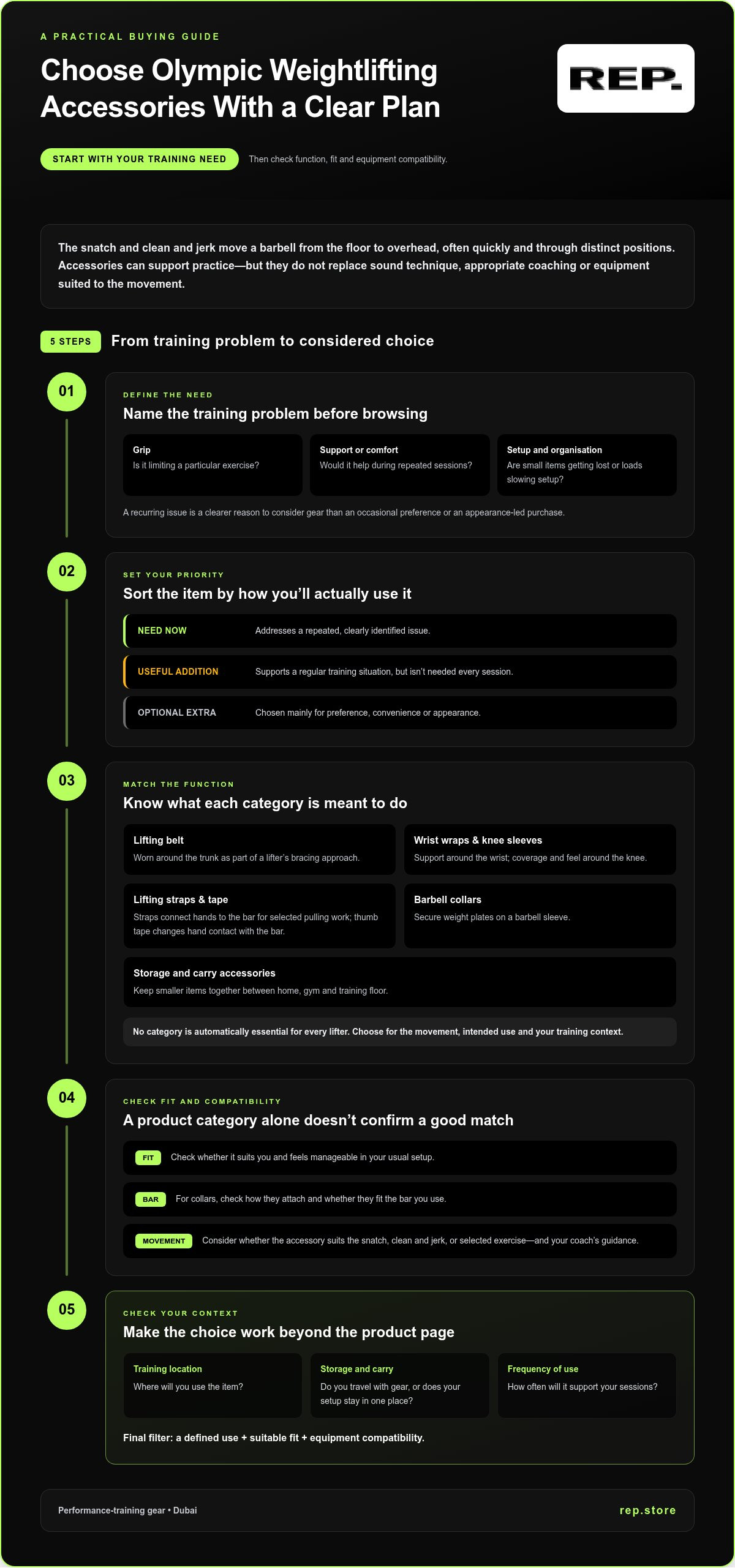
Start with a training need, not a shopping list. Olympic weightlifting centres on the snatch and clean and jerk, movements that take a barbell from the floor to overhead, often quickly and through distinct positions. That makes their demands different from general strength training, which may focus on controlled movements such as squats, presses or deadlifts. For a wider introduction to the sport and its lifts, see this Olympic Weightlifting Overview.
Accessories can support practice, but they don’t replace sound technique, appropriate coaching or equipment suited to the movement. Choose each accessory for a defined use, a suitable fit and your training context. This keeps each purchase connected to your sessions rather than to a generic idea of a complete kit.
Which training problem are you trying to solve?
Identify the issue before you browse. Is your grip limiting a particular exercise? Would you benefit from more stability or comfort during repeated sessions? Do small items get lost between sets, or does handling and organising loads slow down your setup? A clear answer can help you distinguish a recurring training need from an occasional preference or an appearance-led purchase.
Your experience can also shape what to prioritise. A beginner may get more value from learning the lifts with suitable equipment and building repeatable habits than from adding several aids at once. An experienced lifter may have a specific, established use for supportive wear or grip aids. Either way, consider whether the item addresses a recurring situation, or whether adjusting your technique or setup would be a more direct solution.
Essentials, useful additions and optional extras
Think in tiers rather than absolutes. Supportive wear, grip aids and barbell collars are broad accessory categories, but none is automatically essential for every lifter. Their usefulness depends on the movement, the person using them and the training environment. A collar, for example, secures plates on a compatible bar; a grip aid makes sense only when it suits the exercise and your approach.
Before you buy Olympic weightlifting accessories Dubai shoppers may be considering, write a short priority list:
- Need now: an item that addresses a repeated, clearly identified issue.
- Useful addition: gear that supports a regular training situation but isn’t needed for every session.
- Optional extra: something chosen mainly for preference, convenience or appearance.
Check this list against where you train, what equipment you use and how often you’ll use each item. This simple filter makes browsing more deliberate and helps you decide what deserves attention before comparing specific categories.
Olympic Weightlifting Accessories Explained: What Each Category Does
An Olympic weightlifting accessory is supporting gear used during training. It isn’t the barbell, plates or platform that make up the core lifting setup. Those items enable the lifts; accessories serve narrower purposes, such as supporting a lifter’s preferred setup, securing plates or keeping training gear organised.
The distinction matters. A belt, strap or collar doesn’t replace suitable equipment or sound technique. The Science of Olympic Weightlifting provides further context on the sport’s biomechanics and training demands. Use that context to choose gear based on your lifts and routine, rather than someone else’s kit.
Support, grip and hand-protection categories
These categories serve different purposes. A lifting belt is worn around the trunk as part of a lifter’s bracing approach. Wrist wraps provide support around the wrist, while knee sleeves cover the knee and may suit lifters who prefer their feel during training. Neither should be treated as a substitute for technique or a guarantee against injury.
Lifting straps connect the hands to the bar and can be useful for selected pulling work when grip isn’t the focus. Tape, often applied around the thumb, changes how the hand contacts the bar. For snatches and clean and jerks, consider whether an item suits the movement and your coach’s guidance. Choose for comfort and purpose, not because another lifter uses it.
Barbell collars and equipment organization
Collars secure weight plates on a barbell sleeve. When choosing one, consider how it attaches and whether it fits the bar you use. Mechanisms can vary in how they open, close and tighten, so consider what feels manageable during your usual setup. The aim is a suitable fit and a clear, repeatable way to secure the plates.
Storage and carry accessories have a simpler job: keeping smaller items together between home, gym and training floor. They can be useful if loose gear is easy to misplace or you regularly travel with it. If your setup stays in one place, elaborate organisation may add little value. Start with your routine, then choose a practical solution.
In short, accessory choice depends on the lift, fit and intended use. If you’re planning to buy Olympic weightlifting accessories Dubai, distinguish supporting gear from the barbell, plates and platform, then assess each category against your actual sessions. For a local place to explore performance-training gear, visit REP Store in Dubai, which carries Nike Strength Gym Equipment.
Compare Olympic Weightlifting Accessories by Fit, Function and Training Use
A product name tells you its category, not whether it suits your routine. Compare what it does, how it should fit and what it needs to work with. Match the accessory’s fit to both the lifter and the equipment. Use the table as a starting point, then check product specifications for the details that matter to your choice.
| Accessory category | Intended use | Fit check | Buyer priority |
|---|---|---|---|
| Belt | Part of a lifter’s bracing approach during selected lifts | Check the product’s sizing guidance and whether it allows comfortable movement | Useful if it has a defined place in your lifting routine |
| Wrist wraps | Provide support around the wrist | Look for a secure fit that doesn’t restrict the movement you need | Consider your comfort during overhead positions |
| Knee sleeves | Cover the knee during training | Use the stated size guidance; assess comfort through a full range of motion | Choose based on fit and intended use, not appearance |
| Lifting straps | Connect the hands to the bar during selected pulling exercises | Review the design and instructions for use | Prioritise them only if they suit the exercise and your approach to grip |
| Tape | Changes how the hand contacts the bar, often around the thumb | Follow application and care guidance for the specific product | Consider comfort and the type of training where you’ll use it |
| Barbell collars | Secure plates on the bar sleeve | Match the collar to the sleeve dimensions and check its closing mechanism | Fit and ease of use matter more than style |
How to assess fit and compatibility before buying
For wearables, read the sizing instructions and consider how the item feels in motion, not just while standing still. It should feel secure without interfering with the positions you practise. For collars, compare the stated dimensions with the bar sleeve; a product name or image alone doesn’t establish compatibility. Review the care instructions as well, since cleaning and storage affect how an item fits into your routine. Don’t assume similar-looking products have the same sizing.
Match accessories to snatch, clean and jerk training
The snatch and clean and jerk involve different positions and transitions, so the same accessory may feel different across training tasks. A lifter might consider thumb tape for bar contact, wrist support for overhead work or straps for selected pulls when grip isn’t the focus. None is mandatory for a lift or experience level. Assess comfort and movement in appropriate training conditions, and follow coaching guidance if you have it. Stop using an item if it interferes with your technique or feels unsuitable.
Before you buy Olympic weightlifting accessories Dubai, compare each item’s intended use with your equipment and read its listed specifications. A suitable choice fits you, works with your setup and has a clear role in your training.
A Dubai Buyer’s Checklist for Olympic Weightlifting Accessories
A short process beats impulse buying. Before you buy Olympic weightlifting accessories Dubai, work through these checks and tie each decision to your training setup.
- Identify the use. Name the movement or recurring training situation the accessory should support. If you can’t identify one, it may not be a priority.
- Set priorities. Separate immediate needs from optional additions. Rank items by how often they’ll serve a clear purpose, not by how complete they make your kit look.
- Check fit. For wearables, follow the product’s sizing guidance and consider whether it allows comfortable movement. For equipment, check compatibility with the bar or setup you use.
- Review specifications. Read stated dimensions, fit information and care guidance. Don’t infer measurements or compatibility from a product photo or category name.
- Choose for your routine. Consider where you train, how much storage space you have and how often you’ll use each item. A compact item for regular travel may suit you better than something that stays at a fixed training location.
What to check when shopping in Dubai
Plan a store visit with your priority list and, if relevant, details of the bar or equipment you use. REP Store is at Dubai Hills Mall, First Floor, Dubai. Visiting in person gives you a chance to explore the performance-training range and assess the feel or proportions of gear you can handle. The sports stores in Dubai guide can also help you plan local shopping. Use product specifications to confirm fit and compatibility.
Build a focused accessory setup without overbuying
Start with the category that addresses your clearest training need. Put items that solve a recurring issue on your immediate list; place preference-led or occasional-use additions in a separate “consider later” group. This gives each purchase a purpose and helps prevent gear from piling up unused.
Revisit your list as your routine changes. A new training location, different equipment or more frequent sessions may change what’s useful. For now, let fit, function and frequency guide your decisions, then Explore REP Store’s performance-training selection.
Shop Performance Training Gear at REP Store in Dubai
A good buying journey ends with a choice that fits your training, not a basket full of unneeded gear. REP Store is a Dubai-based specialist retailer for performance apparel, footwear and training gear, with an online store and a physical location at Dubai Hills Mall. If you’re searching for “buy Olympic weightlifting accessories Dubai,” use your shortlist to guide your research and keep fit and intended use at the centre of the decision.
A performance-focused shopping experience in Dubai
REP Store’s curated performance-training range gives athletes and training-focused shoppers a place to explore gear. Its strength-equipment range includes Nike Strength Gym Equipment. Visit the physical store at Dubai Hills Mall, First Floor, Dubai, or browse performance gear through the online store. For any accessory you’re considering, use its product information to assess fit, dimensions and compatibility.
An in-person visit lets you explore the store and get a feel for the performance gear on display. Go prepared: bring your priority list, note the equipment you train with and keep relevant measurements or specifications handy. This helps you make the most of your visit and compare options against your setup.
Take the next step with your accessory shortlist
Before choosing, run through the decision once more: identify the training need, select the relevant category, assess fit, check compatibility with your equipment and confirm that the item has a defined use in your routine. Keep immediate requirements separate from optional additions. This makes browsing more purposeful, whether you prefer to compare online or visit the store.
- Training need: What recurring situation should the gear address?
- Category: Does the item serve that purpose?
- Fit: Do the sizing details suit you?
- Compatibility: Do the stated specifications match your equipment?
- Intended use: Will it earn a regular place in your training?
Keep the process simple. Browse REP Store online or visit the Dubai Hills Mall location, then use product details to make a considered choice. Explore REP Store and build your performance-training setup around what you actually use.
Make Your Next Gear Choice Count
Your training setup should evolve with your lifting, not with every new item you see. After a few sessions, notice what genuinely helps you train comfortably and consistently. Keep that feedback in mind as your technique, goals or routine develop. It gives your next purchase a clear purpose and helps prevent unused gear from piling up.
When you’re ready to buy Olympic weightlifting accessories Dubai, make the decision with your training context in view. Choose what serves your lifts now, and leave room to reassess later. A focused setup comes from deliberate choices, not a one-time attempt to own everything.
REP Store brings together curated performance apparel, footwear and training gear, including Nike Strength Gym Equipment. Explore the online store or visit the Dubai Hills Mall location to discover the performance-focused selection. Explore REP Store’s performance-training gear and take your next step with confidence.
Frequently Asked Questions
Do Olympic weightlifting accessories need to meet competition standards?
Only if you plan to use them in a competition, and the applicable requirements depend on the event and its governing rules. Recreational training usually gives you more flexibility, but don’t assume every item permitted in the gym is permitted on the competition platform. Check the current regulations for your event, including any rules covering personal equipment, before competing. Your coach or event officials can help clarify requirements.
Can beginners use Olympic weightlifting accessories?
Yes, beginners can use accessories, but they don’t need a full kit before learning the lifts. Start with what your sessions require and introduce items one at a time, so you can judge whether each feels comfortable and useful. For example, a beginner who trains in a shared gym might first focus on practical session essentials, then consider additional gear as their routine becomes clearer. Follow coaching guidance.
Are Olympic weightlifting accessories also useful for powerlifting?
Some can be useful for both sports, but the training demands aren’t identical. A belt or wrist support, for instance, may suit certain strength-training movements, while an item used for one exercise may not help with another. Consider the movement and your training goal rather than assuming a weightlifting accessory transfers automatically. If you compete in powerlifting, check that event’s equipment rules separately from your training preferences.
How should I care for weightlifting accessories in Dubai’s climate?
Clean and dry your gear after sessions, especially items that absorb sweat or sit against the skin. Avoid leaving damp accessories sealed in a gym bag or in a hot vehicle; let them air-dry before storing them. Follow each product’s care label, since materials can require different cleaning methods. Check items periodically for wear, loose stitching or changes in fit, and replace them if they no longer function as intended.
What should I take to my first Olympic weightlifting session?
Bring comfortable training clothes, water and any personal footwear or accessories you already use and know are suitable. A small towel and a way to note coaching cues can also be practical. You don’t need specialist gear for every possible lift. Keep your bag simple, and use the first session to understand the training format, equipment setup and any guidance your coach gives about what to bring next time.
Can Olympic weightlifting accessories be used for general gym training?
Often, yes. Some items may suit broader strength or cross-training routines, provided they work for the exercise and equipment involved. Before you buy Olympic weightlifting accessories Dubai for mixed training, consider whether each item works across the movements you perform or serves a narrower purpose. Read the product’s use and care guidance, and don’t use an accessory in a way that restricts movement or conflicts with your technique.


