

Flat Sole vs. Raised Heel Weightlifting Shoes: The Definitive Athlete’s Guide

You are wasting potential and risking joint damage by wearing a shoe that fights your anatomy. The choice between flat sole vs raised heel weightlifting shoes isn't a matter of fashion; it's a matter of mechanical leverage. If you've struggled with knees caving during heavy squats or felt your heels lift as you fight for depth, your footwear is likely the culprit, not your effort. You shouldn't have to guess which gear will stabilize your overhead movements or maximize your power output.
It's frustrating to invest time in the gym only to be held back by equipment that doesn't suit your frame. This guide will help you master the biomechanics of your own body so you can choose the exact shoe that protects your joints. You'll learn to identify your specific anatomical needs, such as femur length and ankle dorsiflexion, to stop wasting money on the wrong gear. We'll analyze the latest 2026 IWF and IPF regulations and compare how different offsets impact your primary training style. It's time to stop guessing and start lifting with total control over your structural stability.
Key Takeaways
- Decode the mechanical differences between 0mm flat soles and 22mm raised heels to understand how they manipulate your center of gravity.
- Identify how your specific femur length and ankle mobility dictate whether you require a heel offset to maintain an upright torso.
- Evaluate the performance trade-offs of flat sole vs raised heel weightlifting shoes to determine which foundation maximizes your specific primary lifts.
- Learn the "rooting" techniques that make flat soles superior for deadlift stability and shortening the bar's path.
- Master the essential in-store fit-tests to prevent heel slip and ensure proper toe splay before you commit to a technical shoe.
The Mechanical Foundation: Flat Sole vs. Raised Heel Explained
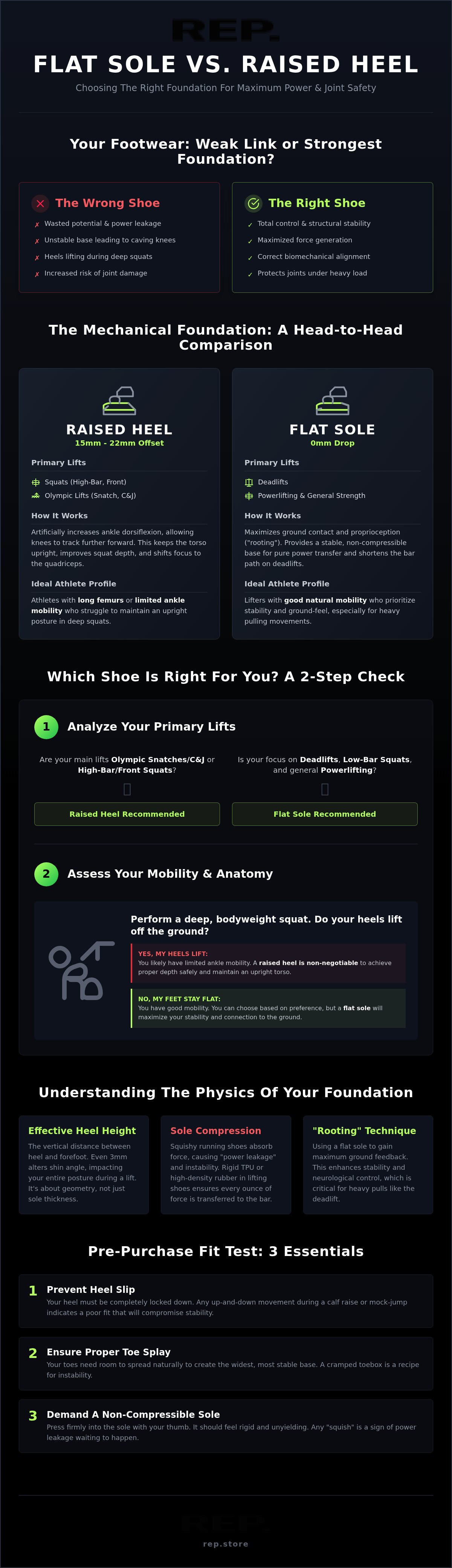
Your training footwear acts as the primary interface between your body and the platform. It's the most critical lever in your kinetic chain. Choosing between flat sole vs raised heel weightlifting shoes determines how efficiently you generate force and how your joints distribute that load. Flat soles provide a 0mm drop, maximizing ground contact and proprioception. This allows the brain to receive immediate feedback from the floor, which is essential for "rooting" during heavy pulls. When you feel the floor, you can control the lift.
Conversely, Olympic weightlifting shoes utilize a raised heel, typically ranging from 15mm to 22mm. This elevation isn't just about height; it's about geometry. It allows the knee to track further forward without requiring extreme ankle mobility. This mechanical shift keeps the torso upright and moves the load toward the quadriceps. Physics doesn't negotiate. If you use general purpose sneakers for heavy strength training, you're fighting a losing battle. Squishy soles absorb force like a sponge, leading to "power leakage" that sabotages your personal bests.
Stability requires a non-compressible foundation. Every millimeter of foam between your foot and the floor is a potential point of failure. Professional athletes don't leave their stability to chance. They choose footwear that acts as a rigid extension of their skeleton.
What is Effective Heel Height?
Effective heel height is the vertical distance between the heel and the forefoot. It's different from stack height, which is the total thickness of the sole. A shoe might have a massive stack height but still be "flat" if the heel and toe are on the same plane. Even a 3mm difference in effective height significantly alters the angle of your shin during a squat. This minor adjustment can be the difference between a vertical spine and a "good morning" squat where your hips rise too early. Precision matters here.
The Role of Sole Compression
When you squat 150kg in running shoes, the foam compresses unevenly. This creates a micro-environment of instability. It bleeds power and forces your stabilizing muscles to work overtime. High-performance gear uses TPU (Thermoplastic Polyurethane) or high-density rubber to ensure that force returns to the bar. Modern engineering has bridged the gap for those who need versatility. The R.A.D Shoes Now in UAE manage compression through a proprietary midsole that offers enough density for heavy lifting while maintaining the flexibility needed for dynamic movements. You need a base that won't buckle under pressure.
The Case for Raised Heels: Squats, Snatches, and Mobility
Stop fighting your anatomy. If your heels lift when you hit the bottom of a squat, you aren't just missing depth; you're losing force. The debate over flat sole vs raised heel weightlifting shoes often ignores the reality of human proportions. For athletes with long femurs or limited ankle mobility, a raised heel is a requirement, not a luxury. It shifts the center of mass, allowing for increased quadriceps recruitment while sparing the lower back from excessive leaning. You can't out-train bad geometry.
By elevating the calcaneus, you artificially increase ankle dorsiflexion. This allows the knees to travel forward without the heels losing contact with the platform. While some academic research on barefoot squats suggests that zero-drop positioning offers certain proprioceptive benefits, it often fails to account for the speed and depth required in competitive Olympic lifting. In a snatch or clean and jerk, the "catch" position is a high-stakes environment where stability is everything. A raised heel provides that stability by creating a solid, unyielding platform that prevents the torso from collapsing forward.
When a Raised Heel is Non-Negotiable
Torso verticality is the priority for high-bar and front squats. Without a heel, your hips will likely drift back, turning a squat into a "good morning" pattern that overloads the lumbar spine. Competitive Olympic lifting is another arena where you cannot compromise. If you can't hit a deep, upright squat because your ankles won't flex, you're capped by your gear, not your strength. This is especially true for athletes dealing with old injuries that have left them with permanent mobility restrictions. The heel isn't a crutch; it's a tactical adjustment.
Top Raised Heel Options at REP Store
We provide the TYR L-1 Lifter because it delivers a precise 21mm heel-to-toe drop. This is the industry standard for athletes who need an aggressive offset to conquer mobility restrictions. TYR Training Shoes are engineered to withstand the high-volume training demands of the modern athlete. They don't just provide height; they provide a wide toe box that allows for natural splay, ensuring you remain grounded during maximum efforts. You can compare these technical specs in person at REP Store to see which offset feels most natural under load. Choosing the right heel height is a calculated decision that directly impacts your power output.
The Case for Flat Soles: Deadlifts, Stability, and Powerlifting
Physics doesn't care about your brand loyalty. It cares about leverage. When analyzing flat sole vs raised heel weightlifting shoes, the deadlift provides the most objective data. A raised heel is a mechanical liability during a heavy pull. By adding 20mm of height, you aren't just increasing the range of motion; you're shifting your center of gravity forward. This forced tilt often results in the bar drifting away from the shins, causing a catastrophic loss of tension in the posterior chain. Flat soles eliminate this "tipping" effect, keeping the load centered over the midfoot for maximum force production.
Stability starts with rooting. Maximizing the surface area of your foot on the platform allows for better balance and "ground feel." For powerlifters who prefer a low-bar squat, flat soles are often superior. They encourage a hip-dominant movement pattern that allows the lifter to sit back into the squat without the knees tracking excessively forward. While a heel helps those with limited mobility, a flat shoe rewards those with the structural integrity to maintain a neutral spine under load. You're trading artificial mobility for raw, unadulterated stability.
The "Barefoot" Advantage in Strength
Modern strength training in Dubai is seeing a massive shift toward minimalist footwear. Traditional shoes often act as a cast, weakening the intrinsic muscles of the foot. By switching to zero-drop options like Vivobarefoot Shoes, you re-engage these dormant stabilizers. This direct foot-to-ground feedback sharpens central nervous system activation. When your brain receives clear signals from the floor, it can coordinate a more powerful muscular response. It's about building a foundation that doesn't rely on foam or plastic to stay upright.
Deadlifting: Why 20mm Can Ruin Your Pull
Every millimeter you add to your heel is a millimeter further you have to pull the bar. In a sport where world records are decided by fractions of a kilogram, this is an unnecessary handicap. Beyond the range of motion, the biomechanical impact is significant. A UNLV study on squat biomechanics highlights how shifting heel height alters joint angles and muscle recruitment. During a deadlift, this shift can pull you out of position before the plates even leave the floor. Flat shoes ensure your shins stay vertical and your hips stay in the optimal power position. If you want to move the most weight possible, don't let your footwear push you out of the pocket. Precision in your gear leads to precision in your performance.
The Decision Matrix: Anatomy vs. Training Style
Stop guessing. Your body's geometry dictates your footwear, not your ego. When choosing between flat sole vs raised heel weightlifting shoes, you must first audit your own structural levers. Long-limbed lifters with high femur-to-torso ratios are at a mechanical disadvantage in zero-drop shoes during squats. Their center of mass shifts backward, forcing an excessive forward lean that compromises the lumbar spine. If you have long legs, a raised heel isn't a choice; it's a structural necessity for survival under a heavy bar.
Your training goal is the second filter. A pure powerlifter specializing in low-bar squats and deadlifts will find the most stability in a flat sole. However, the modern hybrid athlete faces a unique challenge. You might need to transition from heavy snatches to box jumps or a 400-meter sprint. Most technical footwear fails in this multi-modal environment. This is where the industry-leading R.A.D One Shoes provide a strategic advantage. They offer the density required for heavy loads without the rigid, clunky feel of a traditional lifter. You need gear that adapts to your frequency and intensity, not gear that limits your movement pool.
The 30-Second Ankle Mobility Self-Test
Ankle dorsiflexion is the ultimate "yes or no" for heel height. Perform the knee-to-wall test. Kneel on the floor and place your big toe five inches from the wall. Try to touch the wall with your knee without your heel lifting. If you fail this test, your ankles lack the range of motion to keep your torso upright in a deep squat. In this scenario, a raised heel like TYR is your new best friend. It provides the mechanical assistance your joints currently cannot. If you pass easily, a flat or hybrid shoe may offer you more versatility and better "ground feel."
Anatomy Comparison Table
Use this matrix to identify your profile. Don't buy based on what your favorite influencer wears. Buy based on the data your body provides.
| Ankle Mobility | Femur Length | Primary Lift/Style | Best Shoe Match |
|---|---|---|---|
| Poor | Long | Olympic/High-Bar Squat | TYR Training Shoes (Raised Heel) |
| Good | Short | Deadlift/Low-Bar Squat | Vivobarefoot (Flat Sole) |
| Moderate | Average | Hybrid/CrossFit | R.A.D One (Hybrid) |
Choosing the wrong foundation is a fast track to plateauing or injury. If you are still undecided, the R.A.D One serves as the most effective "Best Overall" solution for athletes who demand high performance across multiple disciplines. You can find your match at REP Store and stop leaving your power output to chance.
Choosing Your Perfect Pair at REP Store Dubai
Buying technical footwear online is a gamble you'll likely lose. Sizing charts are static. Your feet are dynamic. When you're under a 100kg load, your foot structure changes. Arch height drops, and your foot volume expands. If you buy based on a digital recommendation, you're likely to end up with a shoe that bleeds power or causes heel slip at the worst possible moment. Technical gear requires a physical audit.
The "Dubai Hills Mall fit-test" is non-negotiable for serious athletes. You don't just walk in these shoes; you perform. At REP Store, we encourage you to squat to full depth, lunge, and even jump. This process reveals if the heel cup is deep enough to lock you in or if the upper material is too rigid for your specific foot shape. A wide toe box is the hallmark of modern performance. Brands like TYR and R.A.D have moved away from the narrow, restrictive designs of the past. Splaying your toes creates a wider base of support. It allows for better "rooting" and ground feel. If your toes are cramped, your balance is compromised before you even touch the bar.
Why the R.A.D One is the "Middle Ground" King
The R.A.D One has claimed its spot for a reason. Its 6mm drop provides a subtle offset that isn't as aggressive as a 21mm lifter but offers significantly more support than a zero-drop flat. This is the preferred choice for the Dubai CrossFit community. It allows you to transition from heavy cleans to box jumps or sprints without changing gear. If you're moving from generic sneakers to technical footwear, this hybrid provides the necessary density without the clunky, heavy feel of a traditional weightlifting shoe. It's the ultimate bridge for those undecided in the flat sole vs raised heel weightlifting shoes debate.
The final verdict depends on your primary objective. If your training is built around the snatch and clean and jerk, the 21mm heel of the TYR L-1 is your best tool. If you're a powerlifter chasing a deadlift record, the zero-drop stability of a flat sole is the only logical choice. For everyone else, the hybrid model offers the best ROI for your training time. Don't let poor footwear be the bottleneck in your athletic progress.
Visit the Performance Hub in Dubai Hills Mall
Physics doesn't negotiate. Neither should you. Choosing between flat sole vs raised heel weightlifting shoes is a decision that impacts every rep of your training cycle. Our performance consultants at REP Store understand lifting mechanics. They'll help you navigate the nuances of heel height and sole density based on your specific anatomy. You can also test these shoes alongside the latest Nike Strength Gym Equipment to feel the difference under real load. Visit us at Dubai Hills Mall to find your perfect fit.
Optimize Your Mechanical Advantage
Your footwear is the most critical lever in your kinetic chain. We've established that the choice between flat sole vs raised heel weightlifting shoes isn't about preference; it's about matching equipment to your specific anatomy and training goals. If you're chasing verticality in the squat, a technical raised heel is your tactical edge. If you're pulling for maximum load, a flat sole provides the unyielding stability you need to stay rooted and transfer force efficiently.
Don't leave your structural integrity to chance with generic sneakers or unverified online purchases. REP Store is the authorized UAE retailer for R.A.D and TYR, offering you direct access to the world's most advanced lifting gear. Our expert performance consultants are available in-store at Dubai Hills Mall to guide you through a professional fit-test, ensuring your gear supports your power output rather than hindering it. It's time to build your strength on a foundation that refuses to compromise.
Shop the Curated Footwear Collection at REP Store and secure your perfect fit at Dubai Hills Mall today. Your next personal best starts from the ground up.
Frequently Asked Questions
Can I deadlift in raised heel weightlifting shoes?
You shouldn't deadlift in a raised heel. Elevating your heel increases the distance the bar must travel and shifts your center of gravity forward. This mechanical disadvantage forces the bar away from your shins, which places unnecessary stress on your lower back. Stick to flat soles to keep the load over your midfoot and maximize your leverage during the pull.
Are flat shoes better for squats if I have good mobility?
Flat shoes are an excellent choice for squats if you have the ankle range of motion to hit depth without your torso collapsing. This setup is particularly effective for low-bar squats where a hip-dominant pattern is preferred. You'll gain a more stable base and better "rooting" compared to a heel, provided your joints can handle the required angles.
What is the best heel height for a beginner lifter?
A standard offset of 15mm to 20mm is the most effective starting point for most beginners. This provides enough mechanical assistance to help you learn proper squat geometry while you work on your natural mobility. When deciding between flat sole vs raised heel weightlifting shoes, beginners usually benefit more from the immediate stability and upright torso position that a moderate heel provides.
How should weightlifting shoes fit compared to running shoes?
Weightlifting shoes must fit significantly tighter than your daily trainers. There should be zero heel slip and almost no dead space in the toe box. While running shoes are designed for impact and expansion, lifting footwear acts as a rigid extension of your foot. If your foot moves inside the shoe under a heavy load, you've already lost your stability.
Do I need different shoes for CrossFit and pure weightlifting?
Hybrid athletes training in CrossFit need a versatile shoe like the R.A.D One that balances density with flexibility. Pure weightlifters, however, require the absolute rigidity of a dedicated lifter like the TYR L-1. Choosing the right flat sole vs raised heel weightlifting shoes depends on whether you're performing multi-modal circuits or focusing exclusively on the platform.
Are Vivobarefoot shoes good for heavy squats?
Vivobarefoot shoes are superior for heavy squats if you want to maximize foot strength and ground feedback. They allow for full toe splay and "rooting," which creates a massive base of support. However, they offer zero mobility compensation. If your ankles are tight, you'll likely struggle to hit depth without a heel, regardless of how strong your feet are.
How often should I replace my weightlifting shoes?
Replace your technical footwear every 18 to 24 months if you train at a high volume. Look for signs of sole compression or upper material degradation. Unlike running shoes, lifting shoes don't "wear out" in the traditional sense; they lose their structural integrity. Once the base becomes soft or the heel cup loses its grip, your power transfer is compromised.
Can I use Converse as a flat lifting shoe alternative?
Converse are a common entry point, but they aren't a long-term solution for serious athletes. The canvas upper stretches under heavy lateral loads, and the narrow toe box prevents the natural splay required for balance. Purpose-built flat shoes like Vivobarefoot or TYR DropZero provide a much wider, more stable foundation that won't buckle when the weights get heavy.


