

How to Choose Running Shoes for Heavy Runners in the UAE

Your body weight doesn’t decide which running shoe you need. Fit, comfort and how you run matter more. If you’re figuring out how to choose running shoes for heavy runners UAE, start with what your feet actually need, not a label based on weight.
It’s understandable to worry that everyday running shoes may feel uncomfortable or wear out quickly. But more cushioning isn’t automatically better, and stability shoes aren’t right for every runner. The best choice is one that feels secure and comfortable for your routine, whether you run outdoors in the UAE heat or mostly on a treadmill.
This guide breaks down cushioning, stability, outsole grip and fit in practical terms, so you can compare shoes without getting lost in jargon or assumptions. You’ll also learn what to notice when trying a pair on, including whether the upper feels breathable and your toes have room. If fit is hard to judge online, trying performance footwear in person can help. REP Store at Dubai Hills Mall offers Saucony running shoes alongside specialist fitness footwear and gear.
Key Takeaways
- Learn how to choose running shoes for heavy runners UAE by matching your running routine and preferred feel to the shoe, rather than relying on weight-based assumptions.
- Compare cushioning, stability and upper fit to narrow your options, then use each shoe’s category as a guide, not a guarantee of comfort.
- Use a simple try-on sequence to assess both shoes while standing and walking, and spot fit issues before you buy.
- Consider how your running surface and UAE conditions shape what feels comfortable for your runs.
- Explore Saucony running shoes at REP Store in Dubai Hills Mall, and use your fit and comfort checklist to guide your choice.
How to choose running shoes for heavier runners in the UAE: start with your needs
Wanting a running shoe that feels comfortable through your usual routine is a sensible priority. Your body size isn’t a flaw to correct, and it doesn’t dictate one shoe type. Start with how you run: how often, at what pace, over what distance, and on which surfaces. Your preferred feel matters too. A shoe that feels supportive to one runner may feel restrictive to another.
Three terms help you compare options. Cushioning is the material underfoot that shapes how the shoe feels as you run. Stability describes design features intended to help the foot feel supported through a stride. Fit is how the shoe holds your heel and midfoot while leaving your toes room to move. These categories can guide your search, but they can’t predict exactly what will feel right on your feet. For a broad overview of different types of running shoes, see Wikipedia’s background on athletic footwear.
A suitable running shoe fits securely, allows natural toe movement, and feels comfortable at your regular running pace, distance, and on your usual surface. That definition is more useful than choosing by body weight alone. It also gives you a practical way to assess options, whether you’re comparing shoes online or trying them on.
What should heavier runners look for in a running shoe?
Start with fit. Your heel should feel held rather than slipping, while your toes should have space to spread and move naturally. Then consider cushioning as a preference: some runners like a softer feel, while others prefer a firmer, more connected sensation. Neither is automatically right for a heavier runner. Think about your usual runs, too. A shoe for occasional short jogs may feel different from one you plan to use for frequent, longer sessions.
- Frequency: How often will you run in the shoes?
- Pace and distance: Do you run easy, short sessions, longer steady outings, or a mix?
- Surface: Will you use a treadmill, a track, paved routes, or a combination?
These details make the phrase how to choose running shoes for heavy runners UAE a practical question about your own needs, not a search for a weight-based formula.
How UAE running conditions can shape your shoe choice
Where you run matters because a treadmill and an outdoor route offer different surfaces and settings. If you switch between them, consider whether one pair feels comfortable across both or whether your preference changes. Outdoor routes also vary, so choose for the surfaces you actually use rather than assuming every UAE runner encounters the same conditions. When practical, try shoes at a time that reflects your usual running schedule. A short walk in-store can help you notice comfort, though it won’t fully recreate a run.
Keep the decision focused: match the shoe to your routine, then trust how it feels on your feet. Next, compare cushioning, stability and fit more closely, without treating any category as a prescription.
Running shoe features that matter: cushioning, stability, and fit
Feature names are useful comparison tools, not promises of comfort. A cushioned shoe may feel soft underfoot, while another feels firmer and more controlled. Stability features can affect how supported your stride feels, but they don’t diagnose your gait. Use the categories to decide what to try, then judge each shoe on your own feet.
This simple comparison can help you focus your in-store try-on:
| Feature | What it may feel like | What to assess |
|---|---|---|
| Cushioning | Softer or firmer underfoot | Which feel is comfortable as you stand and walk |
| Stability | A more guided or supported sensation | Whether the shoe feels secure without forcing your stride |
| Upper fit | Close around the heel and midfoot, with room at the toes | Whether it holds comfortably without pinching or slipping |
These are general impressions, not universal rules. Shoe construction and specifications differ by model, so compare specific details when reviewing brand or model claims. Research into running biomechanics and injury prevention highlights why movement and individual context matter: a shoe label alone can’t tell you how a particular option will feel.
Does more cushioning always mean more comfort?
No. Cushioning describes how the shoe feels underfoot; it doesn’t guarantee reduced discomfort. One runner may prefer a softer sensation, while another finds a firmer ride more comfortable. If possible, try both types with your usual running socks. Stand, walk, and notice whether the feel suits you instead of assuming more cushioning is automatically better for a heavier runner.
Use your own response as the test. If a shoe feels pleasant at first but unstable or awkward as you walk, keep comparing. Comfort isn’t a specification you can infer from a product description alone.
Stability features and fit: what to assess in-store
Stability features are design elements intended to create a more supported feel. They aren’t a prescription, and body weight alone doesn’t determine whether you need them. Try on both shoes and check that your heels feel secure, the midfoot is held without pressure, and your toes can move. Stand and walk in the pair, noticing any rubbing, tight spots, or slipping before deciding.
A comfortable fit is how the shoe feels on your foot; a category label is only a guide to its design.
Look underneath, too. Inspect the outsole’s grip pattern and construction for the running surfaces you use, and check that the shoe feels stable underfoot. These details can inform your comparison, but they don’t promise a particular lifespan. To make how to choose running shoes for heavy runners UAE a practical decision, prioritize feel and fit over assumptions. You can explore running shoes at REP Store.
Do heavier runners need a special running shoe? Compare options without assumptions
No shoe category is automatically right because of body weight. Runners differ in foot shape, stride, preferred feel, pace and routine. A better approach is to compare how a shoe is designed to feel, then judge whether it suits you. Neither a “neutral” nor a “stability” label can make that decision on its own.
There are trade-offs, not universal winners. Softer cushioning may feel plush, while firmer cushioning can feel more direct. A flexible shoe may move readily with your foot; a more structured shoe may feel supportive or restrictive, depending on your preference. Focus on whether the sensation stays comfortable as you stand and walk, not on which description sounds best online.
Neutral versus stability running shoes: how to compare them
Neutral shoes are generally designed without added stability features intended to guide the foot. Stability-oriented shoes include design elements intended to create a more supported or guided feel. These terms describe design approaches, not a prescription based on body size. Try both categories if you’re unsure, and notice whether either feels intrusive, comfortable or distracting.
During a try-on, pay attention to pressure across the midfoot, heel movement and any rubbing. A shoe that feels structured should still feel comfortable, not forceful. Likewise, neutral doesn’t mean it will feel natural to every runner. Your feet provide more useful feedback than the category name.
When online reviews help, and when they cannot decide for you
Reviews can help you spot recurring comments about fit, such as a narrow-feeling toe area or a loose heel. Treat those notes as prompts for comparison, not guarantees. Different foot shapes and preferences can produce different experiences in the same shoe.
Separate specifications from opinions. A listed construction detail describes the shoe; a reviewer’s claim that it feels soft or stable describes their personal experience. Neither replaces trying it on when you can. If a review compares running footwear with a training shoe, remember that they’re designed for different activities. The R.A.D training shoe guide covers training footwear, while this choice is about shoes for running.
Use a simple comparison process:
- Shortlist options based on your running routine and preferred feel.
- Read reviews for repeated fit observations, not one person’s final verdict.
- Compare verified specifications separately from subjective descriptions.
- Try on promising options and rule out any that create pressure or feel insecure.
This is the practical core of how to choose running shoes for heavy runners UAE: use labels and reviews to narrow the field, then let fit and comfort decide. A shoe doesn’t need to be marketed for a particular body type to be suitable for you.
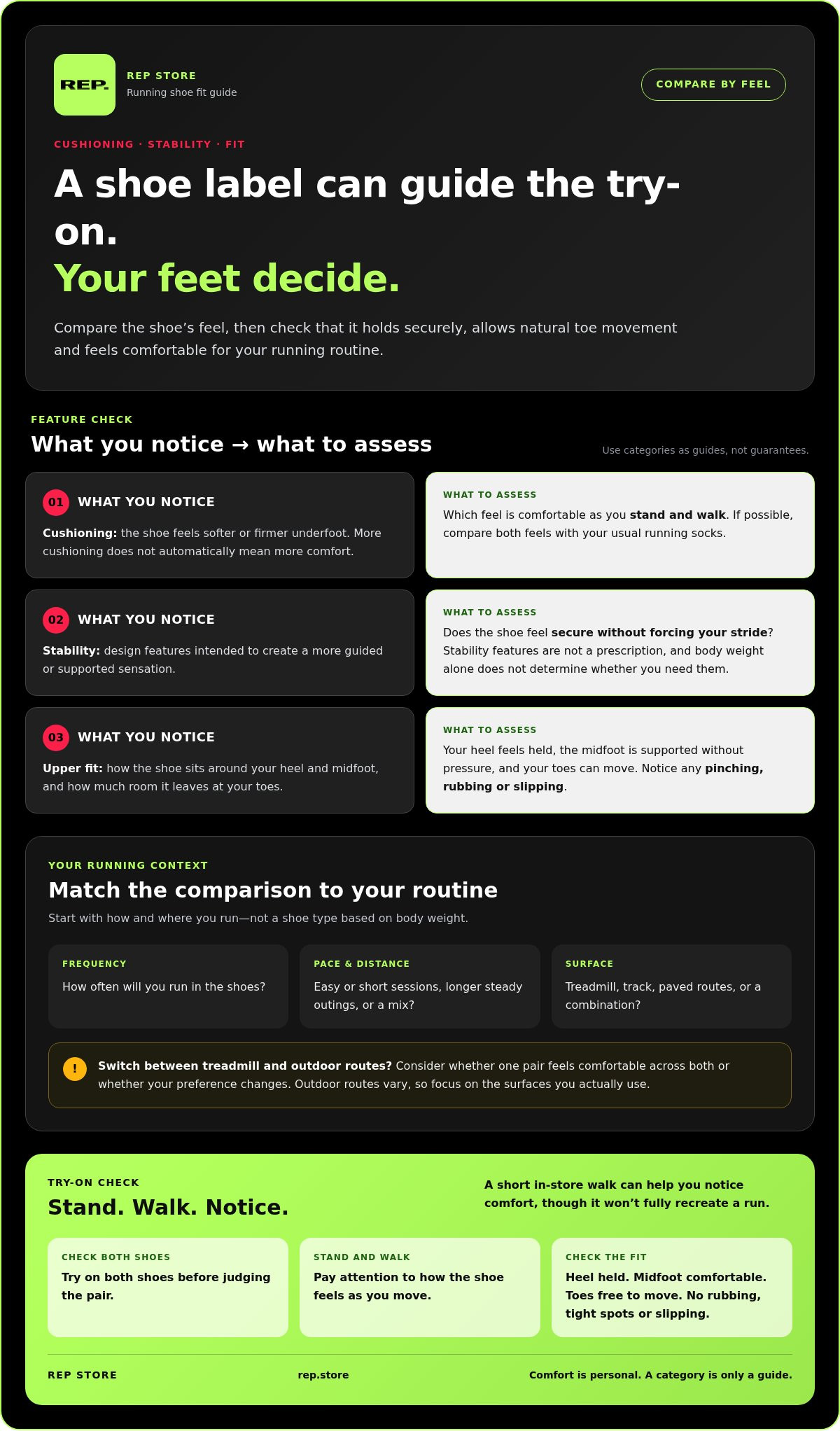
How to check running shoe fit before you buy in the UAE
A size printed on the box is only a starting point. Fit can differ between shoes, so assess how the pair feels rather than assuming your usual size will work. A careful try-on helps you catch heel slipping, toe pressure or upper discomfort before those issues become part of your run.
A practical five-step running shoe try-on
Use this sequence in-store, or adapt the checks you can make at home when ordering online:
- Wear your usual running socks. Bring them along if you’re shopping in person. Sock thickness can change how the shoe feels around your toes and midfoot.
- Try on both shoes. Lace them as you would for a run, then stand naturally. Check that your toes can move and that neither shoe presses uncomfortably across the top or sides of your foot.
- Assess the heel and midfoot. Walk a few steps and notice whether your heel lifts or your foot shifts inside the shoe. The midfoot should feel secure without pinching or creating a pressure point.
- Walk, then jog lightly if the setting allows. Notice whether the shoe stays comfortable through movement. Stop if you feel rubbing, slipping or discomfort rather than assuming you need to “break it in.”
- Compare how each pair feels. If you’re testing more than one option, pay attention to differences in comfort and security. For online orders, review the retailer’s sizing guidance and return information before purchasing.
Don’t rush the decision. A shoe that feels fine while seated may feel different once you’re standing and moving. If your routine includes both treadmill sessions and outdoor runs, consider which setting you want to prioritise when judging comfort. The feel of the shoe during a brief try-on won’t reproduce a full run, but it can reveal obvious fit problems.
Where to try running shoes in Dubai
If online sizing feels uncertain, trying performance footwear in person gives you a chance to compare fit directly. REP Store is located at Dubai Hills Mall in Dubai and offers performance footwear, including Saucony running shoes. Focus your try-on on running footwear, and assess the pair with the same checks you’d use anywhere.
For how to choose running shoes for heavy runners UAE, the practical test is straightforward: both shoes should feel secure, comfortable and free from distracting pressure as you stand and walk. Explore running shoes at REP Store and use the try-on sequence to guide your choice.
Find running shoes at REP Store and make your choice with confidence
You don’t need a shoe chosen for a number on a scale. You need a pair that suits your feet and the way you run. Before settling on an option, use a short checklist to bring your priorities together. It keeps the decision grounded in your actual routine, not marketing labels or assumptions.
How to narrow your shortlist before choosing
Keep only the shoes that feel secure and comfortable when you try them on. Compare their features against your usual runs, and treat product details as useful context, not a substitute for how the shoes feel. If one option creates pressure or feels insecure, don’t keep it on the shortlist just because its description sounds ideal.
- Fit: Does the shoe hold your heel and midfoot comfortably while leaving your toes room to move?
- Comfort: Does it feel good while standing and walking, without distracting pressure or slipping?
- Running routine: Does it suit the pace, distance and frequency of the runs you actually do?
- Surface: Have you considered whether you mainly run outdoors, on a treadmill, or across both?
- Preferred feel: Do you prefer a softer or firmer sensation, and does the shoe feel sufficiently supportive to you?
Use this checklist to compare options side by side. A feature may sound attractive on paper, but your experience in the shoe is what matters. If you shop online, read the product information to understand the shoe’s stated design, then review the retailer’s sizing and return information. Don’t let a category label make the final decision for you.
Explore running shoes at REP Store in Dubai
REP Store is located at Dubai Hills Mall in Dubai and offers performance footwear, including Saucony running shoes. Saucony is a running-shoe brand to consider as you compare options, but the right choice still depends on your fit, comfort and routine. No model name or feature description can replace trying on the shoe and noticing how it feels.
If you’re deciding how to choose running shoes for heavy runners UAE, bring your checklist with you. An in-person try-on can make fit easier to assess than relying on a screen alone. Focus on the details that matter to you: secure hold, toe room, comfort as you move, and a feel suited to the surfaces you run on.
Explore REP Store’s running shoe selection and make your choice with your own comfort and running habits in mind.
Make your next run a better fit
The best choice isn’t the shoe with the most impressive description. It’s the pair that helps you feel comfortable heading out for the runs you actually want to do. Treat your first few outings as a chance to notice how the fit feels in motion, and use that experience to guide future choices. If something feels distracting or uncomfortable, take that feedback seriously rather than assuming you need to adapt to the shoe.
That’s the practical mindset behind how to choose running shoes for heavy runners UAE: make the decision around your needs, not a number or a label. Choosing with confidence starts with paying attention to your own experience.
Ready to take the next step? Explore running shoes at REP Store and try performance footwear in person if you’d like to assess the fit directly. Your running routine is personal, and your shoe choice can be too. Visit REP Store at Dubai Hills Mall and find a pair that feels right for you.
Frequently Asked Questions
Is there a specific type of running shoe for heavier runners?
No, body weight alone doesn’t determine which running shoe category is right for you. A useful choice depends on your individual fit, comfort, running routine and usual surface. Compare options based on how they feel during movement rather than treating a label as a prescription. If you’re researching how to choose running shoes for heavy runners UAE, focus on your own needs and avoid assuming all runners with a similar body type need the same design.
How much cushioning should heavier runners look for?
There’s no set amount of cushioning that suits every heavier runner. Some people prefer a softer underfoot sensation; others feel more comfortable in a firmer shoe. Try both where possible, and notice whether either feels awkward or distracting as you move. Cushioning descriptions don’t guarantee comfort, so use them as a starting point. Check the stated specifications for the model you’re considering, then let your try-on experience guide the decision.
Can heavier runners wear neutral running shoes?
Yes, some heavier runners may find neutral running shoes comfortable, while others may prefer shoes with stability features. Weight alone can’t determine which design will feel right, and a neutral label doesn’t mean a shoe is unsuitable. Compare how each option feels during your usual movement and consider whether its fit suits your foot shape. Don’t treat a shoe category as a gait diagnosis or as a promise to prevent injury.
What should running shoes feel like when trying them on?
They should feel secure without distracting pressure. Check that your heel doesn’t noticeably slip, the midfoot feels held rather than squeezed, and your toes have room to move. Try both shoes with the socks you normally run in, lace them as you would for a run, then walk briefly. A familiar size can feel different across brands and designs, so judge the actual pair rather than relying on a fixed sizing rule.
Are treadmill running shoes different from shoes for outdoor running in the UAE?
They can be, because the surface you use and the way you run may affect what feels comfortable. Start with the surface you run on most, then consider whether the same pair feels suitable for your other sessions. Check that the shoe feels secure during movement and inspect its outsole for a grip pattern suited to your intended use. Don’t assume one shoe will suit every runner, route or treadmill.
How often should heavier runners replace running shoes?
There isn’t one replacement schedule that applies to every runner, and body weight alone doesn’t set it. Consider how often you use the pair, inspect the outsole for visible wear, and notice whether the shoe feels different from when it was new. If comfort or fit has changed, reassess it rather than relying on a mileage rule. Keep track of when you started using the shoes to help you judge changes over time.
Can I try running shoes in person in Dubai?
Yes. REP Store at Dubai Hills Mall is an in-person retail option for exploring performance footwear. Trying a pair lets you assess its fit and comfort through movement, which can be helpful if online sizing feels uncertain. Visit the REP Store website to explore its running-shoe offering.


