

Minimalist Shoe Guide for Dubai Athletes

Your high-cushion trainers are essentially coffins for your feet. Most Dubai athletes accept chronic foot pain and unstable lifts as a cost of doing business, but the reality is that your footwear is sabotaging your biomechanics. You're likely tired of narrow toe boxes and a dependency on orthotics that only masks the underlying weakness. It's a choice between temporary comfort and long-term structural integrity.
It's time to reclaim your natural foundation. A successful transition to minimalist shoes isn't about jumping into a pair of thin soles and hoping for the best; it's a strategic recalibration of your entire kinetic chain. We've developed an evidence-based protocol designed to build stronger, more functional feet while maintaining your training volume. This guide breaks down the exact steps to ditch the padding safely. You'll learn how to assess your current mobility, implement specific strengthening drills, and select the technical gear from Vivobarefoot that allows you to perform at your peak in the gym. We're moving past the hype to focus on the technical precision required for a performance-first foundation.
Key Takeaways
- Understand how a wide toe box and zero-drop profile restore natural foot function and increase neural drive during heavy lifts.
- Master a safe transition to minimalist shoes by applying the 10% rule to prevent strain on your Achilles and calves.
- Learn the "Short Foot" exercise and other essential drills to strengthen the 33 joints in your feet for better stability.
- Discover how to adapt your gait for Dubai's hard urban surfaces while selecting breathable materials suited for the UAE climate.
- Identify whether you need the technical precision of Vivobarefoot or a transitional Saucony model to bridge the gap to total ground feel.
The Performance Case for Minimalist Footwear
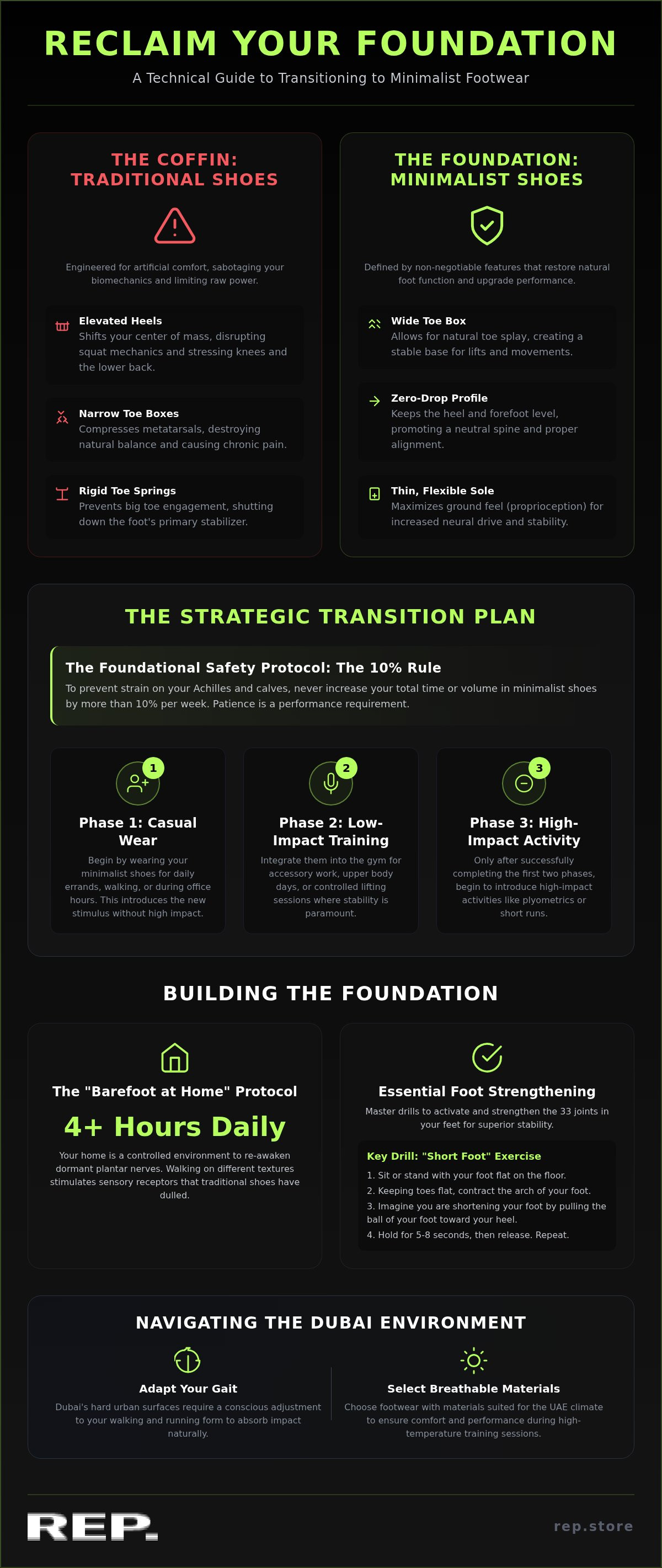
Performance is built from the ground up. Your feet are your primary base of support, yet most Dubai athletes treat them as an afterthought. Traditional trainers act as "coffins" for your feet, compressing the bones and effectively silencing the nervous system. Understanding what are minimalist shoes is the first step toward reclaiming your structural integrity. These shoes are defined by three non-negotiables: a wide toe box that allows for natural toe splay, a thin sole for maximum ground feel, and a zero-drop profile to keep your spine in a neutral position. If you're chasing elite performance in the gym, you cannot afford to ignore the interface between your body and the floor.
Why Traditional Shoes Limit Your Strength
Traditional footwear is engineered for artificial comfort, which often comes at the expense of raw power. Most athletic shoes feature an elevated heel that shifts your center of mass forward, disrupting your natural squat mechanics and placing unnecessary stress on the knees. This misalignment makes it nearly impossible to maintain a vertical shin during heavy pulls. Thick cushioning also creates a sensory void. When your feet can't feel the floor, your stabilizing muscles become "lazy" and unresponsive. This lack of feedback forces the rest of your body to work harder to maintain balance, leaking energy that should be going into the lift.
Standard shoe designs limit your potential through several key structural flaws:
- Elevated Heels: These tilt the pelvis and force the lower back to compensate during heavy compound movements.
- Narrow Toe Boxes: They crush the metatarsals together, destroying your natural balance and causing chronic pain over time.
- Rigid Toe Springs: These prevent the big toe from engaging with the ground, which shuts down the foot's primary stabilizer.
The Benefits of Ground Feel in Training
A deliberate transition to minimalist shoes allows you to tap into the body's natural feedback loops. Proprioception is the body’s ability to sense movement and position. When you train in Vivobarefoot shoes, your brain receives high-resolution data from the thousands of nerve endings in your soles. This increased neural drive leads to better balance during lunges and more explosive force production during deadlifts. You aren't just wearing different shoes; you're upgrading your body's internal GPS.
By removing the barriers between your skin and the gym floor, you force your feet to become the high-performance tools they were meant to be. This transition to minimalist shoes ensures that every watt of power you generate is transferred directly into the floor rather than being absorbed by layers of useless foam. It's about technical precision and total control over your movement. In the demanding Dubai fitness environment, where every session counts, your foundation shouldn't be the weakest link in your chain.
The Strategic Transition Plan: From Cushioned to Zero-Drop
Transitioning to zero-drop footwear is a technical migration, not a weekend experiment. If you rush the process, you'll end up in a clinic rather than hitting a PR. The foundational safety protocol is the 10% Rule: never increase your total time or volume in minimalist shoes by more than 10% each week. This conservative pacing allows your connective tissues to adapt to the new mechanical load. You're reversing years of atrophy. Patience is a performance requirement.
The implementation follows a three-phase integration. Phase 1 starts with casual wear. Begin by wearing your Vivobarefoot shoes for daily errands or office hours. Phase 2 moves into the gym for low-impact training. Use them for accessory work, upper body days, or controlled lifting sessions where stability is paramount. Only in Phase 3 should you introduce high-impact activities like plyometrics or short runs. This gradual exposure ensures your structural integrity remains intact while your feet recalibrate.
The "Barefoot at Home" Protocol
A successful transition to minimalist shoes begins before you even lace up. Your home is the ideal controlled environment to wake up dormant plantar nerves. Aim for at least 4 hours of barefoot time daily. Walking on different textures stimulates the sensory receptors that traditional shoes have spent years dulling. This isn't just about movement; it's about neural data collection. If you aren't sure which model fits your anatomy, you can browse our performance collection to see the technical specs of each trainer.
Managing the "Minimalist Soreness"
Expect muscle adaptation, but don't ignore joint pain. You'll likely feel tension in your calves and Achilles tendon as they regain their natural length and elasticity. Research on minimalist footwear suggests that while muscle strength improves, the initial strain on the lower leg is significant. Differentiate between Delayed Onset Muscle Soreness (DOMS) and sharp, localized joint pain. For high-volume days or long-distance sessions early in the protocol, keep your Saucony running shoes in rotation. They provide a necessary safety net as your foundation hardens. Consistency beats intensity during this recalibration phase.
Building the Foundation: Essential Foot Strengthening
Your foot is a complex mechanical assembly. It contains 26 bones and 33 joints, yet most training programs treat it as a single, rigid block. If you want a successful transition to minimalist shoes, you must treat these intrinsic muscles like any other muscle group in your body. You wouldn't expect to bench press 100kg without training your chest; don't expect your feet to support your entire body weight without specific conditioning. Weak feet are a liability that no amount of expensive cushioning can fix.
The "Short Foot" exercise is your starting point for restoration. It involves pulling the ball of your foot toward your heel to create a strong internal arch without scrunching your toes. This isn't just about aesthetics; it's about structural integrity. Pair this with "Toe Yoga," where you learn to lift your big toe while keeping the others pinned to the floor, and vice versa. These movements recalibrate the neural connection between your brain and your base. If you can't control your toes, you can't control your movement.
The Big Toe: Your Anchor for Stability
The big toe is responsible for approximately 85% of your foot’s stability. If your hallux isn't functioning, your entire kinetic chain is compromised. You can test this at home by checking your big toe extension. You should be able to lift it at least 30 degrees without the rest of the foot compensating. Poor extension leads to inefficient push-off and increased stress on the plantar fascia. Exercises like big toe presses and manual stretching are essential to restore this range of motion. Understanding the biomechanics of barefoot running shows that a functional big toe allows for a more natural midfoot strike, reducing the impact forces that traditional shoes often amplify.
Integrating Foot Work into Your Warm-up
Don't relegate foot health to a separate session. Spend five minutes before every gym session prepping your foundation. Use a lacrosse ball for a deep plantar fascia release, rolling from the heel to the base of the toes to break up restrictive tissue. Follow this with eccentric heel drops off the edge of a step. These slow, controlled descents are non-negotiable for zero-drop success because they build the necessary tension and length in the Achilles tendon. A functional foot is the difference between a PR and a plateau. By making these drills part of your standard operating procedure, you ensure your feet are ready for the increased load of minimalist training. This isn't just mobility work; it's a strategic investment in your longevity as an athlete.
Navigating the Dubai Environment in Minimalist Shoes
Dubai is a city of hard, unforgiving surfaces. From the polished marble of Dubai Hills Mall to the sun-baked asphalt of the Kite Beach track, your feet constantly battle high-impact environments. A successful transition to minimalist shoes in this landscape requires a different strategy than on soft grass or forest trails. You can't rely on the terrain to absorb shock; your gait must do the work. This urban reality makes the adaptation phase more demanding but ultimately more rewarding for your structural health.
The "Dubai Hills Mall Test" is your first performance benchmark. Trying on technical footwear on a carpeted store floor is a mistake that leads to poor purchasing decisions. You need to feel how the sole reacts to the actual hard surfaces you'll encounter daily. This is why visiting a specialist hub is essential. You need to ensure the technical fit and ground feel are perfect before you commit to your first training session. Heat management is another non-negotiable factor in the UAE. During the peak summer months, a non-breathable upper will lead to friction and blisters, effectively halting your training volume. Prioritize engineered mesh or lightweight knit uppers that facilitate maximum airflow to keep your feet cool and dry.
Urban vs. Trail Minimalist Gear
Your gear must match your specific environment. For the CrossFit box or a high-performance gym, a thin, flat sole provides the ground feel needed for heavy compound lifts and lateral stability. However, if your training takes you to the Al Qudra trails, you'll require lugged soles that offer traction on loose sand and gravel. A shoe designed for the street won't survive the desert, and a trail shoe will feel clunky on a gym floor. Select your tool based on the primary surface where you generate force.
Gait Adjustments for Hard Surfaces
Walking on concrete in thin soles requires a fundamental shift to a mid-foot strike. If you continue to heel-strike on hard floors, you'll send a shockwave through your skeleton that your joints aren't designed to handle. Increase your cadence. Taking more, shorter steps reduces your vertical oscillation and lowers the impact force on each stride. This adjustment is the key to an injury-free transition to minimalist shoes. To manage the adaptation phase and prevent burnout, integrate Oofos Recovery Sandals between your sessions. They provide necessary relief without reverting to the restrictive geometry of traditional trainers. Ready to upgrade your foundation? Shop the latest Vivobarefoot and Saucony collections at our Dubai Hills Mall location.
Selecting Your First Pair: Performance Options at REP Store
Gear selection is where most athletes fail. They treat footwear as a fashion statement rather than a mechanical interface. A strategic transition to minimalist shoes requires a tool that respects your foot's natural anatomy while providing the protection needed for the Dubai urban environment. You aren't just buying a shoe; you're selecting a platform for force production. If your equipment doesn't allow for natural movement, your performance will always have a ceiling.
Vivobarefoot: The Performance Choice
The Primus Lite III is the undisputed gold standard for gym and cross-training. Its ultra-thin, puncture-resistant sole provides a direct connection to the floor while protecting you from urban debris. This technical precision allows for maximum sensory feedback without compromising safety. You need to feel the ground to master it. As the premier destination for Vivobarefoot in Dubai, we ensure you have access to the full performance range. Every model we stock is selected for its ability to handle high-intensity load and rapid lateral movements. These aren't just shoes; they're high-performance sensors for your feet.
Why In-Person Fitting Matters
Digital sizing is a gamble you can't afford. Minimalist sizing often deviates significantly from traditional US or UK standards. A proper fit requires exactly a thumb’s width of space at the front. This isn't a suggestion; it's a mechanical requirement to allow for natural toe splay under load. When you squat or lunge, your foot expands. If your shoe doesn't accommodate this expansion, you're effectively back in a "coffin" that limits your stability and sabotages your gait. Testing this expansion in real-time under a barbell is the only way to guarantee a successful transition to minimalist shoes.
For athletes who aren't yet ready for a true zero-drop profile, we provide a stepped approach. We stock specific Saucony running shoes that offer a reduced drop compared to standard trainers. These act as a necessary bridge for your Achilles and calves as they regain their natural elasticity. Don't leave your structural health to chance. Book a consultation or visit us today at Dubai Hills Mall to find the exact technical fit your training demands. Our experts will analyze your foot shape and ensure your new footwear aligns with your performance goals. Control your foundation, control your future.
Reclaim Your Natural Foundation
Your athletic potential is tethered to the health of your foundation. A successful transition to minimalist shoes requires more than just new gear; it demands a disciplined approach to foot strengthening and a gradual adaptation to Dubai’s hard urban surfaces. By prioritizing technical precision over artificial cushioning, you're investing in long-term structural integrity and explosive power. You've learned the protocol; now it's time to implement the change.
Don't leave your biomechanics to chance. As the official UAE stockist of premium performance brands, we provide the expert guidance needed to navigate this shift safely. Our staff is specifically trained in technical footwear fitting to ensure your toes have the splay they need to function under heavy load. Visit us in the heart of Dubai Hills Mall to test the latest models on a real-world surface and feel the difference for yourself.
Explore the Vivobarefoot Collection at REP Store Dubai and start building a more functional, injury-resistant base today. Your feet are capable of incredible things; it's time you gave them the freedom to prove it.
Frequently Asked Questions
How long does it take to transition to minimalist shoes?
Full adaptation typically requires six to twelve months of consistent, gradual exposure. Your connective tissues and intrinsic foot muscles need time to remodel after years of atrophy in cushioned trainers. If you rush this timeline, you risk stress fractures or tendonitis. Follow a structured protocol where you increase your time in the shoes by no more than 10% weekly. This ensures your foundation hardens without compromising your current training cycle.
Can I wear minimalist shoes if I have flat feet?
Yes, because most flat feet are actually just weak feet that have collapsed due to over-reliance on external arch supports. Minimalist shoes force your internal arch muscles to engage and strengthen. Over time, this active engagement can help rebuild a functional arch. However, you must pair the footwear with specific drills like the Short Foot exercise to ensure you're building structural integrity rather than just straining your ligaments.
Will minimalist shoes help with my plantar fasciitis?
Minimalist shoes address the root cause of plantar fasciitis by strengthening the foot's supporting structures. Traditional orthotics often provide temporary relief but perpetuate the underlying weakness. By allowing your toes to splay and your arch to function naturally, you reduce the tension on the plantar fascia. You should begin your transition to minimalist shoes only after the acute inflammation has subsided, using them as a long-term tool for mechanical restoration.
Do I need to wear socks with my Vivobarefoot shoes?
Wearing socks is a matter of personal preference, but technical performance socks are highly recommended in the Dubai climate. They provide an essential moisture-wicking barrier that prevents blisters and keeps the shoe interior hygienic during high-intensity sessions. If you choose to go sockless, ensure you're using a shoe with a breathable upper to manage sweat. Many athletes prefer thin, toe-separating socks to maximize the benefits of the wide toe box while maintaining comfort.
Can I run a marathon in minimalist shoes immediately?
Absolutely not. Attempting high-volume endurance events without a multi-month adaptation period is a guaranteed path to injury. Your calves and Achilles tendons aren't currently conditioned to handle the increased load of a zero-drop profile over long distances. Start your transition to minimalist shoes with short recovery walks and low-impact gym sessions. Save the marathons for when your gait has fully shifted to a mid-foot strike and your lower leg strength has reached elite benchmarks.
What are the best minimalist shoes for CrossFit in Dubai?
The Vivobarefoot Primus Lite III and Motus Strength are the top choices for CrossFit athletes in the UAE. These models offer the thin, flat sole required for stable lifting while remaining flexible enough for dynamic movements like box jumps or double-unders. The puncture-resistant sole is particularly useful for rope climbs. For those who still need a slight drop for high-rep Olympic lifting, the R.A.D One serves as an excellent technical alternative stocked at our Dubai Hills Mall location.
How do I know if my minimalist shoes fit correctly?
A correct fit requires a full thumb’s width of space between your longest toe and the front of the shoe. Your toes must have enough room to splay completely when you're standing under load. If you feel any pinching at the sides or if your toes touch the front during a lunge, the shoe is too small. Visit us for a professional fitting to ensure you aren't sacrificing performance for a size that feels snug but restrictive.
Are zero-drop shoes the same as minimalist shoes?
Not exactly. Zero-drop simply means the heel and forefoot are at the same height, but many zero-drop shoes still feature thick cushioning. A true minimalist shoe must combine a zero-drop profile with a wide toe box and a thin, flexible sole. While all minimalist shoes are zero-drop, not all zero-drop shoes provide the ground feel and sensory feedback required for a full natural movement experience. This distinction is vital for your long-term biomechanical health.


