

Post-Workout Foot Care: The Athlete’s Guide to Recovery and Performance

Your feet are the foundation of every lift and stride, yet they remain the most neglected asset in your training arsenal. Neglect isn't just an oversight; it's a performance bottleneck that guarantees eventual injury. If you are pushing high volumes, persistent soreness in your arches or skin irritation from friction isn't a badge of honor. It's a sign that your post-workout foot care is failing. You are leaving gains on the table by ignoring the very platform that supports your entire kinetic chain.
You likely accept foot fatigue as an inevitable part of the daily grind. It's not. High-performance athletes understand that recovery is a technical requirement, not a luxury. By implementing a systematic approach to your feet, you can stop the cycle of morning-after pain and start every session with a stable, pain-free base. When your foundation is compromised, your power output and stability follow suit. Efficiency demands a better strategy.
This guide provides a clear, professional protocol to master your recovery. We will examine the science of active recovery footwear, the mechanics of arch maintenance, and the essential steps to eliminate skin issues before they sideline you. You'll learn how to treat your foundation with the same precision as your programming. It's time to stop surviving your workouts and start dominating them from the ground up.
Key Takeaways
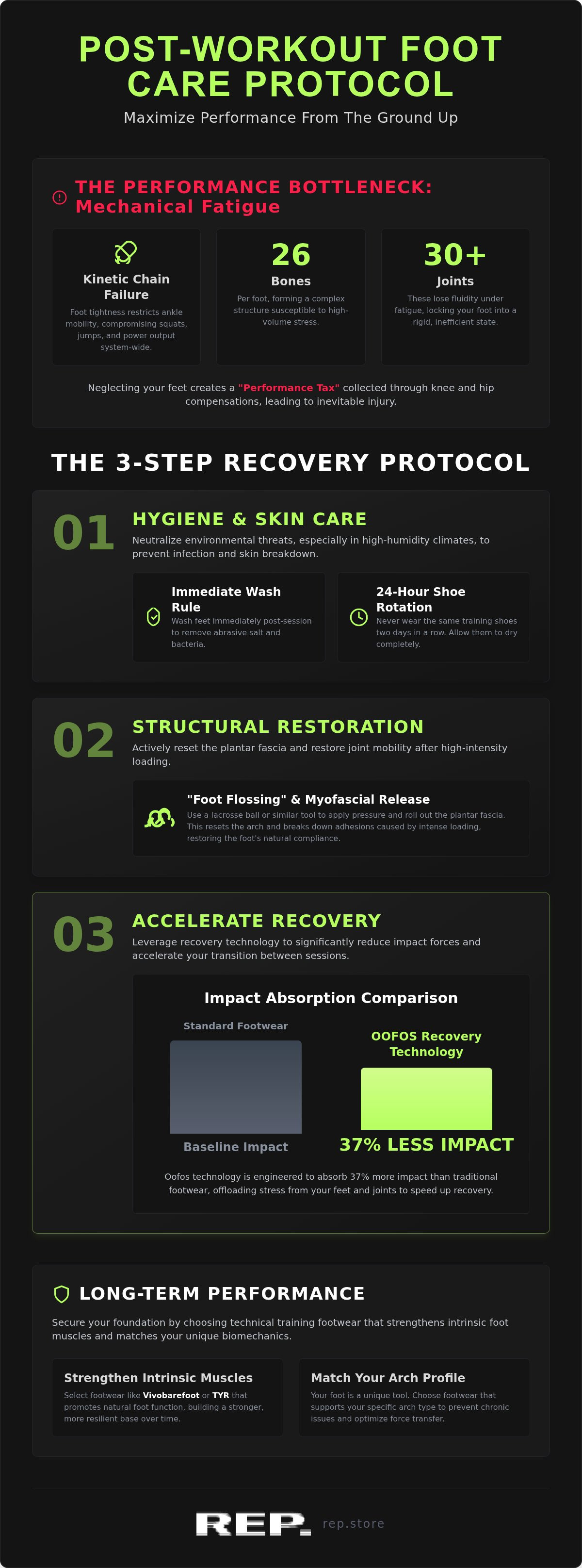
- Understand your feet as a technical requirement; mechanical fatigue in the 26 bones and 30+ joints is the primary bottleneck to your performance.
- Adopt a professional post-workout foot care protocol to neutralize the specific risks of high-humidity training and bacterial buildup in the UAE climate.
- Restore structural integrity using "Foot Flossing" and myofascial release techniques to reset the plantar fascia after high-intensity loading.
- Leverage Oofos recovery technology to absorb 37% more impact than standard footwear, accelerating your transition between sessions.
- Secure long-term performance by selecting technical footwear, such as Vivobarefoot or TYR, to strengthen intrinsic muscles and match your specific arch profile.
Why Post-Workout Foot Care is a Performance Requirement
Your feet are the primary shock absorbers for every heavy lift and high-intensity sprint. They aren't just passive slabs of tissue; they're complex mechanical structures. With 26 bones and over 30 joints, the foot is highly susceptible to mechanical fatigue after high-volume sessions. When these joints lose their fluidity, your performance suffers immediately. Neglecting post-workout foot care creates a "Performance Tax" that your body eventually collects through compensations in your knees and hips. You cannot build a high-performance engine on a broken chassis.
The foot must function as both a rigid lever for propulsion and a compliant structure for impact absorption. After intense training, it often gets stuck in a rigid, fatigued state. This mechanical limitation prevents you from moving efficiently in your next session. If you ignore this, you aren't just risking a sore arch; you're inviting a systemic breakdown. Elite athletes treat their feet like any other high-value piece of equipment. They don't wait for a breakdown to perform maintenance.
The Kinetic Chain Connection
Foot tightness isn't an isolated issue. It's a systemic failure. When your feet are locked up, your ankle dorsiflexion is the first thing to disappear. Without that range of motion, your squat depth becomes shallow and your power output drops. You'll find yourself leaning forward or lifting your heels, sacrificing your mechanics to compensate for a stiff foundation. During metcons, foot fatigue destroys your proprioception. This loss of balance makes every jump and lateral movement more dangerous and less efficient. Real strength requires a foundation that can reset itself after every session.
Injury Prevention vs. Performance Optimization
Stop thinking about foot care as a way to avoid pain. Think of it as a tool to maximize your output. While many focus on basic stretching, professional Podiatry principles suggest that active revitalization is the only way to maintain a high training frequency. A 10-minute investment today prevents a 10-day layoff tomorrow. It's a simple calculation of ROI. If you don't have time for recovery, you'll eventually have to find time for an injury.
Active Foot Recovery is the process of restoring structural integrity through mobility and specialized gear. By treating your feet as technical equipment, you ensure they're ready for the next high-intensity load without hesitation. This proactive approach separates the athletes who stay in the game from those who watch from the sidelines. Your longevity depends on the health of your foundation.
The Dubai Protocol: Hygiene and Skin Care in High Humidity
Training in the UAE presents a specific set of environmental risks that most global guides ignore. High heat and humidity transform your training shoes into a pressurized incubator for bacteria. This isn't a minor inconvenience; it's a direct threat to your skin integrity. If you ignore the hygiene aspect of post-workout foot care, you're inviting infections that lead to forced downtime. Efficiency in training requires efficiency in sanitation.
Implement the 'Immediate Wash' rule without exception. Salt from sweat and accumulated bacteria are abrasive. They degrade skin health and weaken the foot's natural barrier. You must Maintain proper hygiene by removing training socks and washing your feet immediately after your session ends. Waiting even an hour allows microbes to colonize in the damp environment of your footwear. Moisture-wicking socks are essential during the lift, but they're not a solution for recovery. Once the session is over, your feet need air. Transitioning to a barefoot state or open-toe recovery footwear facilitates rapid evaporation and resets the skin's pH balance.
Anti-Microbial Strategies for Athletes
Your shoes need a recovery period just as much as your muscles do. Adhere to the 24-hour rule: never wear the same pair of training shoes two days in a row. They require a full day to dry completely, especially in the humid Dubai air. Shared gym environments are high-risk zones for Athlete's Foot and other fungal issues. Use technical foot soaks or tea tree oil to neutralize pathogens before they take hold. It's a proactive defense against invisible performance killers.
Blister Management and Callus Care
Calluses are your body's natural armor. They provide a necessary protective layer for heavy squats and high-volume runs. Never shave them too thin; you want to maintain a tough, even surface, not raw, sensitive skin. However, the constant transition between extreme heat and dry, air-conditioned environments can cause these calluses to lose elasticity and crack. Use a high-quality moisturizer to prevent deep fissures. If you feel a friction hot spot after a run, treat it instantly. Ignoring a hot spot is a conscious choice to endure a blister later. For gear that supports this level of maintenance, explore the curated technical range at REP Store.
Structural Restoration: Post-Workout Foot Mobility Drills
High-intensity training compresses the foot's architecture. Every jump and heavy lift exerts massive force through the plantar fascia, which acts as the primary force transmitter in your kinetic chain. If you don't reset this structure, you're training on a compromised foundation. Structural restoration is the mechanical answer to the strain of modern athletics. "Foot flossing" and myofascial release are not optional; they are essential for anyone using high-performance training shoes to push their physical limits.
Toe splay is the secret to a stable base. Many athletes cram their feet into narrow footwear, which eventually shuts down the intrinsic muscles. Restoring splay allows for better force distribution and prevents the "power leak" that occurs when your foundation is unstable. A dedicated 5-minute daily routine is the minimum requirement for Dubai athletes who want to maintain peak performance. This is the cornerstone of effective post-workout foot care. Efficiency demands a better strategy than just resting.
Myofascial Release Techniques
Use a lacrosse ball or a specialized roller to break up adhesions in the fascia. Start with the 3-point roll: focus on the heel, the arch, and the ball of the foot. Apply enough pressure to feel a release, but stay within a range that allows you to breathe normally. You must learn to distinguish between "good" release pain and "bad" injury pain. Good pain feels like a productive release of deep tension. Bad pain is sharp, stabbing, or localized to a bone. If you feel the latter, stop immediately. Consistency in release work ensures the 26 bones of the foot remain mobile and functional.
Active Stretching and Strengthening
The "Short Foot" exercise is vital for arch activation. Pull the ball of your foot toward your heel without curling your toes. This engages the deep muscles that support your arch under heavy loads. Pair this with toe yoga: lift your big toe while keeping the others down, then reverse the movement. This builds the neurological control required for better balance during complex movements. Finally, perform calf and Achilles resets. The foot doesn't end at the ankle; tightness in the posterior chain will pull on the plantar fascia, undoing your mobility work. A stable base requires a holistic approach to the entire lower limb.
The Role of Recovery Footwear: Why Oofos are Essential
Do not confuse aesthetic lifestyle slides with technical recovery tools. Standard flip-flops provide zero structural support and often exacerbate fatigue by forcing your toes to grip the sole. High-performance post-workout foot care requires gear that offloads pressure rather than adding to it. In Dubai, many athletes make the mistake of walking barefoot on hard villa floors immediately after training. This is a critical performance error. Hard surfaces like marble or tile offer no shock absorption, forcing your tired metatarsals to endure unnecessary mechanical stress during the most sensitive phase of your recovery cycle.
Efficiency in recovery is a choice. If you spend your training session in high-end footwear and your recovery time barefoot on stone floors, you are sabotaging your own progress. You need a dedicated tool to bridge the gap between sessions. Passive rest is insufficient; you need active structural support that allows the 26 bones of the foot to settle without further impact.
Recovery Sandals vs. Lifestyle Slides
The distinction lies in material science. While the foam in your training shoes is designed for energy return and propulsion, OOfoam technology is engineered specifically for impact absorption. It absorbs 37% more impact than traditional footwear materials. This massive reduction in stress allows your joints and soft tissues to recover at an accelerated rate. Oofos Recovery Sandals feature a patented footbed that cradles the arch, providing a therapeutic "reset" for the foot’s architecture. The rockered sole promotes a natural gait, which minimizes the energy required for every step you take outside the gym. It's a technical upgrade for your downtime.
When to Wear Recovery Gear
Timing is a variable you must control. The "Golden Hour" for recovery begins the moment you remove your gym shoes. Transitioning immediately into recovery footwear prevents post-training inflammation from settling into the joints. You should use these sandals as your primary house shoes to provide constant therapeutic support against hard surfaces. Whether you are commuting or traveling, keeping your feet in a recovery state ensures you are ready for the next high-intensity session without lingering soreness. Longevity in the "Everyday Performance" lifestyle depends on these marginal gains. Secure your foundation by exploring the full recovery range at REP Store today.
Long-Term Foot Health: Choosing Your Next Training Tool
Selecting the correct training tool is the final, most critical stage of post-workout foot care. Your footwear must do more than just shield your skin; it must actively support your mechanical development. Most athletes prioritize aesthetics over function. This is a strategic error that leads to chronic dysfunction. You must select footwear based on your arch type and foot width. When the internal structure of a shoe collapses, it stops absorbing force and starts redirecting it into your joints. Look for deep compression lines in the midsole or uneven wear patterns on the outsole. If the shoe feels "dead" during a heavy lift, it's already a liability that will degrade your recovery. With 75% of people expected to experience foot health problems in their lifetime, your choice of training tool is a direct investment in your athletic longevity.
The Minimalist Transition
Vivobarefoot shoes represent a long-term workout for your feet. They remove the crutch of artificial cushioning and force your intrinsic muscles to perform their natural function. This builds a resilient foundation that can handle higher training volumes without collapsing. A wide toe box is essential for natural splay. It allows the hallux to engage fully, which is the secret to maximum stability during explosive movements. Transitioning to zero-drop shoes must be methodical to avoid injury. Sudden changes in heel-to-toe drop can strain the Achilles tendon. Start by wearing them for short periods of low-intensity movement. Listen to your body’s feedback before increasing the load. It's a process of restoring what modern footwear has stripped away.
Selecting Technical Training Footwear
You must match your footwear to the specific training stimulus of your session. A shoe that excels in a heavy squat session might fail during a high-volume run. The R.A.D One has emerged as the versatile standard for hybrid athletes who refuse to compromise on performance. It provides the lateral stability required for heavy lifting while maintaining the flexibility needed for plyometrics. Integrating different styles creates a well-rounded athlete. Use minimalist shoes for strengthening your foundation and technical trainers for peak performance sessions. This variety ensures your feet remain adaptable and strong. Visit our experts at Dubai Hills Mall for a professional fitting and gait analysis to ensure your equipment matches your performance goals. Don't leave your foundation to chance.
Master Your Foundation for Sustained Performance
High-performance training is only as sustainable as your recovery protocol. You've learned that treating your feet as technical equipment is a requirement, not an option. From the immediate hygiene demands of the Dubai climate to the structural reset of myofascial release, every step in your post-workout foot care routine determines your readiness for the next session. Ignoring these fundamentals is a choice to accept plateaued performance and avoidable injury. Efficiency demands a better strategy.
Professional restoration requires professional-grade tools. REP Store is the official UAE retailer for Oofos and R.A.D, providing the specialized gear needed to bridge the gap between training and recovery. Visit our expert staff at Dubai Hills Mall for a professional fitting to ensure your gear matches your specific gait. For those who prefer the efficiency of digital access, we offer free shipping on orders over 500 AED.
Don't leave your athletic longevity to chance. Shop the full Oofos Recovery Collection at REP Store and give your feet the technical support they deserve. Your next personal best starts with how you recover today.
Frequently Asked Questions
Is it better to walk barefoot or wear shoes after a workout?
Wearing technical recovery footwear is superior to walking barefoot. While barefoot movement has benefits for strengthening, immediate post-workout recovery requires impact absorption. Walking on hard surfaces like marble or tile floors in Dubai villas forces your fatigued metatarsals to endure mechanical stress without support. This can lead to inflammation and prolong soreness. Use recovery sandals to offload pressure and allow the soft tissues to settle after high-intensity sessions.
How often should I massage my feet for recovery?
You should perform a brief foot massage or myofascial release daily. A five-minute session using a lacrosse ball or specialized roller is sufficient to break up adhesions in the plantar fascia. Consistency is more important than duration. By integrating this into your nightly routine, you prevent mechanical fatigue from accumulating. This proactive approach ensures your foundation remains mobile and ready for the next day's training volume without the risk of structural collapse.
Do recovery sandals actually work for athletes?
Recovery sandals are a technical requirement for serious athletes. Unlike standard flip-flops, tools like Oofos are engineered with OOfoam technology, which absorbs 37% more impact than traditional materials. This massive reduction in joint stress accelerates the recovery of the 26 bones and 30+ joints in the foot. Integrating these into your post-workout foot care protocol provides the structural reset needed to maintain high training frequency while minimizing the risk of overuse injuries.
What are the first signs of a foot injury I shouldn't ignore?
Never ignore sharp, localized pain that persists after your session ends. Morning stiffness in the heel or arch that takes several minutes to warm up is a primary indicator of plantar fasciitis. Localized swelling or pain that changes your gait during a lift is a sign of structural failure. If you experience these symptoms, stop high-impact loading immediately. Proactive maintenance is cheaper than long-term rehabilitation, so address these signs before they become chronic issues.
How does Dubai's heat affect my foot health during training?
Extreme heat and humidity in the UAE turn your training shoes into an incubator for bacteria. High sweat volume degrades the skin's natural barrier, making you more susceptible to infections and friction-related blisters. This environmental stressor requires an aggressive hygiene protocol. You must remove damp socks and dry your footwear completely between sessions. Failing to manage moisture leads to skin integrity issues that can sideline your training just as effectively as a structural injury.
Should I ice my feet if they are sore after the gym?
Use ice only if you are dealing with acute inflammation or sharp pain. While icing can provide temporary relief by numbing the area, it can also slow down the natural healing process by restricting blood flow. For general soreness, focus on active recovery techniques like myofascial release and wearing supportive sandals. These methods encourage circulation and structural restoration, which are more effective for long-term performance than simply masking the pain with cold therapy.
Can the wrong gym shoes cause permanent foot damage?
Ill-fitting footwear can lead to permanent structural changes over time. Narrow toe boxes cause bunions and nerve compression, while collapsed arch supports lead to chronic misalignment in the kinetic chain. This damage isn't just limited to the feet; it often manifests as permanent issues in the knees and lower back. Choosing technical footwear like R.A.D or Vivobarefoot ensures your feet are strengthened and supported, protecting your foundation from the long-term effects of mechanical neglect.
How do I choose between Oofos sandals and slides?
Choosing between Oofos sandals and slides depends on your specific recovery environment. Sandals provide a more secure fit, which is ideal for a natural gait during commutes or longer walks. Slides offer more versatility, allowing you to wear them with recovery socks or easily slip them on between gym sessions. Both models utilize the same OOfoam technology, making them equally effective components of a professional post-workout foot care strategy. Pick the style that best fits your daily transition.


