

Premium Gym Equipment Procurement in Abu Dhabi: A Buyer’s Guide

A product list isn’t a procurement plan. For premium gym equipment procurement Abu Dhabi, start with how your facility will operate: its training programme, available space and day-to-day priorities. Get that brief wrong, and even premium equipment can be a poor fit.
To compare bulk purchasing options effectively, decide what the equipment needs to do before you review products. The right order depends on the facility’s users, programme and site, not just the catalogue. This guide shows you how to define those requirements, organise an equipment brief and evaluate choices against practical operating needs.
Once the brief is ready, you can consider REP Store’s Nike Strength Gym Equipment and its bulk purchasing options and specialized quotes for commercial gyms and fitness studios. A clear scope makes the quote discussion more specific and keeps purchasing decisions tied to the facility.
Key Takeaways
- Start premium gym equipment procurement Abu Dhabi with the facility’s operating plan, not a product list.
- Compare equipment against your training programme, expected user volume, floor plan and daily operating priorities.
- Choose between a coordinated purchase and phased procurement based on the project scope, opening plans and future needs.
- Prepare a site-ready brief that covers access, receiving arrangements and project scheduling before reviewing quotes.
- REP Store offers bulk purchasing options and specialized quotes for commercial gyms and studios, including Nike Strength Gym Equipment.
Premium gym equipment procurement in Abu Dhabi: define the facility need first
Commercial equipment procurement starts with the facility’s operating requirements: who will train, which sessions it will run, how the space is arranged and how often it will be used. That is the foundation of premium gym equipment procurement Abu Dhabi.
A home gym order may focus on a few items for one person or household. A commercial gym or studio needs to account for different users, overlapping sessions, staff workflows and the limits of the site. Equipment that works in isolation may not fit the programme or available floor area. Define the operating model first, then build the equipment list around it.
A clear equipment brief connects facility use to purchasing decisions. It gives everyone involved a shared basis for comparing options and requesting a quote, rather than relying on a broad wish list or brand recognition alone.
What should an Abu Dhabi gym equipment brief include?
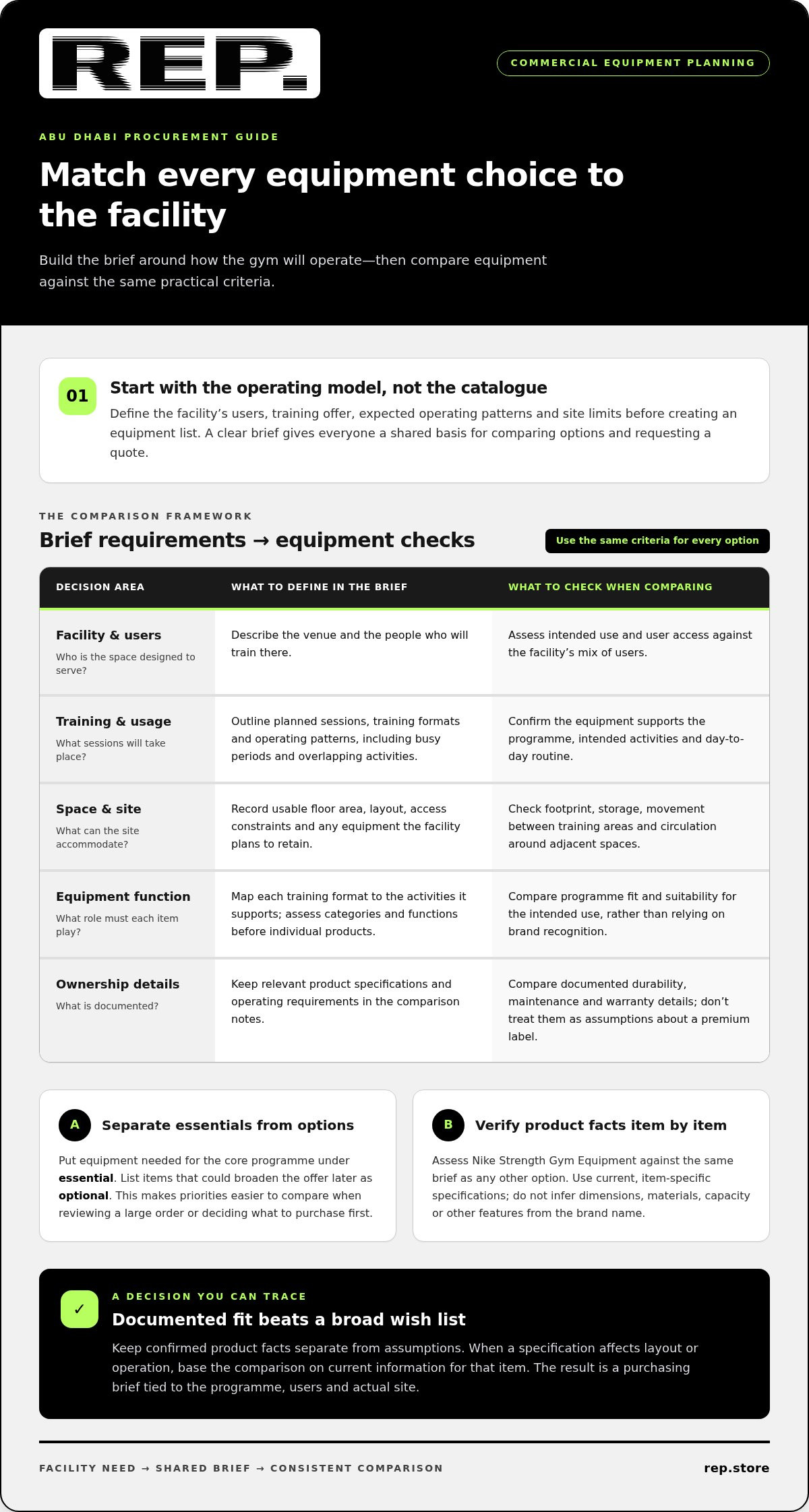
Make the brief specific enough to guide decisions without turning it into a product catalogue. Record the facility type, intended users, training offer and expected operating patterns. Include usable floor area, site access constraints and any existing equipment the facility plans to retain. These details help keep the proposed order grounded in the actual site.
Separate essential requirements from optional additions before requesting a quote. Equipment needed to deliver the core programme belongs in the essential category. Items that could broaden the offer later can be listed as optional. This makes priorities easier to compare when reviewing a large order or deciding what to purchase first.
- Facility and users: describe the venue and the people it is designed to serve.
- Training and usage: outline planned sessions, formats and operating patterns.
- Space and site: note the layout, access constraints and equipment to retain.
- Priorities: distinguish essential requirements from potential additions.
If equipment categories need clarifying, a general overview of types of exercise equipment can help establish shared terminology. Use it as background, then define the facility’s specific needs.
How does a facility’s training model shape procurement?
Start with the sessions the facility intends to run. A studio built around coached strength sessions has different space and equipment needs from a gym with open access throughout the day. Map each training format to the activities it supports, then consider how users with different experience levels will move through the space. The aim is a coherent setup for beginner, experienced and coached sessions, not a collection of unrelated items.
Think about busy periods as well as quieter sessions. If several activities will take place at once, reflect that in the layout and equipment mix. Assess equipment categories and functions first, before specifying individual products. This order helps ensure the brief reflects the programme, users and site constraints.
How to evaluate premium gym equipment for a commercial facility
Start your comparison with the facility brief, not a logo. Test each option against the programme it must support, the intended mix of users, the floor plan and the daily operating routine. An item that suits a single-user training area may be a poor fit for a busy shared space. Premium gym equipment procurement Abu Dhabi is more disciplined when every decision has a clear use case.
Equipment is suitable only when its intended use, user experience and site requirements fit the facility that will operate it. Keep that rule in view as you compare alternatives. It helps prevent brand recognition or an impressive catalogue from outweighing practical fit.
Which procurement criteria matter beyond the brand name?
Use the same criteria across options so that you can compare them consistently. Assess function, intended use, user access and compatibility with the planned training offer. Then consider footprint, storage needs and movement between training areas. Equipment may meet a training need but still disrupt circulation or make a shared space harder to use.
Treat durability, maintenance and warranty as specification questions, not assumptions attached to a premium label. Record relevant product details and operating requirements in your comparison notes. This makes differences visible and keeps the evaluation based on documented information.
- Programme fit: identify the activities and sessions the item supports.
- Capacity and access: assess how it will serve the facility’s intended users and operating pattern.
- Space: account for footprint, storage and movement around adjacent areas.
- Ownership considerations: compare documented durability, maintenance and warranty details.
How should buyers assess Nike Strength equipment?
Evaluate Nike Strength Gym Equipment against the same facility brief and criteria as any other option. Start with the role each item needs to play in the training programme, then use current, item-specific specifications to assess its suitability. Don’t infer dimensions, materials, capacity or other features from the brand name alone.
Keep confirmed product facts separate from assumptions in your notes. If a specification affects the layout or operation, base the comparison on current information for that item. This makes the decision traceable and prevents a general impression from being mistaken for a technical fact.
For a straightforward comparison, use a table with one row per item and one column per criterion. Mark each point as documented, unresolved or not relevant to the facility. This makes information gaps easy to spot and keeps options comparable when product details are presented in different formats.
Once your criteria are set, review REP Store’s commercial equipment options alongside your facility requirements, including its Nike Strength Gym Equipment.
Single-stage or phased gym equipment procurement: compare the trade-offs
Choose the purchasing route that fits the facility’s scope and schedule. A single-stage plan brings the intended order into one coordinated purchasing discussion. Phased procurement separates decisions into planned stages. Neither approach is automatically better. For premium gym equipment procurement Abu Dhabi, decide whether one complete order or a sequence of defined priorities better supports the facility’s opening and operating plan.
Compare the approaches against your project priorities. The table shows planning trade-offs, not guaranteed cost or product outcomes.
| Buyer priority | Single-stage procurement | Phased procurement |
|---|---|---|
| Planning effort | Requires the intended scope to be coordinated upfront. | Requires clear stage boundaries and ongoing coordination. |
| Consistency | Makes it easier to review the planned equipment mix as a whole. | Needs documented criteria to keep later decisions aligned. |
| Prioritisation | Considers requirements across the facility together. | Focuses first on the needs assigned to an initial stage. |
| Future flexibility | May leave fewer purchasing decisions for later stages. | Leaves room to plan later purchasing as needs develop. |
| Timing | Depends on readiness of the full brief and site schedule. | Can align purchasing stages with a phased operating plan. |
When might a single-stage procurement plan make sense?
A coordinated plan can suit a facility with a complete brief and a clear picture of the training areas it intends to operate. Reviewing the proposed order as a whole helps the buyer assess consistency across those areas. Before choosing this route, review the project schedule and item-level requirements. If the brief or site plan is still changing, it may be too early to make one complete purchasing decision.
When might phased purchasing suit an Abu Dhabi facility?
Phasing may suit a facility opening in stages, prioritising some areas first or working with a space plan that will evolve. It can align decisions with those stages, but it also creates follow-up work. Record future requirements, selection criteria and dependencies now. That reference helps later decisions stay coherent without assuming that phasing reduces costs or secures availability.
Make the choice based on the project. A facility with a settled scope and schedule may prefer one coordinated discussion. A project with distinct launch stages or evolving space requirements may find a phased plan more practical. In either case, define what belongs in each decision, how it connects to the operating plan and what information remains unresolved. The goal is a procurement sequence the team can explain and manage, not a structure chosen by habit.
Prepare an Abu Dhabi gym equipment procurement plan that works on site
An equipment plan has to work in the actual facility, not just on a spreadsheet. For premium gym equipment procurement Abu Dhabi, include site access, receiving arrangements and project timing in the brief. These details connect the proposed order to the site and the wider project schedule.
What should buyers document before requesting a quote?
Prepare a concise brief before requesting quotes. Capture the information that affects what you’re buying, how it fits on site and when decisions need to happen. Separate confirmed details from open questions so everyone can see which parts of the plan are fixed and where there is room to adapt.
- Describe the facility: record the site, usable dimensions, planned training areas and intended activities.
- Set purchasing priorities: identify essential equipment, optional additions and planned purchasing stages.
- Document existing equipment: note what will remain and how it affects the layout or purchasing scope.
- Map site access: describe the receiving point, route into the facility and access or coordination constraints for the Abu Dhabi location.
- Align the schedule: note key project milestones and when the site is expected to be ready to receive equipment. Coordinate these dates with the project team.
- Mark fixed and flexible details: flag firm requirements separately from items or timing that may change.
As you shape the brief and purchasing priorities, review REP Store’s performance equipment.
How can buyers compare and review procurement quotes?
Compare each quote against the same written scope. Check quantities, item-level details and how the proposed equipment relates to the intended use. A quote that leaves key information unstated is difficult to compare fairly with one that spells it out. Keep the brief beside each proposal and assess like against like.
- Confirm the quoted items and quantities match the requested scope.
- Review item specifications against the facility’s documented requirements.
- Identify assumptions, exclusions and differences in how the scope is presented.
- Record unanswered questions to resolve during the procurement discussion.
Before making a purchase decision, review site access, receiving coordination and scheduling as connected project questions. Clarify who coordinates receiving at the facility, what access information needs to be shared and how the intended timing fits with other site activities. Verify applicable building and operational requirements through the appropriate channels for the project.
Make the decision against the written requirements, not the most polished presentation. A clear record of scope, specifications, assumptions and resolved questions gives the buyer a sound basis for proceeding and helps the team coordinate next steps.
How REP Store supports premium gym equipment procurement
REP Store provides bulk purchasing options and specialized quotes for commercial gyms and fitness studios. Its equipment offering includes Nike Strength Gym Equipment, which commercial buyers can assess against their facility requirements and the specifications of individual products.
REP Store’s physical retail location is at Dubai Hills Mall. For an Abu Dhabi project, include the facility location, site constraints and coordination needs in the brief so the purchasing discussion reflects the project’s requirements. Connect each purchasing priority to a defined use in the facility rather than assembling a generic product list.
What commercial buyers can bring to a REP Store quote discussion
Prepare a short project summary before discussing a bulk order. Include the facility type, intended training use, equipment priorities and whether purchasing is planned as one coordinated order or in stages. Add practical site context, such as receiving arrangements, access constraints and project timing. Distinguish fixed requirements from flexible preferences so the discussion can focus on the choices that matter.
- Facility brief: intended users, training activities and operating plan.
- Equipment priorities: essential requirements, optional additions and planned stages.
- Site notes: relevant access, receiving and coordination details.
- Decision points: fixed requirements, flexible items and open questions.
With this information organised, you can request a specialized quote based on your commercial requirements. A precise scope keeps the discussion focused on the intended order and the facility’s actual needs.
Turn the procurement brief into a clear next step
Before moving forward, consolidate the shortlist and note why each item or requirement belongs in the plan. Link the reason to its intended use, the facility layout or an operating priority. Keep product comparisons tied to current item-specific specifications and the agreed brief, not assumptions based on a brand name. This creates a clear record for reviewing the quote and making a considered purchase decision.
For premium gym equipment procurement Abu Dhabi, bring the brief, priorities and site context into a focused discussion about bulk purchasing and quote requirements. Explore REP Store’s commercial equipment options as you prepare your procurement plan.
Turn your procurement brief into a confident decision
Turn your brief into a decision your team can act on. Keep the agreed requirements visible as the project moves forward, and document why each priority matters. That record helps prevent late changes from reshaping the order without a clear operational reason.
For premium gym equipment procurement Abu Dhabi, make the buying discussion specific: share the facility’s intended use, shortlist and project priorities, then compare proposed options against those requirements. A focused conversation gives the procurement process more direction than a broad request for products.
REP Store offers bulk purchasing options and specialized quotes for business clients, with Nike Strength Gym Equipment among its offerings. Discuss your premium gym equipment requirements with REP Store and take the next step with a clear brief.
Frequently Asked Questions
How much does premium gym equipment procurement cost in Abu Dhabi?
There’s no reliable one-size-fits-all figure for a commercial gym order. The total depends on the facility’s scope, selected equipment, quantities and project requirements. To get a useful estimate, define what the facility needs and request a tailored quote against that brief. When comparing responses, keep the requested scope consistent. A quote for a limited studio setup isn’t directly comparable with one covering several training areas.
Can a small Abu Dhabi studio request bulk equipment procurement?
Yes. Commercial procurement can apply to a fitness studio as well as a larger gym. REP Store offers bulk purchasing options and specialized quotes for business clients. A smaller studio can make its request more precise by describing its core classes, the equipment needed to run them and any planned expansion stages. This keeps the discussion focused on the studio’s operating model rather than a generic facility checklist.
Is Nike Strength equipment suitable for every commercial gym?
No. Suitability depends on the facility’s intended use, users, available space and the current specifications of each product. A gym planning a specialised training programme should compare equipment details against that programme’s requirements rather than choosing by brand recognition. Keep confirmed specifications separate from assumptions in your notes. This gives the team a sound basis for deciding whether a particular item fits its plan.
What should an Abu Dhabi gym include in an equipment procurement request?
Include enough detail for a quote to reflect the real project: facility type, training formats, usable space, priority items and purchasing stages. Add site access or receiving constraints that may affect coordination. Identify who will review specifications and approve the final scope. Separate firm requirements from flexible preferences so proposed alternatives can be assessed without losing sight of the facility’s core needs.
Can gym equipment procurement be completed in phases?
Yes. A facility can plan purchasing in phases when its priorities, launch stages or space plans change over time. Document immediate requirements and later needs so each stage connects to the same operating plan. A single coordinated purchase may suit a defined, complete scope. The choice depends on the project schedule and requirements, not an assumption that phasing will reduce costs or guarantee availability.
Does REP Store have a physical location in Abu Dhabi?
No. REP Store’s physical retail location is in Dubai Hills Mall, Dubai. Abu Dhabi buyers can organise a commercial procurement discussion around their facility brief and project requirements. Include relevant site context and coordination needs in that brief. REP Store offers bulk purchasing options and specialized quotes for commercial gyms and fitness studios.


