

Running Shoes to Prevent Blisters in Dubai: The 2026 Performance Guide

Did you know that saturated in-shoe conditions in Dubai’s 40°C heat can cause the friction coefficient inside your footwear to spike by over 120%? This isn't just uncomfortable; it's a mechanical assault on your skin that makes blisters almost inevitable for the unprepared. You've likely felt that familiar, searing heat on your toes halfway through a Kite Beach loop. It's frustrating to have the cardiovascular engine for a long run but be sidelined because your gear failed to manage the microclimate around your feet.
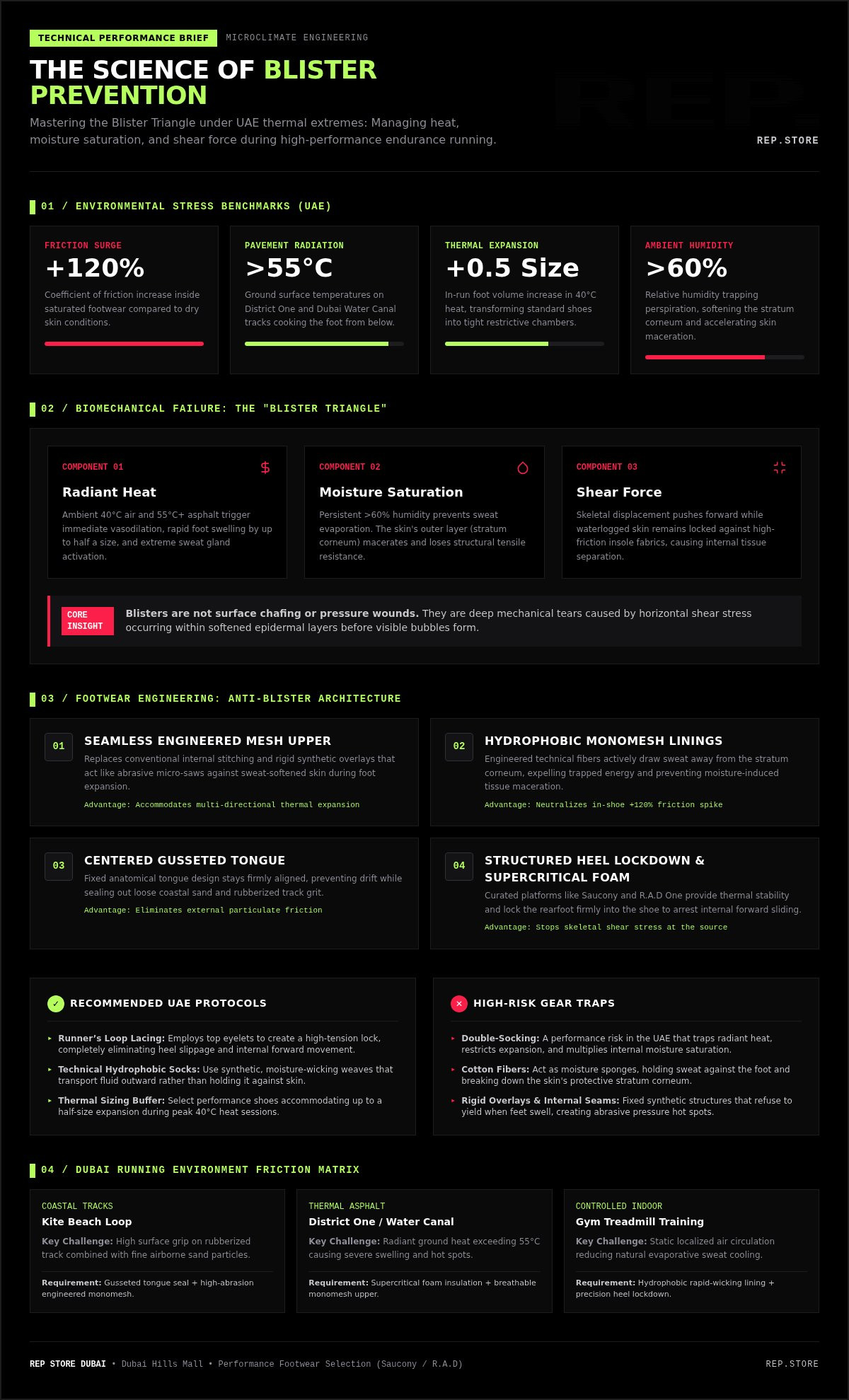
Finding the right running shoes to prevent blisters Dubai athletes can trust is about mastering the "Blister Triangle": the intersection of heat, moisture, and friction. This 2026 performance guide promises to eliminate the guesswork. We'll explore how technical innovations in Saucony and R.A.D footwear, from supercritical foams to hydrophobic monomesh, provide the stability needed to stop internal shearing. You'll learn how to secure your fit and choose materials that won't break down when track temperatures exceed 55°C, giving you total control over your training consistency.
Key Takeaways
- Master the mechanics of the "Blister Triangle" to understand how Dubai's extreme humidity and heat accelerate skin failure during endurance training.
- Identify the specific technical features of running shoes to prevent blisters Dubai athletes need, focusing on seamless uppers and structured heel counters.
- Learn why double-socking is a performance risk in the UAE and how advanced lacing techniques like the "runner’s loop" eliminate internal foot slippage.
- Adapt your gear selection based on your running environment, from high-grip rubberized tracks at Kite Beach to the unique airflow challenges of indoor treadmills.
- Discover why precision-engineered brands like Saucony and R.A.D One provide the thermal stability and anatomical fit required for consistent, injury-free miles.
The Science of Blisters: Why Dubai’s Climate is Your Feet’s Worst Enemy
Blisters aren't an accident. They're a technical failure of your gear to manage a hostile environment. In Dubai, the "Blister Triangle," consisting of heat, moisture, and friction, is your primary adversary. When these three factors align, your skin’s structural integrity collapses. Understanding this mechanical breakdown is the only way to maintain training consistency in the Middle East.
Most runners mistake pressure for the primary cause of injury. It isn't. Blisters result from shear force, which is the horizontal stretching of skin layers. This occurs when your skeletal structure moves forward while your skin remains locked against a high-friction sock or insole. In the intense UAE heat, your feet can expand by up to half a size. This thermal expansion turns a comfortable shoe into a restrictive chamber, drastically increasing shear stress across the forefoot and heel. Citing the mechanics of friction blister formation helps us realize that skin doesn't just rub away; it tears internally before the bubble ever appears.
Moisture: The Silent Catalyst for Friction
Dubai’s humidity regularly exceeds 60%, creating a microclimate inside your shoe that destroys skin resilience. Moisture is a lubricant for failure. Sweat-soaked skin has a coefficient of friction that can be 120% higher than dry skin. Cotton socks are a liability in this climate because they trap fluid against the foot, leading to maceration. Excessive moisture causes the stratum corneum to soften and lose its natural resistance to mechanical stress. When your skin is waterlogged, it takes significantly less force to trigger a deep-tissue tear.
Thermal Management in High-Performance Footwear
Breathability is a safety feature, not a comfort luxury. When you run on the Dubai Water Canal or the District One track, pavement temperatures often exceed 55°C. This radiant heat transfers through the outsole, cooking the foot from below and accelerating sweat production. High-performance running shoes to prevent blisters Dubai athletes rely on must utilize engineered monomesh to expel this trapped energy. Without active thermal management, "hot spots" ignite within minutes. This heat-induced swelling creates a feedback loop: the foot grows, the shoe tightens, and friction points become unbearable. You cannot outrun poor thermal regulation; you can only solve it with better footwear technology.
Technical Features to Look for in Anti-Blister Running Shoes
Generic sports shoes fail because they prioritize aesthetics over internal architecture. For athletes seeking running shoes to prevent blisters Dubai heat makes non-negotiable, technical precision is the only metric that matters. You aren't just buying a shoe; you're investing in a friction management system designed to survive the UAE’s thermal extremes. Every seam, overlay, and material choice either protects your skin or contributes to its eventual breakdown.
Seamless uppers are the first line of defense. Traditional construction uses internal stitching that creates "edges" which act like abrasive micro-saws against sweat-softened skin. Modern performance footwear, such as the curated range at the REP Store in Dubai Hills Mall, utilizes engineered mesh instead of rigid synthetic overlays. This mesh allows for multi-directional stretch, accommodating the thermal expansion of your foot without creating localized pressure points. Following the American Academy of Dermatology guidance on blister prevention, ensuring your footwear doesn't have internal rubbing points is the most effective way to mitigate repetitive chafing during endurance sessions.
The Anatomy of a Blister-Proof Upper
The internal lining must do more than just feel soft. It needs to be hydrophobic. Technical brands like Saucony integrate moisture-wicking linings that actively pull sweat away from the skin's surface, preventing the maceration discussed in our previous section. A gusseted tongue is another critical safety feature. By staying centered and preventing sand or track debris from entering the shoe, it eliminates the external friction sources common on Dubai’s coastal running tracks. Rigid overlays are the enemy; they're static barriers that won't give when your foot swells half a size during a midday run.
Midsole Stability and Foot Lockdown
Shear force is the result of uncontrolled movement. If your foot slides inside the shoe, you're generating the horizontal stress that tears deep skin layers. A structured heel counter is mandatory to lock the calcaneus in place. This prevents the micro-slippage that typically causes "hot spots" on the back of the heel. While plush cushioning is desirable for hard surfaces like the Dubai Canal, it must be balanced with a secure midfoot lockdown. Precision fitting and gait analysis are essential. They ensure your foot doesn't move laterally, which is the primary cause of friction between the toes and the side of the toe box. Don't settle for a "good enough" fit when technical solutions are available to eliminate the risk entirely.
Beyond the Shoe: The Role of Socks and Lacing Techniques
Even the most advanced running shoes to prevent blisters Dubai athletes can buy will fail if the internal interface is compromised. The shoe provides the structure, but the sock and lacing system manage the final millimeters of friction. In a climate where coastal humidity swings between 72% and 95%, your gear must function as an integrated system. Ignoring the interaction between your skin and your footwear is a shortcut to training-ending injuries.
Common endurance advice often suggests "double-socking" to reduce friction. In Dubai’s 40°C heat, this is a dangerous error. Layering socks traps heat, accelerates sweat production, and leads to skin maceration. Clinical data shows that saturated in-shoe conditions can cause the coefficient of friction to double from a dry baseline. This creates a environment where the skin is soft, wet, and highly susceptible to the shear forces identified in clinical research on foot blister prevention. You need a single, high-performance barrier, not bulk.
Choosing Technical Running Socks in Dubai
Technical fibers are mandatory. Look for high-gauge synthetic blends like Dryarn or Coolmax, or ultra-fine merino wool. These technical fibers utilize capillary action to pull liquid moisture away from the skin surface and disperse it across a larger surface area for accelerated evaporation. Anatomical, left and right specific fits are also essential. They eliminate the excess fabric bunching at the toes that accounts for 65% of endurance blisters in regional runners. A precise, seamless toe closure prevents the mechanical "hot spots" that ignite during long runs on the Meydan track.
Mastering the Runner’s Loop (Heel Lock)
The extra eyelet at the top of your running shoes is a precision tool for locking the calcaneus in place. This "Heel Lock" or "Runner's Loop" is the most effective mechanical solution for stopping the forward foot slippage that causes toe-on-toe shearing. By cinching the ankle collar without compressing the midfoot tendons, you anchor the foot into the heel counter. This is particularly vital for the rubberized tracks at Kite Beach, where high traction increases the lateral shear forces at the outsole interface.
- Create small loops using the final two eyelets on each side.
- Cross your laces through the opposite loops.
- Pull down to secure the ankle without over-tightening the bridge of the foot.
Your lacing tension must be dynamic. Start your run with a slightly relaxed fit to accommodate the half-size thermal expansion typical in the UAE heat. If you feel a "hot spot" forming, stop and adjust immediately. Lubricants can help, but avoid powders in high humidity; they often clump and become abrasive. Use high-viscosity anti-friction sticks on known problem areas like the Achilles and the spaces between your toes for maximum protection.
Adapting Your Gear to Dubai’s Running Environments
Running in Dubai isn't a singular experience. The surface beneath your feet and the atmosphere around them shift the mechanical demands on your footwear. While you've invested in running shoes to prevent blisters Dubai athletes rely on, the way you deploy that gear across different environments determines your success. A shoe that performs on a 5 a.m. track run might fail during a humid evening session at Kite Beach if you don't account for external variables.
Surface temperature is a critical risk factor. Rubberized tracks at Meydan or District One are designed for traction, but they retain immense radiant heat. Surface temperatures often exceed 55°C, transferring energy directly through the outsole to your foot. This heat accelerates the "Blister Triangle" by softening your skin and expanding your foot volume. You must monitor lacing tension as the run progresses to prevent the shoe from becoming a restrictive pressure chamber.
Outdoor Running: The Heat and Sand Factor
Fine desert sand is an abrasive that acts like sandpaper against sweat-softened skin. Even the most advanced engineered mesh can't block every particle. Once sand penetrates the shoe, it settles into the seams and creates friction points that technical socks can only partially mitigate. The "Evening Run Trap" complicates this further. After sunset, especially during "Sweatember" in late August, humidity often spikes to 95%. This prevents sweat evaporation, causing your feet to become waterlogged and increasing the risk of maceration. Footwear rotation is your best defense. It takes over 24 hours for technical foams to fully shed moisture in this climate. Never start a run in damp shoes.
Treadmill Training in the Gym
Indoor running presents a different challenge: the total lack of natural airflow. Without the cooling effect of wind, heat builds up inside the shoe significantly faster than it does outdoors. Blister patterns on treadmills often shift to the medial side of the foot because the belt's repetitive, unchanging motion creates localized shear stress. Proper gym ventilation is a performance requirement for thermoregulation. Serious athletes understand that indoor sessions require the same level of moisture management as outdoor endurance work. This is why many choose the specialty training gear at REP Store to ensure their footwear handles the unique heat-trapping environment of a climate-controlled gym.
Consistency in training requires gear that matches your environment. To find the perfect technical match for your specific route, explore our curated running collection at Dubai Hills Mall.
The REP Store Selection: Precision Footwear for Blister-Free Miles
Blisters aren't an inevitable part of training; they're a symptom of inadequate gear. Most retailers sell shoes based on colorways and lifestyle appeal. We don't. At the REP Store in Dubai Hills Mall, we curate running shoes to prevent blisters Dubai athletes need to survive 45°C pavement and 90% humidity. Our selection focuses on the mechanical interface between skin and textile. We treat footwear as a performance system, not a fashion statement.
Why Saucony Leads in Blister Prevention
Saucony remains the gold standard for technical running uppers because they prioritize anatomical adaptability. Their FORMFIT technology creates a dynamic cradle that moves with your foot, rather than against it. This is critical when your feet expand half a size during a long session on the Dubai Water Canal. By using engineered, seamless mesh uppers, Saucony eliminates the internal stitching that typically triggers "hot spots." These materials are hydrophobic, meaning they won't waterlog and cause the skin maceration that leads to deep-tissue tears. It's precision engineering for a high-friction environment.
Hybrid Performance and Natural Strength
For athletes who mix high-intensity lifting with metabolic conditioning, the R.A.D One provides a unique solution. It offers a secure lockdown that prevents the lateral slippage common in hybrid training. You can explore more about this technology in our ultimate training shoe guide. If your goal is to reduce friction naturally, Vivobarefoot shoes offer a wide toe box that allows for natural metatarsal splay. This prevents the interdigital shearing that accounts for 65% of endurance blisters. Developing intrinsic foot strength is a long-term strategy for maintaining skin integrity under stress.
Finding Your Fit at REP Store Dubai Hills Mall
Professional fitting beats online guessing every time. Blister sufferers often buy shoes that are too small, failing to account for the thermal expansion typical in the UAE. Our expert staff understands the "Everyday Performance" mindset. We analyze your gait and foot volume to ensure your running shoes to prevent blisters Dubai are sized for the reality of desert running. We also provide Oofos Recovery Sandals to manage foot health between sessions. Allowing your feet to recover in an anatomically supportive, open-air environment is essential for maintaining the stratum corneum's resilience. Stop guessing. Start performing. Visit us at Dubai Hills Mall to secure your training consistency.
Master Your Miles with Technical Precision
Blisters aren't a rite of passage; they're a technical failure of your gear to adapt to Dubai’s extreme climate. You now understand that managing the "Blister Triangle" requires more than just luck. It demands footwear that handles thermal expansion and moisture-wicking socks that prevent skin maceration. By choosing the right running shoes to prevent blisters Dubai, you secure your training consistency and protect your most valuable asset: your ability to show up every day.
Expertise is the difference between a successful season and a painful injury. At the REP Store in Dubai Hills Mall, our staff brings performance backgrounds to every consultation, ensuring you don't just buy a shoe, but a solution. As an official retailer of Saucony and R.A.D, we provide the elite tools needed to dominate the desert heat. Stop letting friction dictate your pace and take control of your foot health today.
Visit REP Store at Dubai Hills Mall for a professional footwear fitting and experience the difference technical precision makes. Your next personal best is waiting on the other side of a pain-free run. Keep pushing.
Frequently Asked Questions
What are the best running shoes to prevent blisters in Dubai's heat?
Saucony running shoes with engineered monomesh uppers are the most effective running shoes to prevent blisters Dubai runners can use in extreme heat. These technical trainers prioritize breathability to expel trapped thermal energy. Unlike generic sports shoes, brands like Saucony and R.A.D One use supercritical foams that remain stable when track temperatures exceed 55°C. This prevents the midsole from collapsing, which maintains the anatomical alignment necessary to stop friction before it starts.
Can the wrong lacing technique cause blisters?
Incorrect lacing is a primary cause of internal foot slippage and shear stress. If your laces are too loose, your foot generates horizontal friction against the insole. Conversely, over-tightening the midfoot restricts circulation and exacerbates swelling in the UAE heat. Using the "Runner's Loop" or heel lock method anchors the calcaneus into the heel counter. This simple adjustment eliminates the micro-movements that lead to painful heel and toe blisters during endurance sessions.
Why do I get blisters even when my shoes fit perfectly?
Blisters often occur in well-fitting shoes because of moisture and heat, not just size. In Dubai’s high humidity, sweat cannot evaporate, causing skin maceration. This process softens the stratum corneum, making it significantly more susceptible to shear forces. Even if the shoe fits, if the internal microclimate isn't managed with hydrophobic materials and technical socks, the friction coefficient will spike. This triggers internal tissue tears regardless of how the shoe feels in the store.
Is it better to wear thick or thin socks for running in the UAE?
Thin, technical synthetic or ultra-fine merino wool socks are the only viable choice for the Middle East. Thick socks trap excessive heat and moisture, which accelerates skin softening and blister formation. You need high-gauge fabrics like Dryarn or Coolmax that utilize capillary action to pull sweat away from the skin. Avoid the "double-socking" myth; in 40°C temperatures, two layers will cause overheating and guarantee a performance-ending injury.
How do I stop my heel from slipping and rubbing in my running shoes?
Securing your heel requires a combination of a structured heel counter and the extra eyelet found on technical footwear. Use the "Heel Lock" lacing technique to cinch the ankle collar without compressing the bridge of your foot. This anchors your foot in place, stopping the forward slide that causes toe-on-toe friction. At the REP Store, we ensure your shoe architecture matches your heel width to eliminate the mechanical slippage that generic uppers fail to prevent.
Should I buy running shoes a size larger to prevent blisters?
Buying running shoes to prevent blisters Dubai usually requires sizing up by approximately half a size. In the UAE’s intense heat, your feet undergo significant thermal expansion, often growing half a size during a single long run. If your shoes are too tight, this swelling increases pressure and shear stress. A professional fitting at our Dubai Hills Mall location ensures you have enough volume to accommodate this expansion without sacrificing a secure lockdown.
Does the humidity in Dubai affect how shoes fit?
High humidity in Dubai significantly impacts shoe fit by preventing sweat evaporation and increasing foot volume. When moisture stays trapped inside the shoe, the skin becomes waterlogged and swells. This creates a tighter fit and increases the friction coefficient between your foot and the shoe lining. Choosing footwear with high-airflow engineered mesh is essential to manage this microclimate and maintain a consistent fit from the first kilometer to the last.
Are seamless running shoes worth the extra cost for blister prevention?
Seamless running shoes are absolutely worth the investment because they eliminate the internal "edges" that cause rubbing. Traditional uppers use stitching that creates localized friction points, which become abrasive as your skin softens from sweat. Technical brands like Saucony and R.A.D use heat-bonded overlays and engineered mesh to create a smooth internal environment. This architecture reduces the mechanical stress on your skin, allowing you to maintain training consistency in hostile desert conditions.


