

Transitioning to Minimalist Shoes: Step on to your barefoot journey

Transitioning to Minimalist Shoes: The High-Performance Guide for Dubai Athletes
Your 500 AED high-tech cushioned trainers are likely the primary obstacle between you and your next personal best. While you think you're protecting your joints, you're actually deactivating the 29 muscles that stabilize your foundation. For the modern Dubai athlete, the transition to minimalist shoes isn't just a lifestyle choice; it's a necessary recalibration of your biomechanics. You already know that the unforgiving pavements of the Dubai Marina and the hard floors of the city's mega-malls offer zero mercy to a weak foot. You've heard the horror stories of stress fractures, and you're right to be cautious about making the switch without a plan.
I'll help you master this shift with a structured, injury-free protocol that turns your feet into high-performance tools. This guide removes the confusion between zero-drop and minimalist footwear while providing a clear, six-week schedule tailored for the UAE's specific terrain. You'll learn how to build the proprioception and balance required for heavy lifting and explosive running. We're moving past the fear of Achilles tendonitis and toward a stronger, more resilient version of your athletic self.
Key Takeaways
- Stop treating your feet like they belong in a cast; reclaim your natural performance by awakening the 29 muscles modern footwear has neutralized.
- Execute a precise 12-week transition to minimalist shoes tailored for the concrete and gym surfaces of the UAE to ensure peak power without injury.
- Master the "Short Foot" exercise to build a foundation of arch stability that no expensive, cushioned shoe can replicate.
- Avoid the high-risk trap of immediate zero-drop shifts by implementing a strategic gear progression designed for the modern urban athlete.
- Unlock a superior "rooting" effect during heavy lifts to maximize your gym performance through direct ground feedback and enhanced proprioception.
Understanding the Shift: Why Modern Footwear is Killing Your Performance
Your feet contain 29 muscles, 26 bones, and 33 joints. Most modern trainers act like a medical cast, locking these components into a rigid, artificial environment. This immobilization leads to significant muscle atrophy. Research indicates that foot strength can decrease by 60% when relying on heavily cushioned soles over long periods. If you're a performance athlete in Dubai or Abu Dhabi, you've likely noticed the shift in local boxes and gyms. High-level competitors are ditching traditional trainers because they want results, not a padded excuse for poor form. Understanding What are minimalist shoes? is the first step toward reclaiming your natural power and stability.
Heavy cushioning disrupts your body's natural mechanics by encouraging a heavy heel strike. This impact sends a shockwave through your knees and hips, often leading to chronic injuries that stall your progress. To transition to minimalist shoes, you have to stop treating your feet like fragile ornaments and start treating them like the foundation of your entire kinetic chain. In the UAE's competitive fitness scene, where athletes invest upwards of AED 800 in the latest "super-shoes," many are finding that the real performance edge comes from stripping away the excess foam.
The Anatomy of a Minimalist Shoe
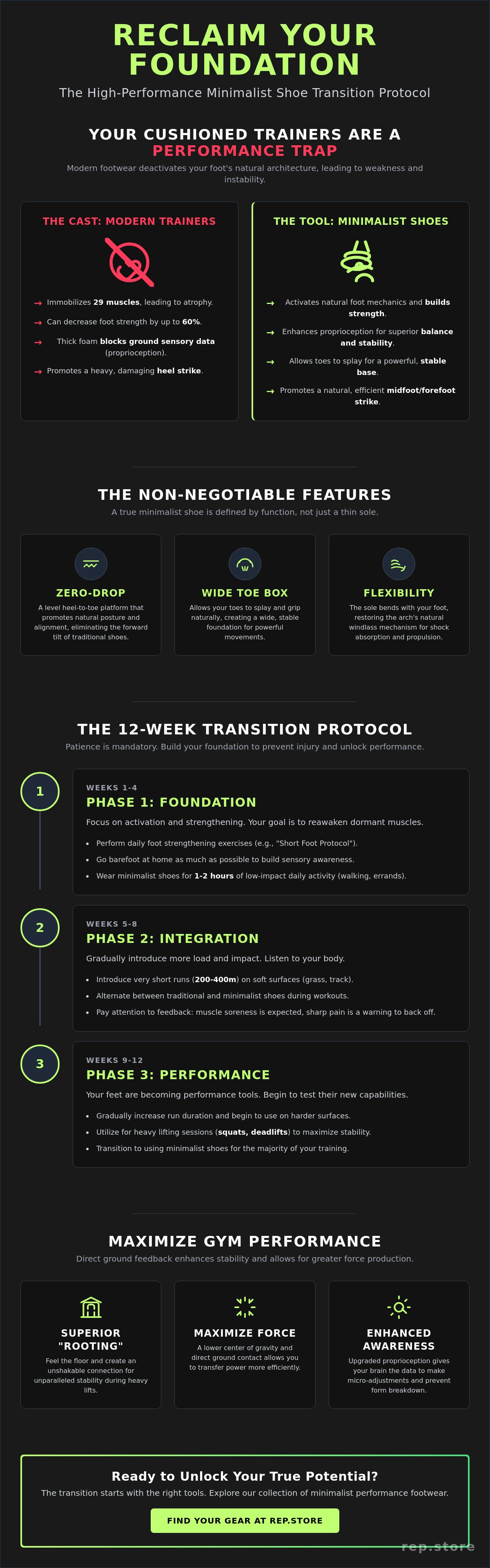
A minimalist shoe isn't just a thinner sneaker; it's a tool for biomechanical efficiency. To successfully transition to minimalist shoes, you must look for three non-negotiable features:
- Zero-drop: A level heel-to-toe ratio is essential for posture. Traditional shoes feature a 10mm to 12mm drop that tilts your pelvis forward, creating a cascade of alignment issues.
- Wide Toe Box: This allows the hallux, or big toe, to splay and engage. A splayed big toe acts as a kickstand, providing the stability needed for explosive movements.
- Flexibility: The sole must bend easily to restore the natural windlass mechanism of the foot arch. This mechanism allows the foot to become a rigid lever for propulsion and a shock absorber for landing.
Proprioception: The Sensory Advantage
Thick foam soles act as sensory deprivation chambers for your brain. Proprioception is the body’s internal GPS for movement. When your feet can't feel the ground, your brain lacks the data it needs to coordinate balance and power. More data means better performance. Minimalist shoes improve your squat and deadlift stability by lowering your center of gravity and maximizing floor contact. This direct connection allows for micro-adjustments in real-time, preventing the "wobble" often seen in high-stack running shoes. By switching to a thinner sole, you're effectively upgrading your body's hardware for better spatial awareness and force production.
The Foundation: Essential Foot Strengthening Exercises
You cannot buy foot health. You must build it. Most people view footwear as a solution; it is often the problem. Traditional shoes function like a medical cast, causing the 29 muscles in your foot to atrophy over years of disuse. If you attempt a transition to minimalist shoes without rebuilding this muscular foundation, you are inviting injury. It is a binary outcome: prepare the tissue or face the consequences. In Dubai's high-performance fitness culture, rushing the process is a common mistake that leads to avoidable clinic visits.
Stability requires more than just strength; it requires sensory feedback. This is interoception. You must learn to feel the floor again. The U.S. Army transition guide emphasizes that patience is the most critical component of this process. Rushing into high-impact activities before your nervous system can map the ground leads to stress fractures. Use balance boards or single-leg standing drills for 2 minutes daily to prep your ankles for the varied terrain of the UAE, from sandy beaches to polished mall floors.
The Short Foot Protocol
This is ground zero for foot function. Sit or stand with your feet flat. Without curling your toes, pull the ball of your foot toward your heel. Your arch will lift and dome. This isometric contraction creates a rigid lever for movement. Perform 3 sets of 10 repetitions daily during your morning routine. It takes less than five minutes but dictates your long-term success. Consistency is the only metric that matters here.
Toe-ga: Regaining Control
Most adults have "shoe-shaped" feet, where the big toe is pushed inward. Toe-ga involves independent toe movement. Try to lift your big toe while keeping the other four on the ground; then switch. This restores the tripod base necessary for balance. Without a functional big toe, your transition to minimalist shoes will lack the power required for an efficient gait. It is about regaining the "grip" your ancestors used to navigate uneven terrain.
Mobilizing the Plantar Fascia
Tension is the enemy of mobility. Use a lacrosse ball or TRNR recovery tools to roll the underside of your foot. Focus on trigger points for 60 seconds per side. You must distinguish between "good" muscle soreness and "bad" tendon pain. Sharp, localized stabs are a signal to stop immediately. Calf mobility is the secret bottleneck in this journey. Tight calves pull on the fascia, making movement painful. Ensure you are managing your physical assets with the same precision you manage your digital ones. High-quality recovery is the only way to sustain high-quality performance.
The Gear Strategy: Choosing Your Transitional Tools
Abrupt changes kill progress. Switching from a standard 12mm heel drop to a zero-drop barefoot shoe overnight is a recipe for injury. Your tendons aren't ready for that load. A successful transition to minimalist shoes requires a calculated reduction in stack height and heel drop. Think of it as a phased software rollout; you don't go live until the infrastructure is stable. If you ignore the adaptation period, you risk stress fractures and Achilles tendonitis. It's that simple.
Start with a "least-worst" audit of your current footwear. Identify shoes in your closet with the lowest drop and most flexibility. This scientific review of minimalist shoe transition confirms that gradual adaptation is the only way to improve running economy without compromising structural integrity. If your current rotation consists of stiff, over-cushioned trainers, you need a bridge. You can't expect a foot that's been casted in foam for 20 years to perform instantly on hard UAE pavement.
Minimalist vs. Barefoot: Knowing the Difference
Minimalist shoes, like the Saucony Kinvara, typically offer a 4-8mm drop and moderate cushioning. They provide a safety net for your joints while you build arch strength. True barefoot shoes, such as the Vivobarefoot Primus, feature a 0mm drop and zero cushion. Buy minimalist first if you're coming from traditional trainers. Only move to full barefoot models once your foot intrinsic muscles can handle the 100% ground feedback. If you can't balance on one leg for 30 seconds today, you aren't ready for 0mm yet.
The REP Store Selection for Transitions
We curate tools based on performance reality. The R.A.D One is our top hybrid pick for UAE gym-goers. It balances a stable lifting base with enough flexibility for dynamic movement. It's the perfect middle ground for someone who wants to feel the floor without losing all protection during a heavy set of squats. For daily life, Vivobarefoot is the gold standard for sensory feedback. It forces your brain to map the ground accurately, which is the foundation of better movement.
Don't ignore recovery. Your transition to minimalist shoes is a marathon, not a sprint. Oofos recovery sandals are essential tools in this process. They provide a necessary "break" for your feet after a day of minimalist training. This isn't about pampering; it's about strategic downtime to ensure your tissues can recover from the increased mechanical load. Use Oofos to manage the fatigue so you don't have to stop your progress entirely.
The 12-Week Dubai Transition Protocol
Dubai’s urban landscape is unforgiving. Between the polished marble of the DIFC and the relentless concrete of Business Bay, your feet face a daily battle against hard, flat surfaces. You can't simply switch your footwear overnight and expect results. Rushing your transition to minimalist shoes is a tactical error that leads to stress fractures and tendonitis. This 12-week protocol is a structured investment in your long-term mobility. It treats foot strength as a measurable asset that requires a disciplined rollout.
Phase 1: Sensory Awakening (Weeks 1-4)
Your feet have been trapped in padded "coffins" for decades. They're weak, and their sensory receptors are dormant. The first month is about re-establishing the neural connection between your brain and the ground. Don't step outside yet. Your home is the laboratory where you build the initial tolerance needed for a successful transition to minimalist shoes.
- The 30-Minute Rule: Wear your Vivobarefoots for exactly 30 minutes a day inside your apartment. Consistency is more valuable than intensity at this stage.
- Mechanical Correction: Focus on walking with a heel-to-midfoot strike. Traditional sneakers allow for heavy heel striking, but minimalist shoes will punish this habit. Walk softly.
- Coffee Habits: Use your morning routine as a trigger. Perform foot exercises, like toe spreads and "short foot" contractions, while waiting for your coffee to brew. These small, daily wins accumulate into significant structural changes.
Phase 2: Urban Loading (Weeks 5-12)
Once your feet can handle 4 weeks of indoor movement, it's time to face the UAE’s urban environment. Dubai Hills Mall is an ideal testing ground. It offers kilometers of flat, climate-controlled flooring where you can monitor your gait without the distraction of uneven outdoor terrain or extreme heat.
- Mall Walking: Start with a 20-minute walk at Dubai Hills Mall or Mall of the Emirates. The hard surface provides immediate feedback on your walking form. If you're striking too hard, you'll feel it instantly.
- Gym Integration: Gradually introduce your shoes to the gym during weeks 9-12. Start by wearing them only on upper-body days. The flat sole provides a stable base for overhead presses and rows, improving your overall power output.
- The 10% Rule: Never increase your weekly minimalist mileage or duration by more than 10%. This is a non-negotiable safety metric. Exceeding this limit is the primary cause of transition failures.
You must monitor your body’s "check engine" lights. Achilles soreness or sharp pain in the arches are signals that you've pushed too hard. If these symptoms appear, reduce your volume by 50% for the following week. This isn't a setback; it's a necessary calibration. Your goal is a permanent change in your physical capability, not a quick fix that ends in injury. To ensure you're making progress based on data rather than guesswork, optimize your physical foundation and take control of your movement today.
Maximizing Performance: Minimalist Shoes in the Gym
Traditional gym shoes are performance thieves. Every millimeter of foam between your foot and the floor absorbs force that should be moving the weight. When you step onto the platform for a heavy set, you need a "rooting" effect. Minimalist shoes provide this by eliminating the unstable cushion found in standard trainers. You aren't just standing on the floor; you're anchored to it. This connection is the difference between a shaky lift and a locked-in PR.
Deadlifting in Vivobarefoot shoes offers a distinct mechanical advantage over traditional lifting shoes. A 20-millimeter heel lift might help some squatters, but it increases the distance the bar must travel during a pull. By removing the heel, you shorten the range of motion and keep your center of gravity where it belongs. This isn't just theory. It's physics. Your transition to minimalist shoes ensures that 100% of your power transfer goes directly into the lift rather than being dissipated by a compressed rubber sole.
Squat depth often suffers because of poor ankle dorsiflexion. Thick-heeled shoes act as a crutch, masking this mobility deficit. Switching to a zero-drop platform forces your ankles to work through their natural range. Over time, this improves joint health and creates a deeper, more stable squat without the need for artificial elevation. It's about building a body that performs, not one that relies on gear to hide weaknesses. Integrating this philosophy into your "Everyday Performance" mindset means you stop looking for shortcuts and start building a foundation from the ground up.
Lifting with Ground Feel
A wider base of support is the foundation of every heavy movement. Minimalist designs allow your toes to splay, which creates a larger surface area for force production. You should follow the "Three-Point Contact" rule: keep your big toe, pinky toe, and heel firmly pressed into the ground. This tripod position is nearly impossible in narrow, tapered shoes. For athletes tackling high-intensity Metcons in the UAE, the R.A.D One offers the necessary lateral stability while maintaining that essential ground feel. It's the bridge between raw barefoot performance and the durability required for explosive, multi-directional movements.
Long-term Foot Health as a Competitive Edge
Performance isn't just about your next session; it's about staying in the game for decades. Better foot mechanics lead to reduced injury rates in the knees and hips. When your feet function correctly, they absorb shock as intended, sparing your larger joints from unnecessary wear. There's also a psychological edge. Feeling "connected" to the movement increases your proprioception and confidence under heavy loads. Your transition to minimalist shoes is an investment in your athletic longevity. You'll move better, recover faster, and lift heavier.
Stop guessing about your footwear. Experience the difference in person. Visit the REP Store at Dubai Hills Mall for a professional fitting and see how the right shoes can transform your training results today.
Reclaim Your Natural Power
Modern footwear has compromised your biomechanics for decades. Your transition to minimalist shoes isn't a trend; it's a performance mandate. By committing to the 12-week protocol and specific foot-strengthening drills, you're re-engaging 200,000 nerve endings and building a foundation that supports elite-level output. Performance is binary. You either have the structural integrity to move heavy loads with precision, or you're waiting for an injury.
Don't leave your progress to guesswork. REP Store provides the UAE's premier performance community and expert guidance to ensure your feet adapt correctly. We offer a curated selection of world-class brands like Vivobarefoot and R.A.D at our Dubai Hills Mall location. Our specialists provide in-person fittings to match your specific arch profile and training goals. Stop settling for dampened feedback and restricted movement.
Shop the Vivobarefoot collection at REP Store to upgrade your gear. Your strongest season starts from the ground up.
Frequently Asked Questions
Is it normal for my calves to be sore when switching to minimalist shoes?
Yes, calf soreness is a physiological certainty during your transition to minimalist shoes because your lower leg muscles are finally engaging as nature intended. Traditional shoes with an 8mm to 12mm heel drop keep your calves in a shortened state; removing that lift forces the Achilles tendon and gastrocnemius to stretch and work. Expect 4 to 7 days of initial discomfort as your body adapts to the increased load and range of motion.
Can I wear minimalist shoes if I have flat feet or high arches?
Minimalist shoes are effective for both flat feet and high arches because they prioritize foot function over external support. Research shows that 6 months of walking in minimalist footwear increases intrinsic foot muscle strength by 60%. Instead of relying on a foam arch that weakens the foot, you're building a natural suspension system. This structural reinforcement is the only way to achieve long term stability in the UAE's urban environments.
How long does it take to fully transition to barefoot shoes?
A full transition to barefoot shoes typically requires 3 to 6 months of consistent, gradual use. You're reversing years of structural damage caused by restrictive footwear, which doesn't happen overnight. Start with 30 minutes of wear per day for the first 14 days. If you rush the process, you risk stress fractures; patience is the price of permanent foot health and improved athletic performance in the long run.
Should I run in minimalist shoes immediately if I am an experienced runner?
No, even elite runners must treat the transition to minimalist shoes as a complete biomechanical reset. Your cardiovascular system might be ready for 10 kilometers, but your metatarsals and tendons aren't prepared for the 2.5 times bodyweight impact force of barefoot running. Start with 10% of your total weekly mileage in minimalist footwear. This calculated approach prevents the common 30% injury rate seen in runners who switch too quickly without proper form.
Do I need to wear socks with my Vivobarefoot or minimalist shoes?
Wearing socks with your Vivobarefoot or minimalist shoes is a matter of personal preference and hygiene, not a requirement. In the UAE's high humidity, moisture-wicking toe socks are a strategic choice to prevent blisters and manage sweat. They allow your toes to splay naturally while protecting the shoe's interior from bacteria. If you choose to go sockless, ensure you're cleaning your footwear weekly to maintain a professional standard of hygiene.
Are minimalist shoes safe for heavy weightlifting like squats and deadlifts?
Minimalist shoes are the gold standard for heavy weightlifting because they provide a stable, zero-drop base that maximizes ground feel. During a 150kg squat, a thin sole ensures your center of gravity remains over your midfoot, preventing the instability caused by compressed foam. You'll achieve better force production and proprioception. Professional powerlifters often prefer this near-barefoot contact to ensure every watt of energy goes directly into the floor.
What happens if I feel sharp pain in my heel or arch during the transition?
Sharp pain in your heel or arch is a red flag that requires an immediate 48-hour rest period and a reduction in activity. This isn't "good" soreness; it's often a sign of plantar fasciitis or a brewing stress reaction in the bone. If pain persists beyond 72 hours, consult a Dubai-based podiatrist to check your gait. Ignoring these signals destroys your progress and leads to long term setbacks that are expensive to fix.
Can I use my custom orthotics in minimalist shoes during the transition?
You should avoid using custom orthotics in minimalist shoes because their rigid structure contradicts the goal of foot flexibility. Orthotics act as a permanent crutch that prevents your 26 foot bones from moving as they should. If you're struggling, use the orthotics in your old shoes for 80% of the day while using minimalist shoes for the remaining 20%. Gradually phase out the inserts over 12 weeks to reclaim your foot's natural power.


