

Vivobarefoot Shoes in Dubai: The Complete 2026 Athlete’s Buying Guide

Your high-tech, cushioned gym shoes are likely the primary reason your performance has plateaued and your feet ache after every session. It's a hard truth to swallow, but narrow toe boxes and artificial arches have compromised your foundation. You probably feel that lack of stability during heavy squats or the nagging discomfort in your toes after a workout in Dubai Hills Mall. Most athletes treat foot pain as a necessary part of the grind, but it's actually a systemic failure caused by ignoring how your body was designed to move. Transitioning to Vivobarefoot Shoes isn't about following a naturalist gimmick; it's about reclaiming the sensory feedback and structural integrity required for elite output.
We'll show you exactly how to master this transition and avoid the common pitfalls that lead to injury. This guide identifies the best models for Dubai's high-performance training scene, ensuring you select the right gear for your specific discipline. You'll learn how to build a foot that functions like the precision tool it's supposed to be, giving you total control over your athletic future and your long-term mobility.
Key Takeaways
- Stop compromising your foundation with artificial support and discover how the sensory feedback of Vivobarefoot Shoes reclaims your natural stability.
- Differentiate between high-performance models like the Primus Lite III and the Motus Strength to ensure your footwear matches your specific training intensity.
- Apply a disciplined transition strategy using the 10% volume rule to strengthen your feet without risking downtime or injury.
- Master the "thumb rule" for sizing at a physical hub like REP Store to ensure your footwear provides the necessary space for natural metatarsal splay.
Why the Barefoot Movement is Redefining Dubai’s Training Standards
Modern athletic footwear is a silent performance killer. Most brands sell "support" as a benefit, but for a serious athlete, support is synonymous with atrophy. When you encase your foot in a rigid, cushioned coffin, your muscles stop working. They don't have to. Over time, this reliance on external stability creates a fragile foundation. Dubai's elite training community is waking up to this reality. They're ditching the pillowy midsoles for minimalist shoes that demand active engagement. If your foot can't stabilize itself, your heavy lifts will eventually stall. It's that simple.
Power isn't just about muscle mass; it's about neural drive. Your brain needs data from the ground to coordinate explosive movements. Thick foam mutes this signal. By switching to Vivobarefoot Shoes, you restore the sensory loop between your brain and the floor. This increased proprioception allows for micro-adjustments in real-time, leading to better balance and higher power output. Ignoring this connection is a liability. In a city where training standards are world-class, showing up with compromised foot health is an amateur mistake that threatens your long-term athletic longevity.
The Kinetic Chain Starts at the Big Toe
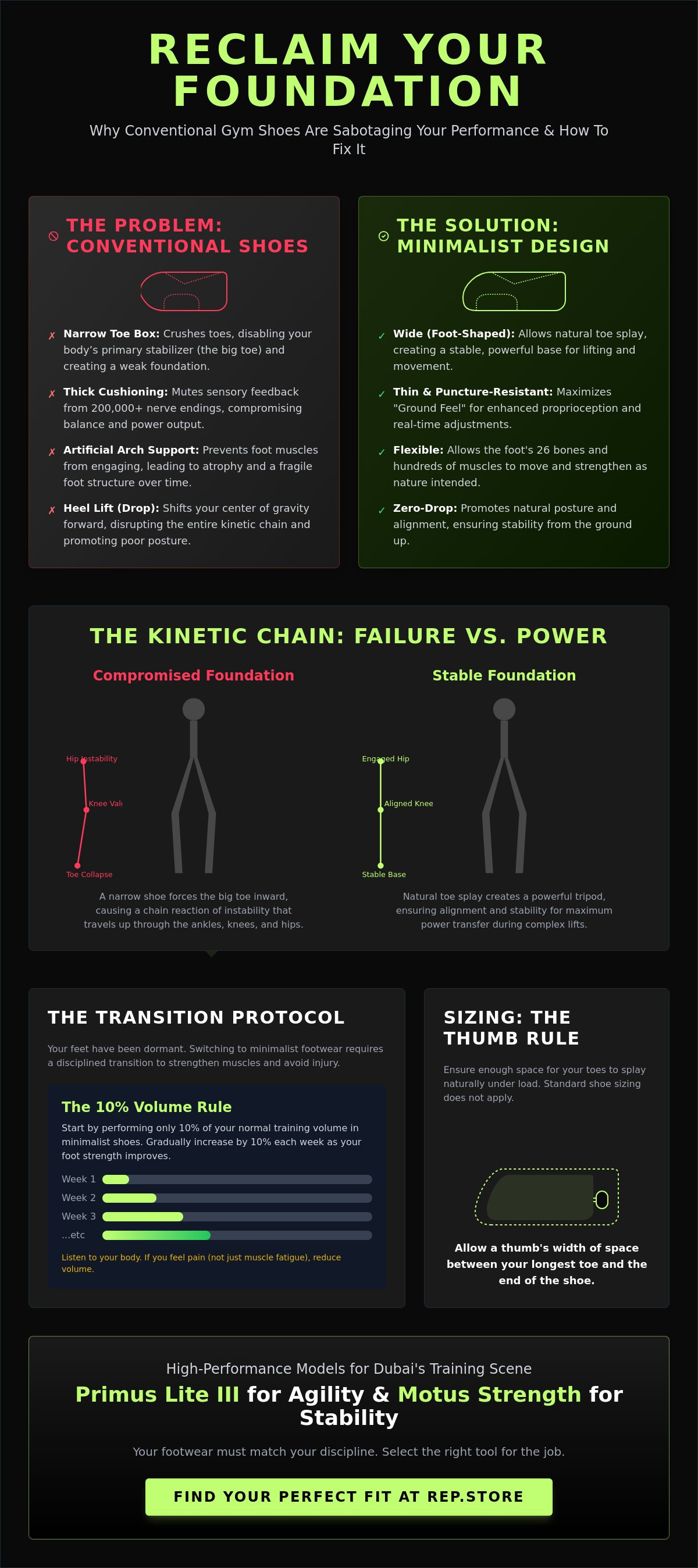
Your big toe is your body’s primary stabilizer. Narrow toe boxes, common in traditional gym shoes, force this digit into a non-functional position. This creates a "shoe-shaped foot" that ripples through your entire kinetic chain. When the big toe is disabled, the arch collapses, the knee caves inward, and the hip loses its alignment. You can't fix a squat with a weight belt if your foundation is broken. Vivobarefoot Shoes provide the width necessary for natural metatarsal splay, turning your foot back into the powerful tripod it was meant to be. This alignment is critical for maintaining stability during technical lifts like snatches and cleans.
Performance Perception vs. Reality in the UAE
The myth that "more cushion equals more safety" is dying on Dubai’s gym floors. High-stack shoes actually increase the risk of ankle rolls by raising your center of gravity. They provide a false sense of security while masking technical flaws in your lifting form. Minimalist footwear provides "ground-truth." You feel exactly where your weight is shifting during every rep. This transparency forces better technique and prevents the compensations that lead to chronic injury. The Dubai fitness scene isn't moving toward barefoot styles because it's a trend; they're doing it because the results prove that natural foot function is the only way to maintain total-body power.
The Vivobarefoot Design Philosophy: Wide, Thin, and Flexible
The engineering behind Vivobarefoot Shoes isn't a stylistic choice; it's a physiological necessity. Most footwear designers prioritize aesthetics or "perceived comfort" over actual biomechanics. This results in shoes that act as casts, holding the foot in a rigid, compromised state. Vivobarefoot reverses this by adhering to three non-negotiable pillars: wide, thin, and flexible. When your footwear allows your foot to function as nature intended, you aren't just moving more comfortably; you're actively strengthening foot muscles with every step.
Wide Toe Box: The Foundation of Balance
Traditional athletic shoes feature a pointed toe box that crushes your digits together. This isn't just uncomfortable; it's a performance bottleneck. By contrast, the Vivobarefoot "foot-shaped" design allows for full toe splay. This prevents the formation of bunions and provides the lateral stability required for high-intensity metcons. Metatarsal Splay is defined as the natural expansion of the forefoot under load, serving as a critical performance indicator for balance and weight distribution. Without this expansion, your base of support is narrowed, making heavy lifts and quick directional changes inherently more dangerous.
Ultra-Thin Soles and Ground Feel
Your feet contain over 200,000 nerve endings. These are the primary data sensors for your brain's movement software. Thick midsoles act as sensory deprivation chambers, forcing your body to guess where it is in space. Vivobarefoot Shoes utilize ultra-thin, puncture-resistant soles that maximize "Ground Feel." This high-resolution feedback allows for the micro-adjustments necessary during a heavy back squat or a technical clean. You don't need to sacrifice safety for sensitivity; the technology used in these soles ensures that thin does not mean fragile or unsafe.
The zero-drop profile is the final, non-negotiable element. Even a slight heel lift shifts your center of gravity, placing undue stress on the knees and lower back. By keeping the heel and forefoot on the same plane, you maintain a neutral spine and optimal pelvic alignment. This isn't just about posture; it's about mechanical efficiency. You can experience this firsthand by testing the latest models at the REP Store. Moving as a dynamic spring rather than a rigid block offers several immediate advantages:
- Improved ankle mobility and Achilles tendon elasticity.
- Reduced shear force on the knee joints during explosive movements.
- Enhanced engagement of the posterior chain during deadlifts and squats.
Selecting Your Model: Training vs. Lifestyle in 2026
Selecting the right pair of Vivobarefoot Shoes is a tactical decision, not a fashion choice. You're choosing a tool that will either enhance your foundation or sit in your closet because it doesn't match your training intensity. In Dubai's competitive fitness landscape, the choice usually comes down to how much "shoe" you actually need to handle your specific load. You wouldn't use a precision scalpel for a heavy-duty demolition job; the same logic applies to your footwear.
Primus Lite III vs. Motus Strength
The Primus Lite III is the minimalist purist's choice. It's the lightest performance shoe in the Vivobarefoot lineup, stripped of everything but the essentials. This makes it the gold standard for pure gym work, where sensory feedback is the priority. If your workout involves heavy barbell work or high-volume bodyweight movements, the Primus Lite III offers a "second skin" feel that traditional trainers can't match. It excels on flat gym floors where you need to feel every millimeter of weight shift during a squat.
However, the Motus Strength represents a new era for high-impact training. If your program includes CrossFit, rope climbs, or aggressive lateral movements, the Motus is your weapon. It provides a more robust upper and a specialized outsole that handles the friction of rope climbs without shredding. While some athletes still prefer the 6mm drop and cushioned response of R.A.D One Shoes for heavy metcons, the Motus Strength is for those committed to a zero-drop platform who need extreme durability. It's heavier than the Primus, but that weight translates into a "power cage" feel for your feet.
Everyday Performance: From the Office to Dubai Hills Mall
You can't expect one hour of barefoot training to undo the damage of eight hours in traditional dress shoes. Foot health is a full-time job. This is why the lifestyle range is critical for the Dubai athlete. The Geo Court offers a classic sneaker silhouette that fits perfectly into the social scene at Dubai Hills Mall or a casual office environment. It maintains the wide toe box and flexible sole, ensuring your feet stay active even when you aren't at the gym.
For more formal settings, the Ra IV provides professional aesthetics without the structural liability of a narrow toe box. If you're heading out of the city, the Tracker model provides the necessary protection for UAE desert trails. It features a rugged, lugged sole for traction on loose sand and rock, yet it remains flexible enough to allow for natural foot movement. This versatility ensures that whether you're in the boardroom or the box, your foundation remains uncompromised. Choosing the right model is about ensuring your feet never have to "turn off."
The Dubai Transition Plan: Moving Safely to Minimalist
Transitioning to Vivobarefoot Shoes is a strategic overhaul of your biomechanics, not a weekend experiment. If you jump straight into a high-intensity WOD after a decade of cushioned support, you're inviting a stress fracture. Dubai’s urban landscape is dominated by concrete, tile, and hard gym flooring. This environment is unforgiving. You must follow a disciplined protocol to wake up dormant muscles without triggering a structural failure. Volume is the variable that kills; managing it is the only way to ensure long-term success.
Apply the 10% rule. Never increase your weekly time in minimalist footwear by more than 10% of your previous week's total. You will inevitably feel "new muscle soreness" in your calves and the arches of your feet. This is the sound of your foundation rebuilding itself. However, you must distinguish this from actual injury. Sharp, localized pain in the metatarsals or a dull ache that persists during rest is a red flag. Ignoring these signals is a liability that will lead to forced downtime.
Phase 1: Sensory Awakening (Weeks 1-2)
The first 14 days focus on neural re-education. Wear your Vivobarefoot Shoes indoors or during low-impact activities like a walk through Dubai Hills Mall. Your brain needs to calibrate to the new level of ground feedback. Use a lacrosse ball daily to release tension in the plantar fascia. This is non-negotiable myofascial maintenance. The towel curl exercise, performed by using your toes to pull a towel toward your heel while seated, is essential for building intrinsic foot strength. It targets the small muscles that traditional shoes have effectively deactivated through years of disuse.
Phase 2: Loading and Integration (Weeks 3-6)
Once your feet adapt to simple walking, introduce loading. Start with static lifting sessions. Deadlifts and overhead presses in barefoot shoes provide a superior base of support compared to squishy trainers. Avoid running, box jumps, or double-unders during this phase. The impact forces are too high for a transitioning foot. Many elite athletes in the UAE adopt a hybrid approach, alternating their minimalist sessions with high-performance training shoes like R.A.D. This method allows you to maintain your training intensity while your feet undergo structural changes.
Control the transition or the transition will control your season. If you're ready to rebuild your foundation from the ground up, browse the full Vivobarefoot range at REP Store and start Phase 1 today.
Why REP Store is the Hub for Vivobarefoot in the UAE
Purchasing high-performance equipment through a generic digital storefront is a tactical oversight. For Vivobarefoot Shoes, the precision of the fit determines the success of your transition. A shoe that mimics a traditional trainer's tightness is a shoe that fails. REP Store is the definitive center for this movement in the UAE. We don't just move inventory; we provide the physiological data and expert fitting required to ensure your foundation remains an asset. Our presence in Dubai Hills Mall places us at the heart of the region's elite fitness community.
Correct sizing follows the "thumb rule" we prioritize during every consultation. You need a full thumb’s width of space to allow for the dynamic expansion of the foot under heavy load. Our staff members aren't just retail employees; they are athletes who actively train in the equipment they sell. They understand how a zero-drop platform interacts with high-intensity movements. By choosing a physical fitting, you eliminate the guesswork that leads to injury and performance bottlenecks. You can view the latest arrivals before visiting us for a professional assessment.
The In-Store Experience at Dubai Hills Mall
Testing the "flex" and "feel" of a minimalist sole requires a surface that reflects your actual training environment. We've designed our space to allow for real-world testing. We provide a professional assessment of your gait and foot shape to ensure your chosen model doesn't conflict with your current mechanics. This level of technical scrutiny is why we are the preferred choice among sports stores close to me for technical athletes. You can't simulate ground feel through a screen; you have to experience it on the floor.
Building the Everyday Performance Community
We've curated a selection that pairs Vivobarefoot with other elite brands like Nike Strength to create a complete performance ecosystem. This isn't about general fashion; it's about equipping yourself with tools that drive measurable results. Joining this community means refusing to settle for subpar gear that compromises your long-term mobility. Our clients treat their physical health as a capital asset. We offer exclusive access to 2026 limited editions and new drops that are unavailable in mass-market outlets. The REP mindset is about total control over your athletic future. Don't leave your foundation to chance.
Reclaim Your Foundation: The Future of Dubai Performance
Your foot is the most sophisticated piece of technology in your training arsenal. Ignoring its natural mechanics is a liability that limits your power and threatens your athletic longevity. By following a disciplined transition plan and selecting the right Vivobarefoot Shoes, you aren't just buying footwear; you're investing in a permanent performance upgrade. This shift toward minimalist standards is already the preferred choice of UAE CrossFitters who prioritize measurable results over cushioned gimmicks. You can't build a high-performance career on a weak foundation.
We maintain the exclusive 2026 stock for athletes who refuse to settle for subpar equipment. Visit us for an expert in-store fitting at Dubai Hills Mall to ensure your sizing follows the precision "thumb rule" required for optimal metatarsal splay. It's time to stop guessing and start moving with the high-resolution sensory feedback your body demands. Reclaiming your natural movement isn't a trend; it's a competitive necessity in Dubai's elite fitness scene.
Shop the Vivobarefoot Collection at REP Store Dubai and take the first step toward a stronger, more resilient foundation today. Your future self will thank you for the stability you build right now.
Frequently Asked Questions
Are Vivobarefoot shoes good for heavy squats and deadlifts?
Vivobarefoot shoes are exceptional for heavy squats and deadlifts because they provide a non-compressible, zero-drop platform. Traditional cushioned trainers create instability by compressing under load, which compromises your force production and balance. By keeping your center of gravity low and allowing your feet to engage directly with the floor, you maintain a more rigid foundation. This direct ground contact ensures that every ounce of power you generate is transferred into the lift rather than being absorbed by foam.
How should Vivobarefoot shoes fit compared to my regular trainers?
You should size your Vivobarefoot Shoes to be wider and longer than your regular trainers to allow for natural movement. The "thumb rule" is non-negotiable; you need approximately 12mm of space between your longest toe and the end of the shoe. This extra volume allows for metatarsal splay when your foot is under tension or carrying heavy loads. If they feel "too big" at first, it's likely because you've spent years in shoes that were actually too small for your natural foot shape.
Can I run on the pavement in Dubai with minimalist shoes?
Running on Dubai's hard pavements is possible but requires a flawless forefoot or midfoot strike to avoid joint impact. Concrete doesn't forgive the heel-striking technique common in cushioned shoes. If you haven't completed a structured transition, the impact forces will lead to discomfort. Start with short distances on softer tracks like the one at Kite Beach before moving to the urban sidewalks of Dubai Hills. Your technique must be the primary shock absorber, not the shoe.
Do I need to wear socks with my Vivobarefoot shoes?
You don't need to wear socks, but thin, moisture-wicking pairs are recommended for hygiene in Dubai's heat. Wearing thick, padded socks defeats the purpose of the ultra-thin sole and mutes the sensory feedback your brain needs for stability. If you choose to go sockless, ensure you're cleaning the shoes regularly to prevent odor buildup. Thin toe-socks are an excellent choice as they allow your digits to splay without the restriction of a traditional sock shape.
How long do Vivobarefoot soles last on hard gym floors?
Vivobarefoot soles are engineered with puncture-resistant technology and typically last as long as traditional athletic shoes under normal training conditions. On hard gym floors, the lack of abrasive surfaces like asphalt actually extends their lifespan. You'll likely wear out the upper through intense rope climbs or lateral work before the sole loses its integrity. Their durability is a key reason why they are a preferred choice for high-volume training in UAE CrossFit boxes.
Will barefoot shoes help with my lower back pain?
Barefoot shoes can alleviate lower back pain by restoring a neutral pelvic tilt and correcting your standing posture. Traditional shoes with even a small heel lift shift your weight forward, forcing your lower back to compensate. By returning to a zero-drop foundation, you realign your spine and engage your posterior chain more effectively. This structural correction addresses the root cause of many postural issues rather than just masking the symptoms with artificial cushioning.
What is the difference between Vivobarefoot and "minimalist" shoes?
Vivobarefoot is a brand that adheres to a strict "foot-shaped" design philosophy, while "minimalist" is a broader category with varying standards. Some minimalist shoes still include slight heel drops or narrow toe boxes that compromise foot function. Vivobarefoot Shoes are defined by being entirely wide, thin, and flexible with zero arch support. This ensures your foot does 100% of the work. Many generic minimalist brands compromise on these pillars to appeal to a wider market, which reduces their performance benefits.
Can I wear Vivobarefoot shoes if I have flat feet?
You can and should wear these shoes if you have flat feet, as they are the most effective tool for building a functional arch. Most flat feet are the result of muscular atrophy caused by overly supportive footwear. By removing the artificial arch support, you force the intrinsic muscles of the foot to engage and strengthen. Over time, this active engagement creates a natural, strong arch that provides better stability than any orthotic insert could offer.


