

Weightlifting Shoes in Dubai: The 2026 Athlete’s Guide to Maximum Power

Your cross-trainers are actively bleeding away your power transfer every time you step onto the platform. In a market where Dubai’s fitness industry is surging toward a $3 billion valuation by 2026, many athletes still fail because they treat footwear as a fashion choice rather than an engineering requirement. If you’ve ever felt your heels rise during a deep squat or experienced instability during heavy cleans, you aren’t necessarily lacking strength. You’re lacking a stable foundation. High-performance weightlifting shoes are not a luxury for the elite; they are a technical necessity for anyone serious about force production.
It is frustrating to hit a mobility wall when your muscles have more to give. You know that shaky ankles and muted power aren't just annoying; they're risks to your long-term progress. This guide will help you master the technical nuances of lifting footwear, revealing why the right heel-to-toe drop is the difference between a plateau and a PR. We will explore how dedicated stability creates a professional aesthetic that actually matches your output on the gym floor. From R.A.D to TYR, we are breaking down the gear that turns every gram of effort into upward momentum.
Key Takeaways
- Eliminate energy leaks by understanding why non-compressible soles are mandatory for maximum force production during heavy lifts.
- Identify the specific heel height your biomechanics require by comparing the performance impact of 15mm versus 21mm effective drops.
- Use the professional "wall test" to assess your ankle mobility and select weightlifting shoes that align with your unique squat style.
- Resolve the hybrid athlete dilemma by learning when to transition from versatile trainers like the R.A.D One to specialized lifting footwear.
- Discover why the REP Store at Dubai Hills Mall serves as the region's technical center for athletes who prioritize measurable results over gym fashion.
Beyond the Basics: Why Your Running Shoes Are Killing Your Gains
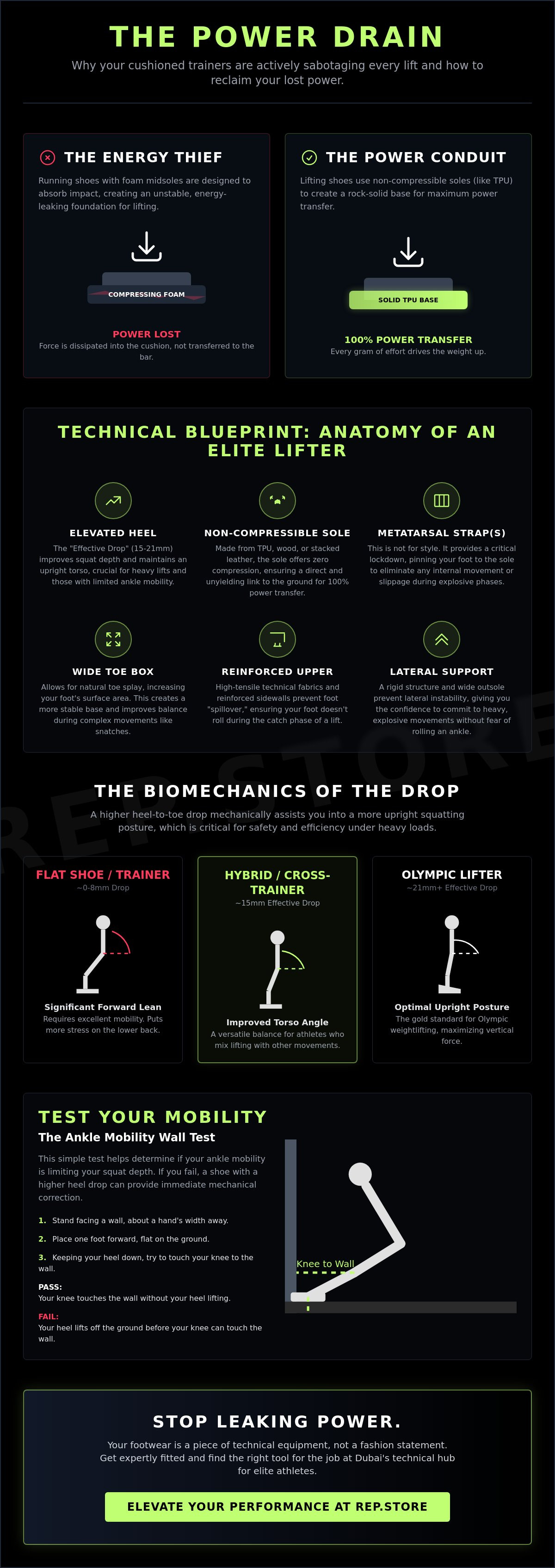
Your running shoes are actively sabotaging your progress on the lifting platform. Running shoes are engineered for a singular purpose: impact absorption. This is a brilliant feature for a 10km run, but it's a catastrophic flaw for a heavy squat. When you step into the rack wearing cushioned sneakers, you're standing on a foundation of shifting sand. We call this phenomenon "energy leaks." Instead of every ounce of force you generate driving the barbell upward, a significant percentage is absorbed and dissipated by the foam midsole. This isn't just a loss of efficiency. It's a fundamental breakdown in your mechanical chain.
Dedicated weightlifting shoes solve this by replacing foam with non-compressible materials like TPU or stacked leather. They create a direct, unyielding link between your body and the ground. In the rigorous world of Olympic weightlifting, where success is measured in millimeters and kilograms, this stability is the baseline for performance. You don't need "cushion" when you're moving a heavy load; you need a rock-solid base that ensures 100% power transfer. Anything less is a compromise that your PRs can't afford.
The Compression Crisis
EVA foam is the ultimate enemy of a 200kg back squat. As the load increases, the foam compresses at varying rates, leading to a "wobbly" sensation that is both physically dangerous and psychologically draining. If your feet feel insecure, your central nervous system will instinctively dampen your power output to prevent injury. You can't out-train a soft foundation. Force production in the context of rigid outsoles is the uninhibited transmission of kinetic energy from your muscular drive through a non-deformable base into the ground.
Stability as a Performance Metric
Stability isn't a vague concept; it's a measurable performance metric. Fashion-focused sneakers often feature narrow silhouettes that look sleek but offer zero lateral support. This is a liability during explosive movements like snatches or cleans. Specialized footwear like TYR Training Shoes or R.A.D One Shoes are built with different priorities. They utilize wide toe boxes to allow for natural toe splay, increasing your surface area and balance.
- The metatarsal strap: This component isn't for style. It provides a secondary lockdown, pinning your foot to the sole to eliminate any internal movement.
- Lateral support: Reinforced sidewalls ensure your feet don't roll during the catch phase of a heavy clean.
- Mesh vs. Structural Integrity: While mesh is breathable, weightlifting shoes use reinforced uppers to prevent foot "spillover" during lateral shifts.
By choosing a dedicated lifter, you're choosing to stop fighting your footwear. You're choosing a specialized tool that provides the stability and mechanical advantage necessary to push past your current plateaus.
The Technical Blueprint: Anatomy of an Elite Weightlifting Shoe
Don't treat your gear as an afterthought. It's an engineering choice. Elite weightlifting shoes are defined by their "Effective Drop." This is the height difference between the heel and the forefoot. A 15mm drop is common for hybrid training, providing a balance of stability and versatility. However, pure Olympic lifting often demands a 21mm drop, roughly 0.82 inches. This higher elevation is a deliberate mechanical adjustment. It allows you to stay upright under extreme loads. It's the difference between catching a clean in a stable position or being folded forward by the weight.
Material science has replaced tradition. While some purists still prefer the feedback of stacked leather or wooden heels, Thermoplastic Polyurethane (TPU) is the modern benchmark. TPU is lightweight and virtually indestructible. Most importantly, it offers zero compression. Modern uppers have also evolved. We've moved from stiff, restrictive leathers to high-tensile technical fabrics. These materials provide the necessary lockdown without a grueling break-in period. This Forbes review of weightlifting shoes highlights how these material shifts have redefined comfort and durability for the modern athlete. You need a shoe that holds its shape when the pressure is highest.
Heel Height and Ankle Dorsiflexion
Poor ankle mobility is a performance bottleneck. A raised heel artificially increases your range of motion by reducing the required angle of dorsiflexion. Standard 0.75-inch heels are the entry point for most. Advanced lifters often move to a 1-inch heel to achieve an aggressive, upright torso position in the bottom of a squat. This isn't a shortcut; it's optimizing your levers for maximum force production. If you're serious about your totals, you can explore technical footwear options that bridge the gap between stability and performance.
Outsole Friction and Grip
The Dubai climate demands gear that withstands high heat without degrading. Cheap rubber compounds turn slick or brittle in non-climate-controlled environments. You need an outsole that maintains "stickiness" on wooden platforms. A flat, wide base is essential. Contoured "walking" soles create instability by reducing surface contact. Your connection to the platform must be absolute.
Security is paramount. Dual-strap systems allow for independent tensioning of the midfoot and upper foot. This ensures your foot doesn't slide forward during heavy triples, maintaining the integrity of your drive. When you're chasing a new PR, the last thing you should worry about is internal foot movement. Every component of a high-end lifter is designed to remove variables and maximize your output.
Lifting Shoes vs. Cross-Trainers: Defining Your Performance Strategy
The hybrid athlete is a modern reality. You want the explosive power of a weightlifter and the agility of a sprinter. This creates a dilemma: do you invest in dedicated weightlifting shoes or stick with a versatile trainer? For most, the answer depends on volume. If your training cycle prioritizes the snatch and clean and jerk more than twice a week, a dedicated shoe isn't optional. It's a requirement for survival. Many athletes in Dubai attempt to hit heavy triples in runners, but they're simply building their house on a flawed foundation.
Cross-trainers are designed for impact and lateral movement. They have a degree of "give" in the sole to protect your joints during box jumps or short runs. In contrast, a dedicated lifter is a rigid tool. It offers zero flexibility. This trade-off is essential for maximum stability. When you're under a heavy load, any compression in your shoe is a failure point. You don't want "comfort" when you're holding 150kg overhead; you want an unyielding connection to the platform.
The Case for Dedicated Lifters
Industry benchmarks like the Nike Romaleos 4 and TYR L-1 are built for the platform, not the pavement. They feature aggressive heel heights and dual-strap systems that lock your foot into a singular, unmoving position. This rigidity is what allows for the upright torso position discussed in previous sections. If your goal is a podium finish or a lifetime PR, these are the tools you use. They aren't meant for walking around the gym. They are specialized equipment designed to maximize force production during the most demanding lifts.
The Versatility of Modern Training Shoes
Not every session requires a 21mm drop. For high-intensity metcons that mix lifting with plyometrics, the R.A.D One Shoes represent the pinnacle of hybrid engineering. Their Swell Foam technology provides a rare middle ground: enough cushioning for impact, yet enough density to prevent collapsing under moderate loads. This is ideal for the athlete who transitions from wall balls to moderate-weight cleans without a break.
Serious CrossFitters often find that a single pair isn't enough. You need a specialized crossfit shoe for the majority of your work, but you keep your lifters in your bag for the heavy strength portions. This isn't about collecting gear. It's about using the right tool for the specific mechanical demand of the movement. For those still identifying their primary style, reviewing a curated list of the best gym shoes can help clarify where your performance strategy currently sits. The threshold is simple. If your footwear is the reason you're missing lifts, it's time to upgrade. Don't let a "versatile" shoe become a permanent ceiling on your strength.
Selection Framework: Matching Footwear to Your Biomechanics
Buying weightlifting shoes based on aesthetics is a rookie mistake that leads to wasted capital and stagnant totals. Your footwear choice must be a calculated response to your specific anatomy. Start with the wall test. Place your foot five inches from a wall and attempt to touch your knee to it without your heel lifting. If you fail, your ankle mobility is a bottleneck. You require a higher heel to compensate for this mechanical deficit. If you pass with ease, a standard 15mm to 17mm drop may suffice.
Your squat style is the next variable. Front squat dominant lifters and high-bar specialists need a more aggressive heel to maintain an upright torso. Conversely, low-bar powerlifters often prefer a flatter sole to sit back into their hips. Femur length also plays a critical role. If you have long femurs, you're naturally prone to excessive forward lean. A higher heel artificially lengthens your ankle's range of motion, allowing for a more efficient, vertical drive. Before committing, consult the technical experts at REP Store to ensure your selection matches your lifting profile.
Squat Mechanics and Heel Choice
Mechanical advantage is found in the details. Long-limbed athletes often struggle with depth and stability. A 1-inch heel can be the catalyst for a breakthrough in these cases. It shifts your center of gravity, allowing your knees to track forward without compromising your spinal alignment. This isn't just about comfort. It's about optimizing the leverage of your own body to move maximum weight with minimum risk.
The 'Technical Fit' Protocol
Forget everything you know about sizing casual sneakers. A "comfortable" fit in a lifter is a loose fit. You should have zero "wiggle room" in the toe box. Any internal movement during an explosive snatch or clean results in a massive loss of force. If you're between sizes, sizing down is usually the superior choice for performance. Use the 'heel slip' test: if your heel moves even a millimeter while you're on your toes, the shoe is too large.
- TYR Training Shoes: Engineered with a wider toe box for athletes who need natural foot splay.
- Nike Profiles: Typically better suited for athletes with narrow or standard foot shapes.
- The Lockdown: Lace your shoes tightly, then use the metatarsal straps to "weld" your foot to the sole.
The final test must happen under load. A shoe might feel solid while standing, but the true assessment occurs at 90% of your max. If the base feels rock-solid and your torso stays vertical, you've found your tool. If you feel any lateral "spill" or shifting, you're wearing the wrong shoe. Don't settle for "good enough" when your performance is on the line.
Elevate Your Performance: Why REP Store is Dubai’s Technical Hub
Mediocrity is a choice, and your equipment is the first indicator of that choice. In a market saturated with generic retail, finding specialized weightlifting shoes that actually meet the demands of a 200kg squat is a challenge. REP Store isn't a generalist apparel shop. We are a technical hub dedicated to "Everyday Performance." We don't sell fashion; we provide the mechanical assets required by the UAE’s most serious athletes. Your foundation determines your ceiling. If your base is flawed, your progress will inevitably stall.
The REP Store philosophy focuses on curation. We've gathered niche global disruptors like R.A.D and TYR alongside industry giants like Nike Strength under one roof. This isn't about variety for the sake of choice. It's about precision. Our Dubai Hills Mall location serves as the center of the regional lifting community because we understand the physics of the platform. Our staff aren't retail associates; they're athletes who understand effective drop and lateral stability because they use these tools daily. They don't just sell gear; they help you optimize your leverage.
The Physical Advantage at Dubai Hills Mall
Selecting technical footwear online is a gamble you don't need to take. Precision fit is binary; it's either perfect or it's a failure point. At our Dubai Hills Mall location, you can test weightlifting shoes before you commit. This physical interaction is vital for diagnosing mobility bottlenecks. If you're searching for sports stores close to me that prioritize performance over aesthetics, you've found the regional benchmark. Our experts are on-site to help you determine if your femur length or ankle dorsiflexion requires a 15mm or 21mm heel, ensuring you leave with a tool, not just a shoe.
Seamless UAE Logistics
High-performance training doesn't wait for slow shipping. For the 2026 season, we've streamlined our operations to offer next-day delivery across Dubai and Abu Dhabi. We understand that the right fit is non-negotiable, which is why we provide hassle-free returns on all technical gear. You get direct access to the latest drops from Northern Spirit and LSKD without the typical wait times of international shipping. Whether you're upgrading your lifters or refreshing your training kit, our system is designed for speed and reliability. We handle the logistics so you can focus on the load. Your next PR starts with a rock-solid foundation, and we've built the infrastructure to deliver it to your door.
Own the Platform: Your Next PR Starts Here
Stop compromising your output with footwear designed for the track. We've established that the right weightlifting shoes are a technical requirement for force production, not a luxury. By matching your specific biomechanics to the correct effective drop and material density, you remove the mechanical bottlenecks that stall progress. Stability is the only path to maximum power and long-term injury prevention. You've done the work in the gym; don't let your foundation be the reason you miss your next total.
As an authorized UAE retailer for R.A.D and TYR, REP Store provides the precision gear that generalist shops ignore. Our collection is curated by athletes for athletes, ensuring every shoe we stock meets the highest standards of the platform. Visit us at Dubai Hills Mall for an expert fitting and experience the difference that a non-compressible base makes under a heavy load. We are here to ensure your gear matches your ambition.
Shop the 2026 Weightlifting Shoe Collection at REP Store and secure your foundation today. Your strength has no ceiling when your base is built for performance.
Frequently Asked Questions
Can I use weightlifting shoes for deadlifts?
No, you should avoid using them for deadlifts. The raised heel in weightlifting shoes increases the distance the bar must travel and shifts your center of gravity forward. This creates a mechanical disadvantage for pulling from the floor. For deadlifts, you need a flat, thin sole to keep your center of gravity over your midfoot and minimize the range of motion.
How tight should my weightlifting shoes be?
Your lifters should be significantly tighter than your daily sneakers. There should be zero internal movement or heel slip when you're on your toes. A technical fit means your foot is essentially welded to the sole. If your foot slides even a millimeter during a heavy clean, you lose stability and power transfer instantly. Secure the straps firmly to ensure total lockdown.
Are weightlifting shoes worth it for beginners?
Yes, they are a vital investment for beginners. They provide an immediate mechanical advantage by compensating for the ankle mobility issues common in new lifters. Using them early helps you establish proper squat depth and a vertical torso position safely. It's more efficient to build your technique on a stable foundation than to fight your footwear while trying to learn complex movements.
What is the difference between Nike Metcon and Nike Romaleos?
The Nike Metcon is a versatile cross-trainer designed for varied movements like box jumps, rope climbs, and short runs. The Nike Romaleos is a dedicated lifter with a non-compressible sole and a steep 20mm drop. You can run in Metcons; you cannot run in Romaleos. Choose the Romaleos for pure strength sessions where maximum stability and an upright torso are your only priorities.
Do weightlifting shoes help with knee pain during squats?
They can significantly reduce knee strain by allowing for a more upright torso. When your ankles lack mobility, your body compensates by leaning too far forward, which often places excessive shear force on the knee joint. The raised heel in weightlifting shoes restores proper alignment. This allows you to drive through your midfoot and reduces unnecessary pressure on the patellar tendon during deep squats.
How long do professional weightlifting shoes typically last?
Professional lifters typically last between two and five years depending on your training frequency. Unlike running shoes, the soles do not compress over time, so they don't lose their performance benefits in the traditional sense. Most athletes only replace them when the upper material starts to show significant wear or when they want to upgrade to newer technology. They are a long-term asset for your kit.
Where can I try on TYR or R.A.D shoes in Dubai?
You can try the full range of TYR and R.A.D footwear at the REP Store in Dubai Hills Mall. Trying these on in person is the only way to guarantee a technical fit and diagnose your specific mobility needs. Our staff are trained athletes who can help you select the exact model that matches your squat style and foot anatomy. Don't leave your performance to guesswork.


