

Best Hot Weather Workout Fabrics: 2026 Dubai Guide

Why does your premium activewear feel like a lead weight five minutes into a mid-July session at Dubai Hills? Most athletes assume that "breathable" cotton or basic polyester is enough to survive the UAE summer. It isn't. You've likely accepted that soaked shirts, persistent gym bag odors, and skin-searing chafing are just the tax you pay for training in 40°C humidity. In this environment, breathability is a marketing illusion if it lacks capillary action. Choosing the best fabric for hot weather workouts is no longer a matter of style; it's a requirement for maintaining your physiological baseline during high-intensity Hyrox or CrossFit sessions.
We've mastered the science of thermoregulation to ensure your gear works as hard as your heart rate. This guide explores the technical fabrics that keep elite athletes cool by leveraging graphene knits and antimicrobial ion technology. You'll learn how to invest in performance apparel that lasts more than one season and prevents the dreaded fabric cling. We'll break down the specific engineering behind brands like Ten Thousand, LSKD, and LNDR. Total climate control is no longer a luxury. It's the baseline for survival in the 2026 Dubai heat.
Key Takeaways
- Master the physiological mechanics of thermoregulation and understand why evaporation is your only defense against 40°C+ humidity.
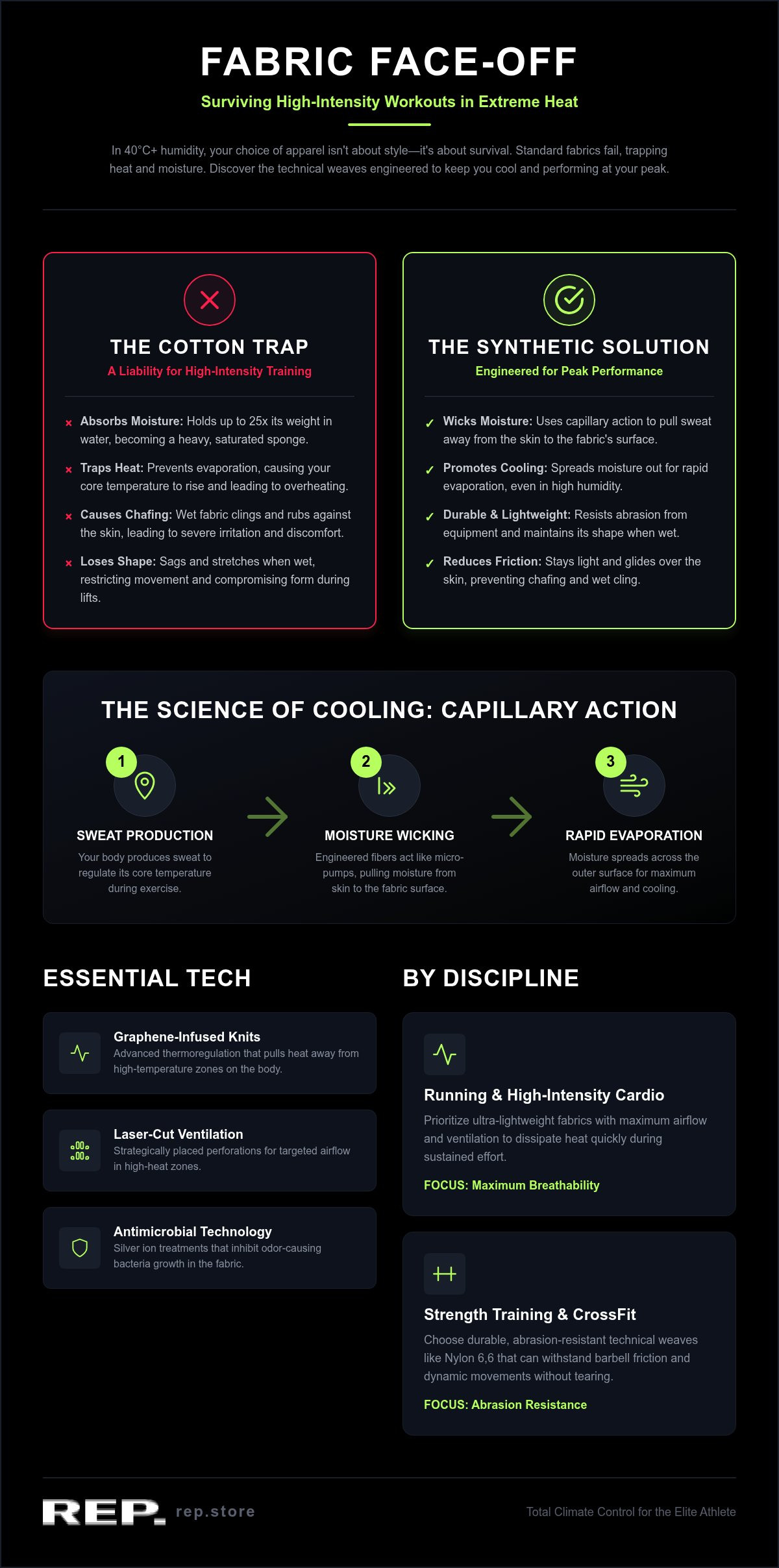
- Expose the "cotton trap" and learn why natural fibers are a liability that increases weight and skin irritation during high-intensity sessions.
- Identify the best fabric for hot weather workouts by prioritizing capillary action, laser-cut ventilation, and advanced graphene-infused knits.
- Optimize your gear for specific disciplines, choosing between ultra-lightweight airflow fabrics for running and abrasion-resistant technical weaves for strength training.
- Discover why elite brands like Ten Thousand and LNDR are essential for the Dubai athlete who demands gear that maintains its performance integrity for more than one season.
The Science of Thermoregulation in Extreme Heat
Thermoregulation is the biological process of maintaining a core temperature of approximately 37°C, regardless of the external environment. When you train, your muscles generate heat as a byproduct of energy production. To prevent overheating, your brain triggers sweat glands. However, sweat is only the delivery mechanism. The actual cooling occurs through evaporation. If liquid stays trapped on your skin, your core temperature continues to climb. This is why identifying the best fabric for hot weather workouts is a matter of physiological survival, not just comfort. Moisture-wicking is specifically defined as the capillary action that moves liquid away from the skin to the outer surface of the garment.
In the UAE, athletes face the "Dubai Factor." When the air is thick with humidity, it's already saturated with moisture. This prevents traditional fabrics from doing their job. Standard gear fails because it can't facilitate evaporation fast enough to keep up with your output. High-performance functional sports fabrics use engineered synthetic fibers to maximize surface area, forcing moisture to spread and dry at a rate that natural fibers can't match. These micro-channels in the yarn act as a mechanical pump. They don't rely on the air's ability to absorb water; they rely on physics to force the water to the exterior.
Heat vs. Humidity: A Critical Distinction
Dry heat is easy to manage; the air acts like a sponge. Humidity is the enemy. When the air is saturated, "breathable" weaves become useless because there is nowhere for the moisture to go. You need mechanical assistance. Technical synthetics don't just "breathe"; they actively pump moisture to the surface. By increasing the surface area of the individual fibers, these materials ensure that every available breeze or movement results in maximum cooling. This mechanical efficiency is the only way to maintain a high work rate when the environmental temperature exceeds your body's own heat.
The Problem with "Wet Cling"
Wet fabric is heavy, restrictive, and dangerous for your skin. Once a garment reaches its saturation point, it creates "wet cling." This isn't just uncomfortable. It creates a layer of friction that leads to severe chafing during CrossFit or Hyrox events. Carrying an extra 500 grams of water weight in a soaked shirt also has a physiological cost. It drains your energy and compromises your focus. In strength training, a damp, shifting shirt can even ruin your core stability during heavy lifts. You can't afford gear that works against your biomechanics.
Synthetic vs. Natural Fibers: Why Cotton is a Training Trap
"Organic" and "natural" are marketing buzzwords that can be dangerous in a high-intensity training environment. Many athletes mistakenly believe that natural fibers are the superior choice for skin health and breathability. They aren't. The Physiological Responses to Exercise dictate that your body needs to shed heat through rapid evaporation. Cotton does the opposite. It is a biological trap. While it feels soft in a temperature-controlled lounge, it becomes a heavy, suffocating sponge the moment your heart rate spikes. Choosing the best fabric for hot weather workouts requires moving beyond the "natural is better" myth and embracing the technical precision of synthetics.
The Failure of Natural Fibers
Cotton fibers are shaped like hollow tubes. This structure is designed by nature to hold liquid, not transport it. When you sweat, cotton doesn't just get wet; it absorbs up to 25 times its weight in water. This leads to the "Death by Cotton" effect. The fabric expands, loses its shape, and begins to sag. Linen is equally problematic for athletes. It's fantastic for a beach stroll, but in a Metcon, it lacks the elasticity and moisture management required for performance. These materials cling to the skin, creating a barrier that stops evaporation and induces severe friction. If you're training in Dubai's humidity, natural fibers are a liability that will end your session early.
The Engineering of Modern Synthetics
Modern technical apparel relies on hydrophobic synthetics to keep you dry. Polyester is the backbone of the industry because it repels water. Instead of soaking it up, it pushes sweat to the outer layer where it can evaporate. Nylon 6,6 represents the gold standard for durability and a "cool-to-the-touch" feel. It's stronger and more abrasion-resistant than standard nylon, making it ideal for barbell work. In 2026, the evolution of recycled synthetics has closed the gap between sustainability and performance. You no longer have to choose between environmental ethics and technical precision. These materials are engineered to maintain their structure even when you're at peak output.
Bamboo and Tencel offer a middle ground. They are softer than synthetics and have better antimicrobial properties than cotton. However, they still retain more moisture than high-end polyester. For low-intensity recovery or yoga, they're acceptable. For a 40°C Dubai session, they're insufficient. You need the mechanical efficiency of high-grade synthetics to stay in the fight. If you want to see how these technical weaves feel before your next session, you can test the latest collections at REP Store in Dubai Hills Mall.
Evaluating Technical Weaves and Cooling Technologies
Material composition is just the foundation. The real performance of the best fabric for hot weather workouts is dictated by its construction. In 2026, the industry has moved beyond simple knits to integrate Graphene knits. These advanced structures use thermal conductivity to distribute heat evenly across the garment, preventing localized hot spots. We now see engineered "Space" and "Chassis" fabric technologies that prioritize structural integrity over cheap chemical additives. Laser-cut ventilation isn't just an aesthetic choice. It's a precisely mapped system of breathability zones located where the body generates the most heat: the underarms, spine, and chest. These micro-perforations allow heat to escape without compromising the garment's durability during high-impact movements. At REP Store in Dubai Hills Mall, you can physically test how these different weaves respond to tension and airflow before committing to your kit.
Mechanical Ventilation vs. Chemical Cooling
Topical cooling finishes provide a temporary sensation that often degrades after five washes. Structural cooling is permanent. Mesh panelling integrated into the "Chassis" of the garment provides consistent airflow regardless of the humidity level. This mechanical ventilation ensures that air moves through the fabric rather than just over it. For outdoor training in the UAE, UV-reflective coatings are non-negotiable. These treatments bounce solar radiation away from the body, preventing the fabric itself from heating up and transferring that thermal energy to your skin. When you're training under the intense Dubai sun, this reflective layer can reduce the surface temperature of the garment by several degrees. This significantly lowers your physiological strain and prevents premature fatigue during outdoor sessions.
Odor Management and Anti-Microbial Tech
Synthetic fibers are inherently prone to trapping bacteria. In a warm, damp environment like a gym bag or a humid Dubai morning, microbes thrive. This is why standard polyester gear starts to smell permanently after a few months. Silver ion (Ag+) technology is the only industrial-grade solution. By embedding silver ions into the yarn itself, the fabric actively inhibits the growth of odor-causing bacteria. Brands like Ten Thousand and LNDR utilize these treatments to ensure their gear remains fresh for more than one season. If your gear smells even after a deep wash, it lacks this molecular-level protection. It's time to upgrade to a system that treats odor as a technical problem to be solved, not an inevitability. Investing in gear with embedded antimicrobial ions ensures your training environment remains professional and hygienic.
Activity-Specific Fabric Selection for Dubai Athletes
One size does not fit all when the temperature hits 40°C. Generalizing your gear is a tactical error that leads to premature fatigue. The best fabric for hot weather workouts must be selected based on the mechanical demands of your discipline. A runner's need for maximum airflow is fundamentally different from a lifter's requirement for abrasion resistance against a knurled barbell. In the extreme UAE climate, these technical nuances determine whether you finish your session or forfeit to the heat.
Running in the UAE Humidity
Weight is the primary metric for Dubai runners. You should target tops with a weight of approximately 100gsm (grams per square meter). Anything heavier becomes a water-logged anchor in high humidity. The "Singlet vs. Shirt" debate is settled by skin-to-air contact; singlets are superior for facilitating evaporation across the largest possible surface area. Construction also matters. While flatlock seams are common, bonded seams are the gold standard for 2026. They eliminate the thread entirely, creating a friction-free internal surface that prevents "runner's nipple" and side-body chafing during long zone 2 efforts on the Kite Beach track.
High-Intensity Strength & Metcons
Strength training requires "Burst Strength" in the fabric itself. During deep squats or Olympic cleans, the material is under extreme tension. Technical synthetics like Nylon 6,6 are essential here because they provide the necessary durability without the heat-trapping thickness of traditional canvas or heavy polyester. You need shorts that utilize a four-way stretch but maintain a structured "Chassis" so they don't ride up when soaked with sweat. Regarding compression, use it sparingly. While it supports blood flow, it can act as a thermal insulator. Limit high-compression pieces to indoor, air-conditioned environments or choose "Space" knits that offer support with integrated ventilation channels.
Hyrox and cross-training athletes require a hybrid approach. You need the rapid-dry technology of a running shirt combined with the tear resistance of a lifting short. High-performance training shoes must be paired with technical socks to prevent internal slipping and blisters caused by heat friction. If your socks are cotton, your shoes cannot do their job. Every component of your kit must work as a unified system to manage the thermal load. You can explore the full range of activity-specific gear at REP Store to ensure your apparel matches your output.
The REP Store Curation: Elite Gear for the UAE Climate
REP Store in Dubai Hills Mall does not stock gear based on seasonal fashion trends. We curate our selection based on technical specifications and environmental survival. The best fabric for hot weather workouts is a requirement for anyone training in the 40°C+ humidity of the UAE. We only partner with brands like Ten Thousand, LSKD, and LNDR because they treat apparel as a performance-critical system. Every item in our store has been vetted for its ability to manage thermal loads while maintaining structural integrity under the most demanding conditions.
Ten Thousand: Built for the World’s Toughest Workouts
The Ten Thousand "Session" short is our benchmark for lightweight performance in the Dubai heat. Its shell is engineered for maximum mobility without the water-retention issues found in cheaper synthetics. When paired with their technical tees, you benefit from permanent silver-ion odor control. As established earlier, this molecular-level treatment is the only way to stop bacteria from colonizing your gear. Ten Thousand utilizes rigorous testing protocols with elite athletes to ensure their fabrics are the most durable synthetics available. Whether you are choosing the "Distance" collection for long runs or "Session" for high-intensity Metcons, you are investing in gear that won't sag or fail after a single summer.
LSKD and LNDR: Precision Engineering
For female athletes, the compromise between high-grade compression and thermoregulation ends here. LNDR’s "Chassis" fabric provides the support necessary for high-impact movements without creating the dreaded heat trap. This material uses a specific knit structure that facilitates airflow while remaining completely squat-proof. LSKD complements this approach with a focus on 4-way stretch and rapid-wicking technology. Their apparel ensures that every movement in a CrossFit box or Hyrox arena is unrestricted by damp, heavy fabric. If you need gear that transitions from the gym to the street without losing its technical edge, our 247 by Represent pants review UAE provides a comprehensive guide to versatile performance wear.
Tactile testing is the only way to truly understand the difference between a standard polyester shirt and a technical "Space" knit. We invite you to visit REP Store at Dubai Hills Mall to feel these fabrics in person. Experience the weight of a 100gsm running top and the cool-to-the-touch finish of Nylon 6,6. We provide the technical infrastructure you need to maintain your output during the 2026 Dubai summer. Don't leave your performance to chance; choose gear that is engineered for the heat.
Own the UAE Summer: Upgrade Your Technical Baseline
Your performance in the Dubai summer isn't just about grit. It's about engineering. You've seen why natural fibers are a training liability and how technical weaves like Graphene and Silver Ion technology solve the problems of heat and odor. Identifying the best fabric for hot weather workouts is a strategic decision that separates elite athletes from those who settle for mediocre results. Don't let inferior gear dictate your physical limits during a high-intensity session.
REP Store provides the technical infrastructure to bypass environmental risks. As the authorized UAE retailer for Ten Thousand, LSKD, and LNDR, we curate only the gear that withstands 40°C+ humidity. Our expert staff at Dubai Hills Mall is trained in the science of performance textiles to help you build a kit that lasts more than one season. You've mastered the science; now secure the tools. Visit us to feel the difference between standard activewear and elite performance apparel.
Shop the Curated Performance Collection at REP Store and take total control of your training environment. The heat isn't an obstacle. It's just another variable to manage with the right equipment. Stay dry, stay focused, and keep winning.
Performance Apparel FAQ: Mastering the Heat
Is 100% polyester better than a polyester-spandex blend for hot weather?
Pure polyester is technically more hydrophobic and dries faster than any blend. However, training requires a range of motion that 100% polyester can't provide. For the best fabric for hot weather workouts, look for a low-percentage spandex blend, usually between 8% and 12%. This provides the necessary stretch for CrossFit or Hyrox while maintaining the mechanical moisture-wicking properties required to stay dry in Dubai's extreme humidity.
How often should I replace my technical workout gear in Dubai?
High-performance gear typically lasts 6 to 12 months under the stress of daily UAE training. The combination of extreme salt levels from sweat and frequent washing eventually degrades elastic fibers and antimicrobial treatments. If your LNDR leggings lose their compression or your shirts retain a permanent odor, the technical integrity is compromised. Investing in premium brands like Ten Thousand or LSKD ensures a longer lifecycle than entry-level alternatives.
Does black clothing actually make you hotter during outdoor workouts?
Indoors, color has no impact on your core temperature. Outdoors, black absorbs more solar radiation, but it can also help pull heat away from the body if the fit is loose. However, in the direct Dubai sun, light-colored UV-reflective fabrics are objectively superior. They bounce radiant heat away before it penetrates the garment. For outdoor sessions, prioritize technical UV-reflective coatings over the color palette to maintain a lower physiological baseline.
Can I use fabric softener on my moisture-wicking gym clothes?
Never use fabric softener on technical apparel. Softeners leave a waxy residue on the fibers that clogs the micro-channels responsible for moisture transport. This effectively turns your high-end performance shirt into a non-breathable plastic bag. To maintain the capillary action of your kit, use a dedicated sports detergent and air dry your clothes. This preserves the structural cooling properties and ensures the fabric continues to function as engineered.
What is the best fabric for preventing gym-related skin rashes?
Synthetic Nylon 6,6 or high-grade polyester with bonded seams is the most effective choice for skin health. Rashes in the UAE are caused by friction and salt crystallization from trapped sweat. You need a material that moves liquid away instantly to prevent this buildup. Avoid cotton, which holds moisture against the skin and causes abrasive wet cling. Look for gear with laser-cut ventilation to keep the skin surface dry.
How do I know if a fabric is truly moisture-wicking before buying it?
Perform a simple water drop test on the interior of the garment. If the water beads up and stays there, the material is a barrier, not a wick. If the water spreads instantly into a wide circle, the capillary action is working. At REP Store in Dubai Hills Mall, our staff can demonstrate these technical differences across our curated range of elite brands. Physical testing is the only way to verify performance.
Are cooling fabrics a marketing gimmick or real science?
Structural cooling is verified science; topical cooling finishes are often temporary gimmicks. 2026 technology utilizes Graphene knits and specialized yarn cross-sections to physically increase surface area and thermal conductivity. These are permanent features of the garment that don't wash out. While no fabric can beat 90% humidity without airflow, technical synthetics are the only materials capable of facilitating the evaporation required for survival in the heat.
Why does my workout gear smell even after a 60-degree wash?
Standard detergents and high heat often fail to penetrate the "biofilms" where bacteria thrive in synthetic fibers. High heat can actually damage technical fibers without solving the odor problem. The solution is gear with permanent silver-ion treatments, like those found in Ten Thousand collections. These ions inhibit bacterial growth at the molecular level. If your gear smells after washing, it lacks the antimicrobial technology required for high-intensity training in humid environments.


