

Weightlifting Footwear Stability: The Foundation of Every Heavy Lift

Your 200kg squat isn't failing because of your legs. It's failing because your shoes are swallowing your force production. Soft, compressible soles act like sponges under load, turning a precision movement into a dangerous balancing act. You've likely felt that lateral wobble during a max effort lift or struggled with ankle range of motion while wearing generic cross-trainers. It's a frustrating barrier that keeps your PRs stagnant despite your hard work. This guide masters the mechanics of footwear stability to eliminate those leaks. We'll settle the debate of flat sole vs heeled weightlifting shoes so you can stop guessing and start lifting with total confidence.
You'll learn how heel elevation impacts your biomechanics and why the right choice is the difference between a failed rep and a new record. Whether you're hitting high-intensity sessions in Dubai Hills Mall or preparing for a sanctioned meet under 2026 regulations, the right foundation is non-negotiable. Investing in technical gear from brands like TYR or R.A.D isn't about style; it's about securing the results your training deserves. Stop leaving kilograms on the platform because of a gear mismatch.
Key Takeaways
- Identify the "power leak" phenomenon and how high-density materials like TPU turn your footwear into a rigid platform for maximum force transfer.
- Master the technical differences between flat sole vs heeled weightlifting shoes to choose the optimal base for your specific anatomy and lifting goals.
- Audit your ankle mobility to determine if you require the mechanical advantage of a raised heel for deep, upright squats.
- Learn why midfoot lockdown straps are a structural necessity for lateral stability during max-effort Olympic and powerlifting movements.
- Explore the 2026 performance curation at the REP Store in Dubai Hills Mall to find elite-tier gear that eliminates lateral wobble.
Why Stability is the Non-Negotiable Capital of Strength
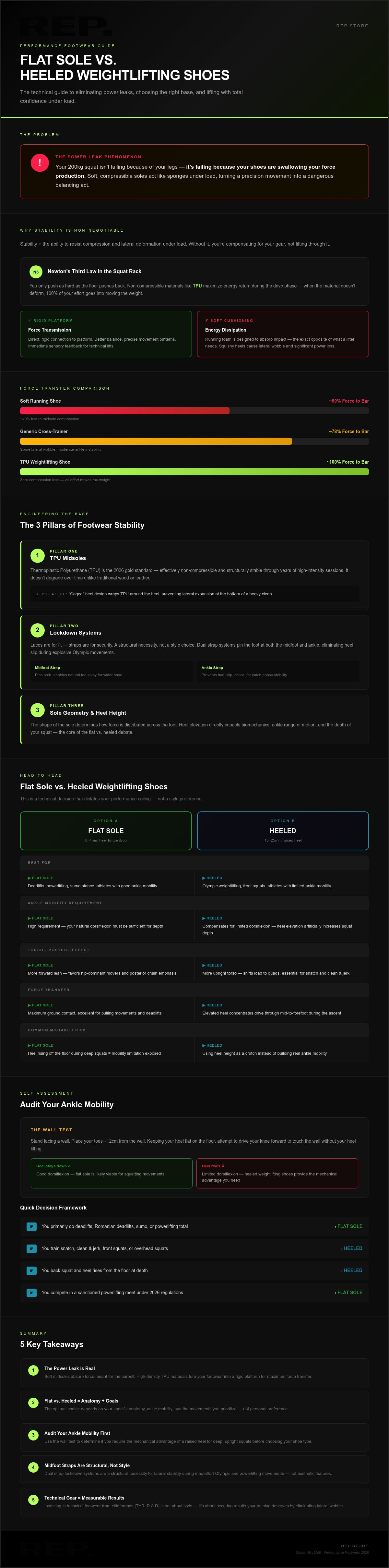
Stability in footwear is the ability to resist compression and lateral deformation under load. It's the primary currency of strength. Without it, you aren't just lifting; you're compensating for your gear. Soft midsoles create a "power leak" where force meant for the barbell is absorbed by the shoe. This is why the debate between flat sole vs heeled weightlifting shoes is more than just a style preference. It's a technical decision that dictates your performance ceiling. A stable base enhances proprioception, allowing your brain to trust the floor and recruit more motor units. In the high-intensity Dubai gym scene, instability leads to ankle rolls and knee valgus. You don't want your gear to be the weak link in your kinetic chain when going for a PR.
The Physics of Ground Force Production
Newton's Third Law states that for every action, there's an equal and opposite reaction. In the squat rack, you only push as hard as the floor pushes back. Non-compressible materials like TPU (Thermoplastic Polyurethane) maximize energy return during the drive phase. Ground reaction force is the force exerted by the ground on a body in contact with it, and it's the absolute key to a successful snatch. Using specialized Olympic weightlifting shoes ensures this force isn't dissipated into the midsole. When the material doesn't deform, 100% of your effort goes into moving the weight. This mechanical advantage is why elite athletes never settle for generic trainers.
Stability vs. Cushioning: The Great Training Divide
Running shoe foam is the enemy of a heavy deadlift. It's designed to dissipate energy to protect joints from impact, which is the exact opposite of what a lifter needs. Squishy heels during high-load Olympic transitions are dangerous and inefficient. When choosing between flat sole vs heeled weightlifting shoes, you are prioritizing force transmission over comfort. Minimal cushioning becomes a performance asset when it creates a direct, rigid connection to the platform. This allows for better balance and more predictable movement patterns under load.
- Soft soles cause lateral wobble, leading to significant power loss.
- Rigid platforms provide the immediate sensory feedback needed for technical precision.
- Compression-resistant bases protect the ankle from rolling under extreme loads during the catch.
In Dubai's premium training environments, athletes demand gear that matches their intensity. If your shoe feels like a pillow, you're leaving kilograms on the floor. True stability doesn't just feel better; it's a measurable performance multiplier that secures your heaviest lifts.
Engineering the Base: The Three Pillars of Footwear Stability
Stability in a weightlifting shoe isn't an accident. It's the result of rigorous engineering designed to handle hundreds of kilograms without flinching. While generic trainers prioritize comfort, technical lifting shoes prioritize structural integrity. Understanding these engineering pillars helps you decide between flat sole vs heeled weightlifting shoes based on how they manage force. A stable base ensures that every watt of power you generate goes directly into the barbell, not into the floor's compression.
TPU Midsoles: The Industry Standard for 2026
Modern lifting footwear has largely abandoned wood and leather for Thermoplastic Polyurethane (TPU). This high-density material is the gold standard for 2026 because it's effectively non-compressible. TPU doesn't degrade over time; it maintains its structural shape through years of high-intensity sessions. Many elite models now feature a "caged" heel design. This technical architecture wraps the TPU around the heel, preventing any lateral expansion when you're at the bottom of a heavy clean. It provides a rigid, predictable platform that traditional materials simply can't match.
Lockdown Systems: Beyond the Laces
Laces are for fit, but straps are for security. A dedicated lockdown system is a structural necessity, not a style choice. Dual strap systems provide superior tarsal security by pinning the foot both at the midfoot and the ankle. This eliminates "heel slip," a common performance killer during explosive Olympic movements. A secure midfoot also allows for better toe splay. When your foot is locked down, your toes can spread naturally, creating a wider base of support and improving your balance. This level of precision is why technical curation matters when selecting your next pair at the REP Store in Dubai Hills Mall.
Outsole geometry also plays a critical role. A wide "footprint" increases the surface area in contact with the platform, which directly translates to better lateral support. This is especially vital during the "catch" phase of a snatch where any side-to-side wobble can result in a missed lift. Finally, the heel-to-toe drop is the pillar that facilitates a vertical torso. By elevating the heel, these shoes reduce the ankle dorsiflexion required, allowing you to stay upright and keep the load centered over your midfoot. Whether you choose flat sole vs heeled weightlifting shoes, the engineering must support your specific lifting mechanics to eliminate power leaks.
- TPU Materials: Zero compression for maximum energy return.
- Dual Straps: Total tarsal lockdown to prevent internal foot movement.
- Wide Outsoles: Expanded surface area for elite lateral stability.
Elite performance requires an elite foundation. If your current footwear lacks these three pillars, you're training on a compromised base. Secure your lifts by choosing gear engineered for the demands of modern strength sports.
Flat Sole vs. Heeled Weightlifting Shoes: Choosing Your Weapon
Selecting the right footwear is a tactical decision. The debate between flat sole vs heeled weightlifting shoes isn't about personal comfort; it's about mechanical efficiency. Your choice dictates how your joints interact with the load and where your center of mass sits during the lift. If you're training in high-performance environments like Dubai Hills Mall, you need a base that matches your specific modality. The wrong choice doesn't just feel awkward. It creates a performance ceiling that no amount of effort can overcome.
When to Choose a Dedicated Heeled Shoe
Dedicated lifters are precision tools. Choose a heeled shoe if your primary focus is Olympic weightlifting or high-bar squatting. The elevated heel acts as a mechanical cheat code for athletes with restricted ankle mobility. It allows you to hit a deep squat while keeping your torso vertical, which is essential for the snatch and clean. This elevation shifts the demand to the quadriceps and stabilizes the catch position. However, these shoes are specialized. They offer zero flexibility for running or plyometrics. Pair them with professional-grade gym equipment from the REP Store for a training environment that demands total stability. In 2026, heeled lifters remain the non-negotiable standard for anyone serious about the classic lifts.
The Flat Sole and Hybrid Advantage
Flat soles excel where heels fail. Powerlifters often prefer a flat base for low-bar squats and deadlifts to maximize posterior chain engagement. By keeping the foot close to the floor, you minimize the range of motion and improve your leverage. This "push the floor away" sensation is vital for heavy pulls. For the modern Dubai athlete, the rise of the "stable hybrid" has changed the game. R.A.D One Shoes have become the 2026 benchmark for this category. They provide a rigid, stable base for heavy lifting without sacrificing the agility needed for high-intensity metcons or plyometric work.
- Heeled Shoes: Best for snatches, cleans, and high-bar squats.
- Flat Soles: Optimal for deadlifts and maximizing glute/hamstring recruitment.
- Hybrids: The versatile choice for CrossFit and everyday performance.
The Dubai training scene values the aesthetic-technical hybrid. You need gear that transitions from a heavy squat session to a dynamic circuit without a second thought. Choosing between flat sole vs heeled weightlifting shoes requires an honest assessment of your goals. Don't buy a specialized tool for a general purpose, but don't expect a general trainer to support a world-class snatch. Match your weapon to your battle.
Assessing Your Stability Needs: A Tactical Framework
Stop guessing which shoe might work. Your footwear is a technical tool, not a fashion accessory. Choosing between flat sole vs heeled weightlifting shoes requires a diagnostic approach based on your anatomy and training environment. If you ignore your biomechanical deficits, you're simply paying for a different way to fail a lift. A systematic audit of your mobility and modality is the only way to ensure your gear supports your PR attempts rather than sabotaging them.
The Ankle Mobility Test
Your ankle dorsiflexion dictates your heel requirements. Use the "Wall Test" to get an objective measurement. Stand facing a wall and place your big toe 10cm away from the baseboard. If you can't touch your knee to the wall without your heel lifting, you have a mobility restriction. A stable heel compensates for this deficit by artificially increasing your range of motion. This allows you to maintain a vertical torso and stay balanced over your midfoot during heavy sets. A 20mm heel drop is the standard for elite lifters because it provides the optimal mechanical advantage for most anatomical structures. If you pass the test with ease, you might find more power in a flat sole that maximizes posterior chain tension.
Environmental Factors in the UAE
Dubai's training environment presents specific challenges that generic reviews often overlook. High-intensity sessions in the UAE demand superior heat management. True stability doesn't require a suffocating upper material; modern technical uppers provide lateral support while allowing essential airflow. This prevents the "swimming" sensation inside the shoe that occurs when sweat compromises the internal grip during long sessions.
The surfaces in Dubai's premium facilities are another critical factor. Polished lifting platforms and high-grade rubber flooring require specific outsole compounds. You need non-marking, high-grip outsoles to prevent slipping during explosive transitions like the split jerk. Brands like TYR have gained traction because they cater to wider anatomical splay, allowing your toes to spread naturally for a more stable base. Don't leave your performance to chance. Finding the perfect match for your foot width and lifting style is why a professional fitting at the REP Store in Dubai Hills Mall is a non-negotiable step for serious athletes.
Identify your primary modality before committing to a purchase. Powerlifters focusing on the low-bar squat and deadlift generally thrive in flats. Olympic weightlifters and CrossFit athletes usually require the versatility of a heel or a high-performance hybrid. Once you understand your mobility and your environment, the choice becomes clear. Secure your foundation by selecting gear that bridges the gap between your current mobility and your performance goals. Visit the REP Store today to audit our curated selection of technical footwear.
Representing Everyday Performance: The REP Store Curation
Generic sports shops sell footwear for the masses. They prioritize inventory turnover over technical precision. At REP Store, we don't just "stock" products; we curate systems for athletes who've outgrown basic gear. Your choice between flat sole vs heeled weightlifting shoes is a strategic investment in your kinetic chain. We've selected brands that represent the absolute peak of 2026 performance technology. If you're training in Dubai, your gear should match the world-class standards of your facility. Settling for average footwear is a conscious decision to leave kilograms on the platform.
The R.A.D One: Stability Reimagined
The R.A.D One has established itself as the non-negotiable leader for the "Everyday Performance" athlete. It's the ultimate hybrid, providing a rigid base for heavy squats while maintaining the agility needed for dynamic movement. As the official retailer for R.A.D One in the UAE, we provide exclusive access to this 2026 performance benchmark. It's designed for the athlete who demands a shoe that looks as good as it performs on the platform. This model eliminates the need to choose between a lifting shoe and a trainer for most high-intensity sessions. For a deeper look at the technology behind this model, read our full R.A.D One Shoes guide.
For those requiring specialized anatomical stability, our selection of TYR Training Shoes offers a distinct advantage. TYR caters to the serious lifter with a wider foot, allowing for maximal toe splay. This anatomical design creates a wider base of support, which is critical when deciding on the flat sole vs heeled weightlifting shoes debate for your specific body type. Stability isn't a one-size-fits-all metric. It's a personalized requirement that depends on your foot shape and lifting style. If your toes are cramped, your balance is compromised before you even touch the bar.
Expert Fitting at Dubai Hills Mall
Buying technical footwear online is a gamble you can't afford to take. You wouldn't buy a precision instrument without testing its calibration. Our location in Dubai Hills Mall provides a professional environment where you can try specialized footwear on a real lifting platform. This isn't about how the shoe feels while walking on a carpet; it's about how it responds under load. Our expert staff helps you identify "power leaks" in your current setup, such as lateral heel collapse or internal foot sliding. We ensure your choice provides the lockdown needed for your heaviest PRs.
- Technical Precision: Every brand in our store is chosen for its engineering, not its marketing budget.
- Real-World Testing: Use our facility to feel the difference a rigid TPU heel makes before you commit.
- Community Hub: Performance gear is a lifestyle choice for the UAE athlete who refuses to settle for average.
Don't let a sub-par foundation sabotage your training. Your PRs are waiting on the other side of a stable base. Visit us at Dubai Hills Mall to find your perfect stability match today and take full control of your lifting future.
Secure Your Foundation and Dominate the Platform
Your footwear is the only interface between your raw strength and the platform. Choosing between flat sole vs heeled weightlifting shoes isn't a matter of preference; it's a technical requirement for eliminating power leaks and securing your heaviest PRs. We've established that high-density TPU midsoles and secure lockdown systems are mandatory for 2026 performance standards. Whether you need the mechanical advantage of an elevated heel or the posterior engagement of a flat sole, your gear must match your ambition.
As the official UAE home of R.A.D One, REP Store provides the elite curation required by athletes who refuse to settle for generic equipment. Stop guessing your size online and risking lateral instability under heavy loads. Experience an expert fitting at Dubai Hills Mall to ensure your base is as solid as your technique. Our selection is curated for everyday performance, giving you total control over your lifting future. Don't let a soft sole be the reason you miss your next record. Explore the Technical Footwear Collection at REP Store and secure your heaviest lifts today.
Frequently Asked Questions
Do weightlifting shoes really make a difference for beginners?
Technical footwear provides an immediate correction to your squat depth and torso angle. Beginners benefit most from this because it prevents bad habits from forming early in their training. A stable base allows you to focus on movement mechanics without fighting your own ankle mobility restrictions. Investing in a professional foundation at the start of your journey accelerates progress and significantly reduces the risk of early injuries.
Can I use weightlifting shoes for deadlifts, or are they only for squats?
You can use them, but it is often suboptimal for heavy pulls. Heeled shoes shift your center of mass forward, which can reduce your leverage during a deadlift. When choosing between flat sole vs heeled weightlifting shoes, remember that flats are superior for deadlifts as they maximize posterior chain tension. Using a heel for deadlifts can increase the distance the bar travels and put unnecessary strain on your lower back.
How tight should my stability straps be during a heavy set?
Your straps should be firm enough to eliminate all internal foot movement without cutting off your circulation. You want a "locked-in" feeling where your foot and the shoe move as a single unit. This tarsal lockdown ensures your foot doesn't slide forward or sideways during explosive transitions. If you feel any lateral wobble during the catch of a snatch, your straps are likely too loose to provide effective stability.
What is the difference between a 15mm and 20mm heel drop?
A 20mm drop is the industry standard for Olympic weightlifting. It provides maximum mechanical assistance for deep, upright squats. A 15mm drop is a "mid-heel" option often preferred by powerlifters or athletes with excellent ankle mobility who want a more natural feel. This 5mm difference significantly alters your knee travel and torso angle at the bottom of a lift. Choosing the right height depends entirely on your specific anatomical requirements.
Are R.A.D One shoes stable enough for heavy Olympic lifting?
R.A.D One shoes are engineered as high-performance hybrids with a rigid internal chassis that handles heavy loads with ease. While a dedicated lifter has a higher heel, the R.A.D One provides elite-level lateral stability for snatches and cleans. It's the top choice for Dubai athletes who need one shoe to handle both heavy triples and dynamic metcons. You get the stability of a lifter with the agility needed for a full training session.
How long do the stability features of high-end lifters last?
Stability features in high-end lifters can last several years even with daily heavy use. Because these shoes use non-compressible TPU midsoles, the base does not degrade like standard running foam. The upper materials or laces might show wear first, but the structural integrity of the platform remains rigid. This durability makes technical footwear a critical long-term investment for any serious strength athlete in the UAE training at a high intensity.
Should I buy barefoot shoes or lifters for better stability?
The choice depends on your specific training goals and mobility. Barefoot shoes like Vivobarefoot provide stability through maximum ground contact and natural toe splay. They are excellent for deadlifts and general strength work. However, the choice of flat sole vs heeled weightlifting shoes is about mechanical advantage. If you struggle to hit depth in a squat, a lifter provides the heel elevation that barefoot shoes simply cannot offer for technical precision.
Can I wear my weightlifting shoes for a full CrossFit WOD?
Dedicated weightlifting shoes are generally too rigid for running or high-impact plyometrics. Wearing them for a full CrossFit WOD can lead to foot fatigue or even injury during box jumps and sprints. If your workout includes both heavy lifting and cardio, choose a hybrid like the R.A.D One. These are designed to bridge the gap, providing the stability needed for the platform without sacrificing the flexibility required for dynamic movements.


