

Strength Training Lifting Straps in Dubai: How to Choose the Right Pair

The most supportive-looking lifting strap isn’t automatically the right one for your training. A strap that works well for heavy deadlifts may feel awkward on other lifts, while a poor fit can cause discomfort or make setup difficult. If you’re searching for strength training lifting straps Dubai options can feel overwhelming. Choose by lift, grip, and fit, not hype.
Strap styles differ in how they wrap around the bar, how quickly you can set them up, and how much padding or wrist coverage they provide. This guide compares lasso straps, figure-eight straps, and padded grip styles, then explains how material and fit affect comfort and control. You’ll come away with a clearer way to match a strap to your main lifts and training habits. REP Store is a Dubai-based performance retailer with an online store and a physical location at Dubai Hills Mall, First Floor, where you can explore performance training gear.
Key Takeaways
- Choose straps around the lifts you perform and the grip issue you want to address, not a universal “best” style.
- Compare loop, lasso, and figure-eight designs by how they wrap around the bar and feel during setup.
- Check material, construction, and fit for comfort and a secure wrap, then follow the product’s use instructions.
- Weigh straps against chalk and lifting hooks by setup, hand contact, and the training feel you prefer.
- Use this guide to narrow your strength training lifting straps Dubai choices, then explore performance training gear at REP Store’s Dubai Hills Mall location.
Why Dubai strength trainers use lifting straps, and what they do
Lifting straps connect your wrist to a bar to assist your grip during selected lifts. They can help when your hands give out before the muscles you’re targeting have finished the work. For example, grip fatigue may interrupt a pulling set even when you still have capacity to continue the movement. Straps can reduce that grip limitation on selected sets, but they don’t make muscles stronger by themselves.
Think of straps as a tool, not a shortcut or a substitute for technique. They don’t need to replace unassisted lifting, and they aren’t the same as wrist-support gear. A suitable choice depends on what you lift and why your grip is becoming a limiting factor. For broader context on the role of accessories in resistance exercise, see this overview of weight training equipment.
When do lifting straps make sense for strength training?
Deadlifts, rows, and other pulling movements are common examples, but straps aren’t necessary for every lifter or every set. Consider them when your grip repeatedly fails before you complete the intended work on a particular exercise. They can help keep grip from cutting a target set short, while form and control remain your responsibility.
Separate heavy working sets from grip-development work. If a set is meant to challenge your grip, using straps changes that demand. If you’re training another part of the pull and grip fatigue is ending the set early, straps may suit that session. Let the exercise goal guide your choice instead of applying a blanket rule.
Do lifting straps weaken your grip?
Using straps for selected sets doesn’t mean you have to stop training without them. Straps assist your hold while they’re in use, while unstrapped work still asks your hands and forearms to hold the load. The practical question is how to balance both approaches around your goals.
If grip strength is a priority, keep suitable exercises or sets unstrapped. If you use straps for some heavier pulling work, reserve other training for an unassisted grip when appropriate. When comparing strength training lifting straps Dubai options, start with your own training pattern: which lifts expose the grip limitation, and which sets should still challenge it? That distinction makes the accessory’s role clear without treating it as essential gear.
Lifting strap styles and materials: what Dubai buyers should compare
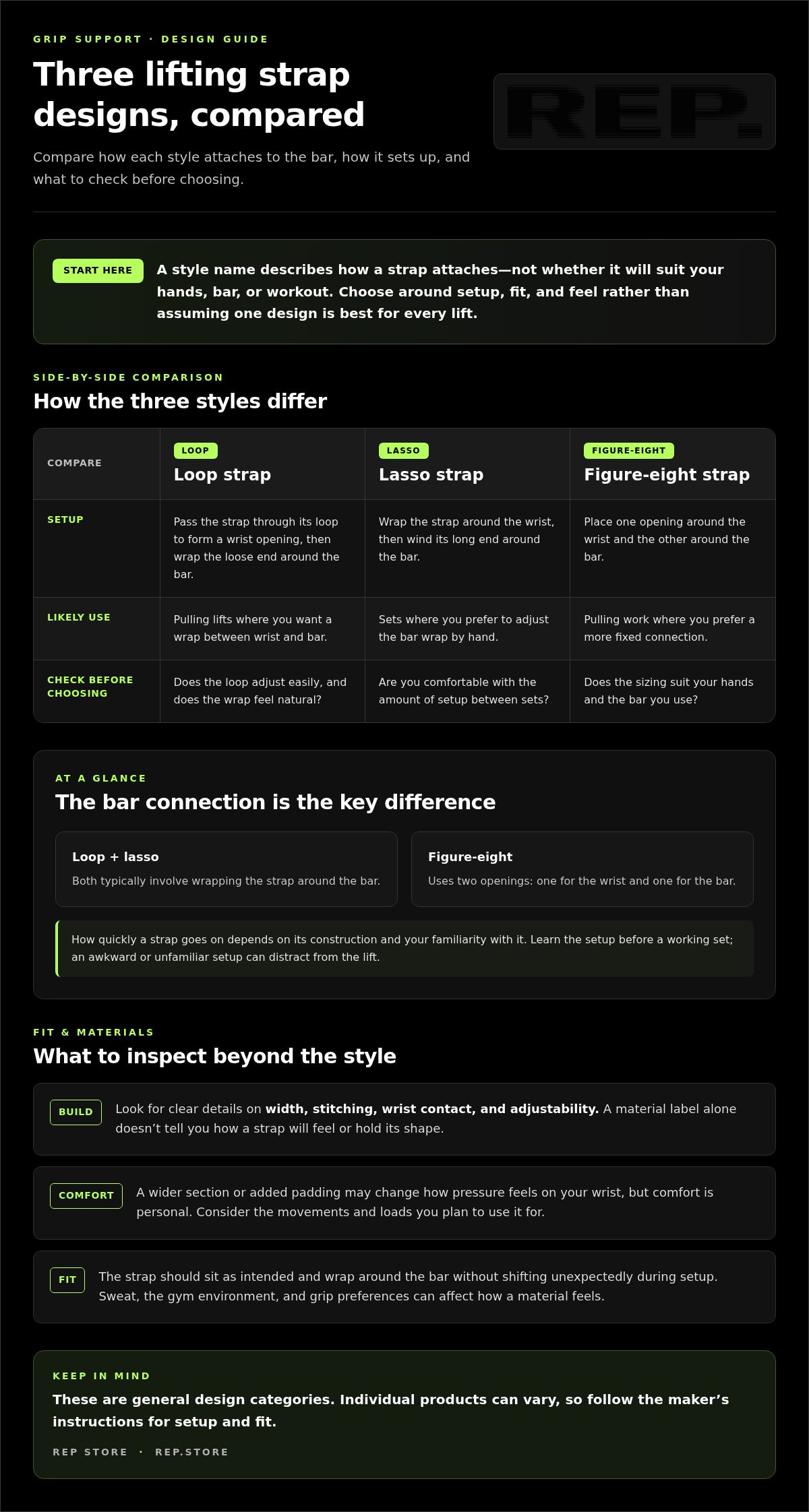
A style name tells you how a strap attaches, not whether it will suit your hands, bar, or workout. When comparing strength training lifting straps Dubai options, focus on setup, fit, and feel rather than assuming one design is best for every lift.
How do common lifting strap designs differ?
These are general design categories. Individual products can vary, so follow the maker’s instructions for setup and fit.
| Style | Setup | Likely use | Selection consideration |
|---|---|---|---|
| Loop | Pass the strap through its loop to form a wrist opening, then wrap the loose end around the bar. | Pulling lifts where you want a wrap between wrist and bar. | Check how easily the loop adjusts and whether the wrap feels natural. |
| Lasso | Wrap the strap around the wrist, then wind its long end around the bar. | Sets where you prefer to adjust the bar wrap by hand. | Consider how much setup you’re comfortable doing between sets. |
| Figure-eight | Place one opening around the wrist and the other around the bar. | Pulling work where you prefer a more fixed connection. | Check that the sizing and fit suit your hands and the bar you use. |
Loop and lasso styles typically involve wrapping the strap around the bar, while a figure-eight design uses two openings. How quickly each goes on depends on its construction and your familiarity with it. Learn the setup before a working set. An awkward or unfamiliar setup can distract from the lift.
Which material and fit details matter?
A material label alone doesn’t tell you whether a strap will feel comfortable, hold its shape, or suit your training. Look for clear details on width, stitching, wrist contact, and adjustability. A wider section or added padding may change how pressure feels on your wrist, but comfort is personal. Consider whether the product’s design matches the movements and loads for which you plan to use it.
Fit matters too. The strap should sit as intended and wrap around the bar without shifting unexpectedly during setup. This isn’t a promise of injury prevention. Sweat, the gym environment, and your grip preferences can all affect how a material feels during training, so consider the conditions in which you’ll use it.
For a broader look at REP Store’s performance gear, the Dubai-based retailer has an in-person location at Dubai Hills Mall, First Floor, as well as an online store.
Lifting straps vs. chalk and hooks: compare grip-support options
These tools address grip in different ways. Straps wrap around your wrist and the bar, hooks create a different hand-to-bar interface, and chalk changes the feel of your hand against the bar. They aren’t interchangeable, and none guarantees heavier lifts, better performance, or greater safety. The useful question for strength training lifting straps Dubai shoppers is: what part of your grip is limiting the movement?
Straps connect your wrist to the bar, hooks alter how your hand engages with it, and chalk works on the hand-to-bar surface. That difference affects setup, contact, and the feel of a set. A strap requires wrapping and adjusting. A hook needs to be positioned at the bar. Chalk is applied to the hands, with no wrist-to-bar connection.
When might straps suit a lifter better than hooks?
Straps may suit someone who prefers a wrap-around connection and wants to adjust how the material sits around the wrist and bar. Hooks provide a different interface, with the hook positioned to engage the bar rather than winding fabric around it. Comfort, the movement being performed, and familiarity with each setup all influence the choice. Neither approach is automatically right for every lift.
Are straps a better choice than chalk?
Not necessarily. Chalk affects the hand’s contact with the bar; straps help attach the wrist to it. If your hands feel like they’re slipping on the bar, chalk may be the more relevant option, subject to your gym’s rules. If grip fatigue interrupts a pulling set, straps may better match that limitation. Your preferred hand contact and setup matter too.
Use this comparison to clarify the trade-offs:
- Straps: A wrap-around connection that takes time to position. They change how directly your hands hold the bar.
- Hooks: A distinct hand-to-bar interface. Consider whether the feel and setup suit your movement and training preferences.
- Chalk: Applied to the hands to affect surface grip, without connecting your wrist to the bar. Facility policies may restrict its use.
Start with the problem you notice, not the accessory that looks most specialised. If hand-to-bar contact is the issue, consider chalk where permitted. If you prefer an attachment around the wrist and bar, compare straps. If you’re weighing hooks, think about how that different interface feels for the movements you train. Check applicable gym rules before using chalk or equipment with specific facility requirements.
How to choose lifting straps for your training in Dubai
Ignore universal rankings. The right choice depends on your lifts, what’s limiting your grip, and how the strap feels in use. Use this sequence to narrow your options:
- Name your lifts. Note where you’re considering straps, such as deadlifts or rows.
- Identify the grip issue. Is your hand slipping, or does grip fatigue interrupt a set?
- Compare styles. Consider how each design wraps, adjusts, and feels during setup.
- Assess fit. Check wrist contact, adjustability, width, and stitching.
- Review instructions. Learn how the strap should be fitted and used before loading the bar.
This process gives strength training lifting straps Dubai shoppers a practical way to cut through vague listings and compare features against a real training need, rather than choosing by hype.
Match strap features to your main lifts
Deadlifts and rows can place different demands on your grip, which may influence which setup feels comfortable. Your technique, preferred lifting style, and the bar’s diameter may also affect how a strap wraps and sits in your hand. If you train a movement often, consider whether the setup feels straightforward enough to repeat. There’s no universal winner. Practise your preferred setup with appropriate loads and controlled movements.
Check comfort, setup, and training rules
Look closely at wrist contact, adjustability, stitching, and how easily you can wrap the strap. Sweaty sessions may affect how materials feel against your skin and how you prefer to grip the bar. Comfort is personal, so give fit and feel real weight in your decision, not just the product label.
Regular gym training and competition aren’t always governed by the same equipment requirements. If you’re preparing for an event, read the relevant competition rulebook before choosing or relying on a strap. That helps you avoid basing a competition setup on assumptions about what will be allowed.
Complete your strength-training kit with the Dubai training shoe guide. Explore REP Store’s online selection or visit its physical location at Dubai Hills Mall, First Floor, to browse performance gear.
Where to explore performance training gear in Dubai
A confident choice comes from matching a strap’s design and fit to the lift, the grip issue you want to address, and the feel you prefer. Factor in the way you train, how the strap is constructed, and any relevant gym or competition rules. A popular option isn’t automatically the right one for your setup.
What can an in-person gear visit add?
Product descriptions can help you compare features, but seeing and handling training gear may give you a better sense of its texture, construction, and feel. This can help you assess what matters to you in performance equipment without relying on broad claims alone. REP Store is a Dubai-based performance retailer with a physical location on the First Floor of Dubai Hills Mall, as well as an online store.
For more local shopping context, explore this guide to sports stores in Dubai.
Make a confident buying decision
Before choosing, run through the essentials: What lift will you use the strap for? Which design suits your preferred setup? Does the fit feel comfortable at the wrist? Do the construction details and instructions make sense for your training? If you’re preparing for an event, check its equipment rules rather than assuming they match everyday gym practice.
Buy for your actual training, not the strongest-sounding product description. A deliberate choice considers the movement, fit, comfort, construction, and training context together. Explore REP Store’s performance gear online or visit the store at Dubai Hills Mall, First Floor, to browse performance equipment in person.
Choose your straps with confidence
The right strap is the one that fits your training, not the one with the loudest product claims. Match its design to the lifts you perform, consider how fit and construction feel on your wrists, and use straps only where they address the grip limitation you’ve identified. Chalk and hooks offer different kinds of support, so choose based on the actual issue and your preferred setup.
For strength training lifting straps Dubai shoppers, a clear buying decision starts with your lifts, comfort, and training context. If you’re preparing for a competition, check its equipment rules before settling on your setup.
REP Store is a Dubai specialty retailer focused on performance apparel, footwear, and training gear, with an in-person location at Dubai Hills Mall, First Floor. Explore the retailer’s performance gear online and build your training kit around what you actually need: Explore performance gear at REP Store.
Choose deliberately, train consistently, and let your equipment support the work you put in.
Frequently Asked Questions
What are lifting straps used for?
Lifting straps help connect your wrist to a bar during selected exercises. A lifter may use them for pulling movements when grip fatigue starts to limit a set, such as rows or deadlift variations. They don’t replace sound technique or grip training. Choose based on the movement, how the strap fits and feels, and the product’s instructions. Straps are an optional aid, not a requirement for every workout.
Are lifting straps good for deadlifts?
They can be useful for some lifters when grip fatigue interrupts a deadlift set before the intended work is complete. Straps aren’t necessary for every person or every set. Consider whether the set targets the deadlift muscles or grip, and whether you also want unassisted grip practice. Keep technique in focus, learn the strap setup before lifting, and check the rules for your specific event if you compete.
Which lifting strap style is best for beginners?
There’s no single best strap style for every beginner. Compare how each design wraps around your wrist and the bar, how easily it adjusts, and whether it feels comfortable for your intended lifts. Read the specific product instructions and practise the setup with manageable loads before using it in a working set. Your exercise choices, preferences, and any applicable training rules should guide the decision.
Are lifting straps better than weightlifting hooks?
Neither option is automatically better for every lifter. Straps wrap around the wrist and bar, while hooks create a different contact point between the hand and bar. That difference can affect setup, comfort, and how each feels during a movement. Consider the exercises you do and your preferred hand-to-bar feel. If you compete, check the equipment rules for your specific event before choosing either option.
Can I use lifting straps for every strength exercise?
No. Straps are most relevant for movements where you hold a bar or handle and want grip assistance. They aren’t needed for every exercise, and some sets may be intended to develop an unassisted grip. Follow the product instructions, keep technique in focus, and decide whether straps suit both the movement and your training environment. Use them purposefully rather than automatically adding them to every set.
Where can I find performance training gear in Dubai?
REP Store is a Dubai-based specialty retailer for performance apparel, footwear, and training gear, with an online store and a physical location on the First Floor of Dubai Hills Mall. If you’re comparing strength training lifting straps Dubai options, use the criteria in this guide to assess what fits your training needs. Explore REP Store’s performance gear online or visit the Dubai Hills Mall location.


