

Vivobarefoot Motus Strength Review Dubai: Is It Right for Your Training in 2026?

A training shoe can improve ground feel without being right for every workout. That’s the key question behind this Vivobarefoot Motus Strength review Dubai: does its barefoot design suit your training, or will zero drop and a wide toe box demand more adjustment than you want?
The current model is the Motus Strength II, an update to the original Motus Strength. Its thin, flexible sole, wide toe box and zero-drop platform are intended to support a close-to-the-ground feel for strength training and high-impact gym work. But a design feature isn’t proof of a universal benefit. We’ll separate what’s specific to the shoe from broader barefoot-footwear claims, then weigh its likely strengths and limits against your workouts. We’ll also cover the transition: if you’re used to cushioned, raised-heel shoes, switching abruptly may not be the smart move.
By the end, you’ll have a clearer way to judge whether the Motus Strength II fits your training priorities, and how to explore Vivobarefoot footwear locally. REP Store carries Vivobarefoot shoes at Dubai Hills Mall, First Floor, with Free delivery, 2-4 working days for UAE orders.
Key Takeaways
- The Motus Strength II is aimed at strength training and high-impact gym work, not every athlete or every workout.
- Learn what zero drop, a wide toe box and a thin, flexible sole may mean for your movement, without treating general barefoot-shoe claims as product-specific proof.
- Compare its potential fit for lifting, mixed workouts, running and daily wear, including where its use may be less suitable.
- Use the Vivobarefoot Motus Strength review Dubai to assess fit and plan a cautious transition, rather than switching all your training at once.
- Find out what to notice during a first fitting and where to explore Vivobarefoot shoes in Dubai.
Vivobarefoot Motus Strength review in Dubai: who is this shoe for?
Verdict: The Motus Strength II is worth considering if you prioritise a close-to-the-ground feel for strength and functional training. It’s a specialist minimalist trainer, not a universal gym shoe: zero drop and a thin, flexible sole may feel unfamiliar, especially if you’re used to cushioned footwear. Comfort, training habits and a gradual adjustment all affect whether the design suits you.
This Vivobarefoot Motus Strength review Dubai focuses on the shoe itself, not blanket claims about barefoot footwear. It looks at the stated design, likely use in lifting and functional movement, fit expectations and how to assess the shoe locally. The aim is to help you match its features to your workouts, not promise better performance or injury prevention.
In one sentence: A minimalist training shoe may appeal to lifters and functional-training athletes who want less sole between foot and floor, provided they’re comfortable adapting to that feel.
What kind of training shoe is Motus Strength?
Vivobarefoot positions the Motus Strength II as a strength-focused trainer for high-impact gym work and functional training. In the manufacturer’s current product description, zero drop means there’s no raised heel relative to the forefoot; the wide toe box gives toes room, while the thin, flexible sole allows more underfoot sensation. These are design characteristics, not proof of a specific training outcome.
The current model’s stated updates include a new tongue construction for a more secure fit and a ribbed KPU overlay intended to support flexibility and airflow. The original Motus Strength and the Strength II aren’t interchangeable in a review: impressions of one version shouldn’t automatically be treated as evidence about the other. General barefoot running principles offer useful background, but running discussions don’t establish how a particular shoe will feel during lifting.
Who should consider this Motus Strength review?
Lifters comparing footwear for controlled gym movements may value the low-profile feel. Functional-training athletes may also want to assess how the shoe feels during varied movement. The key question isn’t whether minimalist footwear is universally better. It’s whether this construction matches your preferred balance of floor feedback, support and cushioning.
If you usually train in cushioned, raised-heel shoes, expect a different sensation rather than an instant upgrade. Consider your current footwear, the movements you do most and how comfortable you feel spreading your toes and sensing the floor. A first impression won’t predict everyone’s experience, so personal fit matters.
For a broader comparison across Vivobarefoot models, the existing Vivobarefoot Dubai buying guide can help put this specialist trainer in context. Use this review to decide whether the Motus Strength II deserves a closer look, then assess its fit and feel against your own training needs in Dubai.
Motus Strength design review: what the barefoot features mean underfoot
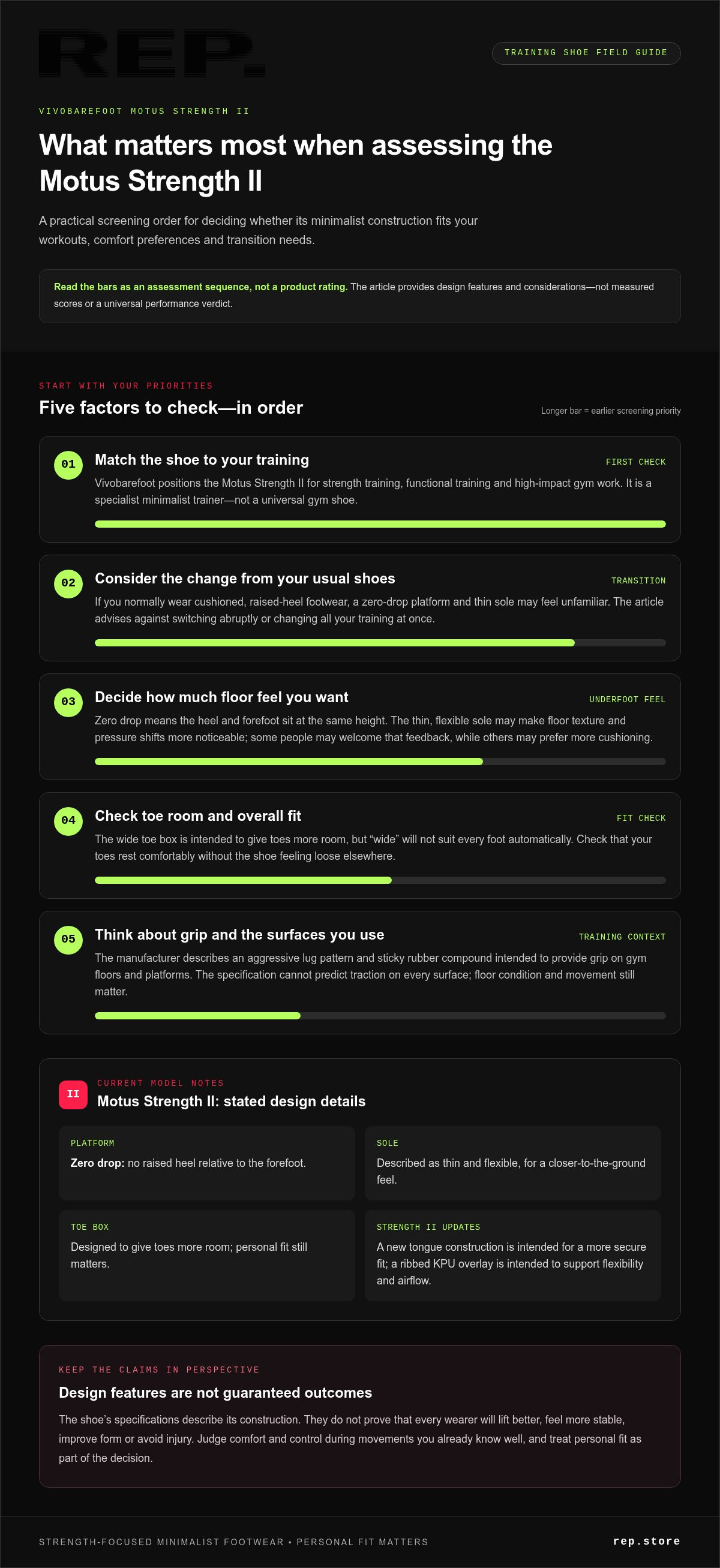
The Motus Strength II’s design is built around a direct connection with the floor, not a thick layer of cushioning. In Vivobarefoot’s current product description, the shoe combines a zero-drop platform, wide toe box, thin flexible sole, grippy outsole and a supportive upper for strength and high-impact training. Those are stated design features, not evidence that every wearer will lift better or feel more stable.
That distinction matters in a Vivobarefoot Motus Strength review Dubai: specifications tell you what the shoe is designed to offer, while your own fitting and training experience tell you whether it works for you. The practical notes below explain what the features may feel like; they aren’t personal wear-test findings or universal outcomes.
Zero-drop design and the ground-feel question
Vivobarefoot describes the Motus Strength II as zero drop, meaning the heel and forefoot sit at the same height relative to the ground. A shoe with a raised heel changes that relationship. Moving to a level platform can therefore feel noticeably different, especially if your usual trainers have more cushioning underfoot or a higher heel.
The sole is also described as thin and flexible. In practice, that design may make floor texture and pressure shifts more noticeable during a controlled lift. Some users may appreciate that feedback; others may prefer more cushioning. Zero drop alone doesn’t guarantee improved lifting form, strength or safety. Treat it as a construction choice, then judge comfort and control during movements you already know well.
Toe-box room, grip, and construction
The manufacturer specifies a wide toe box, which is intended to give the toes more room than a narrower shape. That may feel less restrictive, but “wide” doesn’t automatically mean the fit will suit every foot. Check whether your toes can rest comfortably without the shoe feeling loose elsewhere.
For the outsole, Vivobarefoot describes an aggressive lug pattern and sticky rubber compound. The stated aim is grip on gym floors and platforms. During a controlled squat or lateral movement, grip is relevant because your foot needs to stay planted; the spec alone can’t predict traction on every surface. Floor condition and movement still matter.
The upper is described as durable, breathable mesh with a KPU overlay. For the Motus Strength II, Vivobarefoot also identifies a ribbed KPU overlay for flexibility and airflow, plus a new tongue construction for a more secure fit. These are product claims, not a durability guarantee. Check the fit and hold for yourself rather than assuming the design will feel identical on every foot.
In short, the Motus Strength II pairs zero drop, a wide toe box and a thin, flexible sole with an aggressive-lug sticky-rubber outsole and a supportive mesh upper for strength-focused training. If you want to assess how its profile feels on your own feet, you can explore Vivobarefoot shoes at REP Store.
Is Motus Strength versatile enough for lifting, WODs, and everyday training?
The Motus Strength II has a defined training role, but versatility depends on what you ask it to do. Vivobarefoot positions it for strength work and high-impact training. That’s not the same as proving it’s the best choice for every class, every run or all-day wear. The table separates stated use from practical limits, so the Vivobarefoot Motus Strength review Dubai can inform your choice without turning a specialist shoe into an all-purpose promise.
| Activity | Evidence and potential fit | Limit to keep in mind |
|---|---|---|
| Lifting | The thin, flexible sole and zero-drop design are consistent with a close-to-floor feel. The manufacturer positions the shoe for strength training. | Design doesn’t prove better lifting results. Comfort and confidence under load are personal. |
| Mixed workouts and WODs | Vivobarefoot identifies high-impact and CrossFit-style training, including rope climbs and sled pushes, as intended uses. Its lugged outsole is described as offering grip. | That intended-use claim isn’t a guarantee of grip or comfort in every gym, movement or workout. |
| Running | The research brief describes short sprints and runs under 800 metres to one mile as possible uses. | It isn’t recommended for long-distance running. The brief cites its heavier construction and less breathable upper compared with dedicated running models. |
| Daily wear | A reviewer’s 100-day wear observations can offer one person’s experience beyond training. | That account is personal, not a prediction of every wearer’s comfort or proof that the shoe suits all-day use. |
Where a strength-focused shoe may make sense
For controlled lifts, some athletes prefer a low-profile platform because it gives a closer-to-the-floor sensation. The Motus Strength II’s stated zero-drop construction and thin, flexible sole align with that preference. Its grip claims may also matter during lateral movements, but feeling planted is not the same as lifting more effectively. Your technique, the surface and the load remain part of the picture.
Where the review should set limits
Barefoot-style shoes aren’t automatically right for every athlete. A runner who wants more cushioning for distance, or a gym-goer who prefers a more cushioned feel, may choose differently. The stated short-run use doesn’t make the Motus Strength II a dedicated running shoe. And one reviewer’s extended daily-wear experience can’t settle how it will feel on your feet.
Balanced verdict: Consider the Motus Strength II if strength work and functional training lead your schedule and you value a close-to-ground feel. Choose based on your priorities, not a universal ranking. If running long distances or all-day cushioning matters more, its specialist focus may be a mismatch.
How to assess fit and adapt to Motus Strength in Dubai
A barefoot-style shoe should feel different from a cushioned trainer, but “different” shouldn’t mean ignoring discomfort. In this Vivobarefoot Motus Strength review Dubai, the practical approach is simple: check how the shoe holds your foot, then introduce it gradually. There’s no universal adaptation schedule. Your current footwear habits and comfort should guide the pace.
A practical fit check before training
Assess fit in your usual training socks. A quick standing and movement check can help you notice pressure, slippage and confidence before adding a workout. Focus on how the shoe feels, not on forcing a particular fit.
- Stand naturally. Notice whether your toes feel comfortably positioned in the wide toe box. Room to spread should feel comfortable, not like your foot is sliding around.
- Check the hold. Walk a few steps and change direction gently. Pay attention to whether your heel feels secure and whether the upper holds your foot without uncomfortable pressure.
- Try familiar, controlled movements. If the shoe feels comfortable, test a bodyweight squat or a small side step. Notice whether you feel steady and confident on the surface.
- Reassess before training. If you notice rubbing, pinching, slipping or discomfort, don’t treat it as something you must push through. Reconsider the fit or stop the assessment.
This is a practical first check, not a size chart or fit guarantee. A shoe that feels fine while standing may feel different in motion, so take the time to notice both.
A measured transition from conventional trainers
Start with limited, low-intensity exposure and adjust based on comfort. For example, you could wear the Motus Strength for a short, familiar part of a gym session, rather than immediately using it for a full workout. Keep the first movements controlled. If discomfort develops, stop and return to footwear that feels comfortable; don’t increase use simply to meet a timetable.
You don’t have to abandon other suitable training shoes. Different workouts and personal preferences can call for different footwear. A gradual introduction lets you compare the Motus Strength’s underfoot feel with what you’re used to, without making it your only option before you know how it feels.
For a more detailed approach to changing from conventional trainers, use the dedicated minimalist-shoe transition guide as a companion. Its broader adaptation advice can complement this shoe-specific fit check without turning one schedule into a rule for everyone.
Want to explore Vivobarefoot footwear locally as you assess your options? Browse Vivobarefoot shoes at REP Store.
Explore Vivobarefoot in Dubai and next steps
The Motus Strength II is a specialist choice, not a default answer for every training plan. It may suit lifters and functional-training athletes who value a close-to-ground feel and are comfortable introducing minimalist footwear gradually. If you prefer more cushioning, mainly run longer distances, or want one shoe to cover every activity, its design may not match your priorities.
This Vivobarefoot Motus Strength review Dubai comes down to fit between the shoe and your actual routine. Consider what you train most, how you want a shoe to feel underfoot, and whether you’re prepared to adjust to its minimalist construction. Product features describe the design; only your own comfort and movement can tell you whether it feels right.
Explore performance footwear at Dubai Hills Mall
REP Store is a local place to explore Vivobarefoot footwear and other performance footwear in Dubai. It’s located at Dubai Hills Mall, First Floor, Dubai. A physical retail setting gives you a local point of reference as you consider design and fit; this information doesn’t imply that a specific Motus Strength model, colour or size is currently in stock.
If you’re comparing different footwear for training, the broader Dubai training-shoe guide can help you consider the Motus Strength alongside other options. UAE orders receive Free delivery, 2-4 working days.
A buyer’s final Motus Strength checklist
Before deciding, weigh the shoe against your own use, rather than buying on the strength of the barefoot label alone. These checks keep the decision focused:
- Match the main activity. Its stated role centres on strength and high-impact training. Consider whether those sessions make up a meaningful part of your routine.
- Choose the feel you prefer. Zero drop, a wide toe box and a thin, flexible sole offer a different underfoot experience from a more cushioned trainer. Decide whether that appeals to you.
- Respect the adjustment. If minimalist footwear is new to you, introduce it gradually and let comfort guide how you use it. You don’t need to replace every other suitable training shoe.
- Set realistic expectations. Design intent isn’t a promise of better performance, universal comfort or suitability for every workout.
Bottom line: The Motus Strength II may be worth considering if strength work is central to your training and you want a specialist minimalist feel. If cushioning, distance running or all-purpose versatility comes first, choosing a different type of footwear may make more sense. Explore performance footwear at REP Store as you weigh your options.
Make your next training choice with confidence
The right shoe is the one that fits the work you actually do, not the one with the boldest claims. Before choosing, picture your next few training sessions: which movements matter most, what underfoot feel helps you stay focused, and how much change are you ready to introduce? Use those answers to decide whether the Motus Strength deserves a place in your kit.
This Vivobarefoot Motus Strength review Dubai is a starting point, not a substitute for your own fit check. Give yourself room to compare, notice how the shoe feels in motion, and keep other footwear in rotation if it suits a different session. A considered choice beats forcing a minimalist design into every part of your routine.
REP Store carries Vivobarefoot Shoes and offers a local place to explore performance footwear at Dubai Hills Mall, First Floor, Dubai. UAE orders receive Free delivery, 2-4 working days. Explore performance footwear at REP Store, then choose the option that supports your training priorities. Move forward with curiosity, and let comfort guide the decision.
Frequently Asked Questions
Is the Vivobarefoot Motus Strength good for beginners?
It may suit a beginner, depending on footwear experience, comfort and training needs. Someone new to strength training may have different priorities from an experienced lifter who’s new to minimalist shoes. Try it in a limited, familiar part of a workout before considering broader use. The Vivobarefoot Motus Strength review Dubai can help frame the decision, but one reviewer’s experience can’t predict what will suit every person.
Can you use the Vivobarefoot Motus Strength for running?
It’s a strength-focused shoe, so that purpose alone doesn’t establish whether it’s right for your running. Current product information describes short sprints and short runs as possible uses, but not long-distance running. Think about the distance, pace and surface you regularly run on, then compare those demands with the shoe’s stated role. Don’t assume a training shoe that works for gym sessions will automatically suit every run.
Does a zero-drop shoe automatically improve lifting?
No. The Motus Strength II is described as zero drop, meaning its heel and forefoot are level relative to the ground. That geometry can change how a shoe feels during a lift, but it doesn’t guarantee better form, strength or safety. For example, a comfortable setup for a controlled squat may not feel the same during another exercise. Fit, technique, exercise choice and personal comfort all matter.
Are barefoot-style shoes comfortable for all-day wear?
Not for everyone. Comfort can depend on your usual footwear, the shoe’s fit, how much you walk and whether you’re accustomed to a minimalist feel. A reviewer’s 100-day experience is useful as one person’s account, not a universal result. If you’re considering daily wear, start with a manageable period rather than committing to a full day immediately. Pay attention to discomfort and change footwear if it develops.
How should I choose a size in Vivobarefoot Motus Strength?
Use the current, model-specific sizing information rather than relying on a conversion from another shoe brand. Try the shoe with the socks you expect to wear for training. Check that your toes feel comfortable and that your heel feels held as you walk and change direction gently. Foot shape and sizing preferences vary, so neither a familiar size nor a general size rule can guarantee the right fit.
Can the Motus Strength replace every pair of gym shoes?
Don’t assume one model will suit every session or wearer. The Motus Strength II’s stated focus is strength training, while running distance, workout demands and cushioning preferences can lead to different footwear needs. For example, you may prefer another shoe for longer runs or sessions where you want more cushioning. Keep your decision tied to the activities you do and how each shoe feels, not an all-purpose claim.


