

What to Look for in a Power Cage: The Professional Buyer’s Guide for 2026

Your gym is only as strong as its weakest weld. A power cage is either the structural foundation of your physical progress or a rattling liability taking up space in your villa. If you're building a serious training environment, you cannot afford to settle for equipment that shudders under a heavy load. Knowing what to look for in a power cage is the difference between a lifetime investment and a dangerous mistake.
It's common to feel overwhelmed by technical jargon like steel gauge and Westside spacing while trying to maximize limited square footage. You deserve a rack that performs like a commercial beast and grows with your strength. This guide strips away the marketing noise so you can master the professional specifications of high-grade cages. We will examine why 11-gauge steel remains the non-negotiable standard, how 3x3 uprights have come to dominate the 2026 landscape, and how to choose an attachment ecosystem that ensures your gym never hits a plateau.
Key Takeaways
- 11-gauge steel and 3x3 inch uprights are the non-negotiable standards for a rack that remains rock-solid under heavy loads.
- Mastering what to look for in a power cage requires looking beyond the frame to details like laser-cut numbering and Westside hole spacing for maximum precision.
- A professional cage must be a modular platform, allowing you to integrate attachments that transform a simple squat stand into a full-body training station.
- Spatial intelligence is critical for Dubai gym owners; always account for the pull-up clearance rule to ensure your ceiling height can accommodate overhead movements.
- Nike Strength racks represent the 2026 pinnacle of technical precision, offering a foundation that matches professional performance with high-end gym aesthetics.
The Foundation of Performance: Why Steel Gauge and Upright Size Matter
The Power rack (power cage) acts as the central nervous system of any serious strength facility. It's the hub where your most critical lifts happen. If this foundation is weak, your entire training system is compromised. When evaluating what to look for in a power cage, you must start with the raw materials. Cheap steel isn't just a budget choice; it's a structural risk that degrades your performance and safety. Professional-grade equipment demands a level of density that light-duty alternatives simply cannot match.
Understanding Steel Gauge: 11-Gauge vs. The Rest
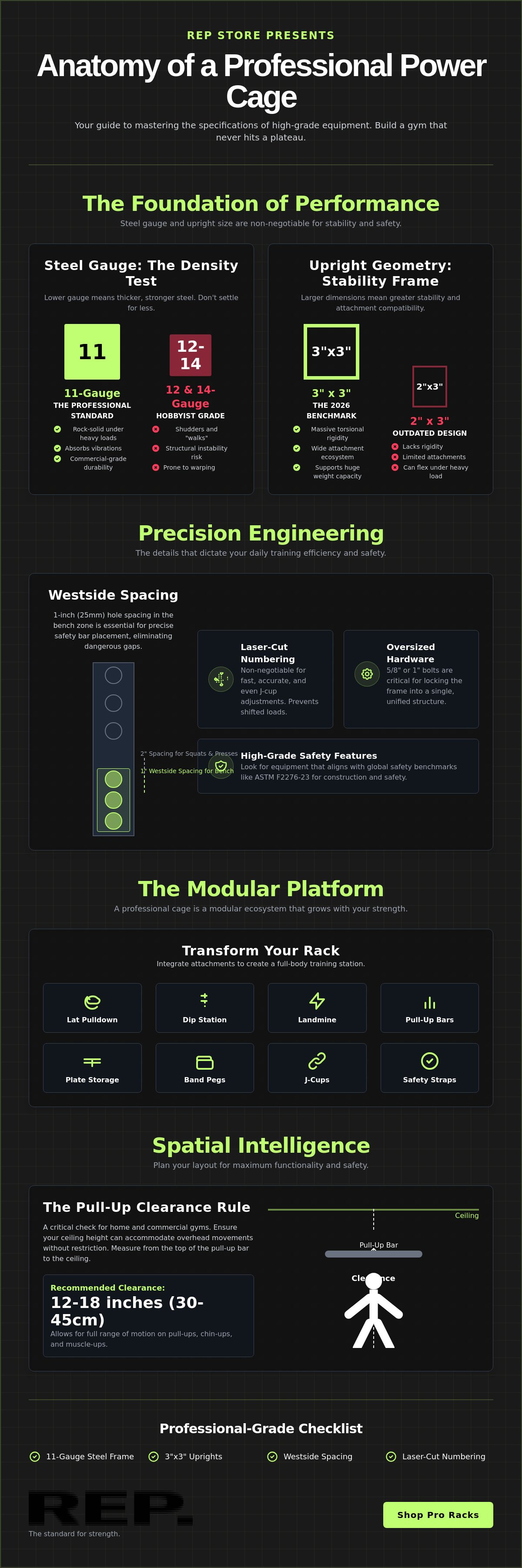
In the steel industry, gauge refers to thickness. The system is counterintuitive. Lower numbers indicate thicker, more resilient walls. Entry-level racks often use 12 or 14-gauge steel. These are essentially hollow shells that vibrate and "walk" across the floor during heavy re-racking. This movement isn't just annoying; it's a sign of structural instability that can lead to catastrophic failure under load. Knowing what to look for in a power cage frame is the first step to total gym control.
11-gauge steel is the industry standard for commercial-grade durability. It provides the mass necessary to dampen vibrations and absorb the kinetic energy of a heavy barbell slamming into the J-cups. You don't want a rack that shudders. You want a rack that remains silent and immovable. Professional-grade 11-gauge steel ensures your equipment doesn't just survive your current strength; it anticipates your future gains.
Upright Geometry and Bolting Patterns
Stability isn't just about weight. It's about geometry. The 3x3-inch upright has become the definitive standard for 2026. This dimension offers a massive surface area for high-performance attachments and a wider footprint that accommodates wide-stance squatters without interference. While 2x3-inch frames exist, they often lack the torsional rigidity required for high-capacity lifting. A 3x3-inch frame provides the structural integrity needed to support massive weight capacities without flexing.
Pay attention to the hardware. Professional cages utilize oversized bolts, typically 5/8-inch or 1-inch, to lock the frame together. This creates a unified structure that behaves like a single piece of forged steel. A wider footprint creates a safer environment by lowering the center of gravity and providing more room for internal movement. If the hardware looks small, the rack's capacity is likely limited.
Spotting "hollow" steel is easy once you know where to look. Check the total shipping weight of the rack. If a full-size cage weighs significantly less than its professional counterparts, it's likely using light-duty materials that will warp over time. True professional equipment feels dense. It's built to withstand decades of abuse, not just a few months of light use. Don't let a sleek coat of paint hide a flimsy skeleton.
Precision Engineering: Hole Spacing, Hardware, and Safety Features
A power cage is more than a steel box. It's a precision instrument. While the frame provides the mass, the engineering details dictate your daily training efficiency. When determining what to look for in a power cage, the quality of the holes and the safety mechanisms separate professional equipment from hobbyist substitutes. You cannot maximize your output if you're struggling with misaligned attachments or imprecise safety heights. Efficiency is the byproduct of precision.
Westside Spacing: The Bench Press Essential
Precision begins with hole density. Professional racks utilize Westside spacing, characterized by 1-inch (25mm) hole gaps through the benching zone. This allows for granular adjustments that ensure your safety bars are positioned exactly where you need them. Standard 2-inch spacing is often too wide for benching; you either lose depth or risk the bar pinning you. 1-inch precision eliminates this "no-man's land." For squats and overhead presses, 2-inch spacing elsewhere remains the standard for speed and convenience.
Laser-cut numbering is another non-negotiable feature for 2026. Counting holes while under extreme fatigue is a recipe for uneven J-cups and a shifted center of gravity. Permanent, laser-etched numbers allow for instant, accurate adjustments. This level of detail aligns with global safety parameters like ASTM F2276-23, which sets the benchmark for construction and safety in fitness equipment. If a rack lacks numbered uprights, it's a clear sign of cost-cutting that will eventually frustrate your workflow.
Safety Systems: Straps vs. Pins
Safety isn't a static feature. It's a system designed to protect both the lifter and the equipment. Understanding what to look for in a power cage safety suite requires comparing three main types:
- Safety Straps: These are the gold standard for 2026. Made of high-strength nylon, they protect your barbell’s knurling during failed lifts and significantly reduce noise.
- Pin-Pipe Safeties: The traditional choice. They're rugged and capable of bearing massive loads, though they lack the "give" that protects your bar.
- Flip-Down Safeties: These offer the fastest transition times. They lock securely into the uprights and are ideal for facilities with multiple lifters using different heights.
Protecting your barbell is just as important as protecting your spine. Professional J-cups must be lined with UHMW plastic or high-density rubber. Metal-on-metal contact destroys knurling and compromises the structural integrity of your bar over time. If you want a rack that respects your investment, look for precision-engineered options like Nike Strength gym equipment, which integrates these protective features as standard. Don't let poor engineering limit your ceiling for growth.
Beyond the Basics: Versatility and the Attachment Ecosystem
A professional power cage isn't merely a squat stand; it's a modular engine for total body development. Buying a frame without considering its future potential is a strategic error. When analyzing what to look for in a power cage, you must evaluate the attachment ecosystem. This determines whether your equipment remains relevant as your training evolves. High-performance facilities don't waste space on single-use machines. They build around a central hub that scales. Efficiency is a choice, not an accident.
To Get the Most Out of the Power Rack, look for future-proof hole patterns. Industry leaders typically use 2-inch or 3-inch center-to-center spacing. This consistency ensures you aren't locked out of new innovations. Pull-up bar variations also dictate utility. A multi-grip bar offers neutral and angled positions to protect your shoulders, while a fat bar builds grip strength. Stability isn't just about the steel; it's about ballast. Integrated weight plate storage adds hundreds of kilograms of mass to the frame. This mass prevents the rack from shifting during high-intensity movements, creating a rock-solid environment for every set.
Core Attachments for Maximum ROI
A cage should replace three or four separate machines. Dip stations and landmine attachments turn a simple frame into a full-body circuit station. Lat pull-down and low row integrations are essential for back training without sacrificing floor space. This stability is the foundation of every rep. Just as your rack needs a solid base, your body requires professional support. Wearing high-performance footwear like R.A.D One Shoes ensures you can capitalize on the immovable platform your cage provides. Your equipment and your apparel must work in tandem to eliminate performance leaks.
The Compatibility Trap
Hardware size is the most common point of failure for buyers. The choice between 1-inch and 5/8-inch holes dictates your entire accessory library. Mixing these standards leads to loose, dangerous fits or total incompatibility. Sticking to a premium, unified ecosystem like Nike Strength ensures every component locks in with surgical precision. This eliminates the guesswork. Finally, examine the finish. A high-grade powder coat offers superior wear resistance compared to cheap chrome, which flakes and rusts under heavy use. Don't let a "good deal" on a generic rack trap you in a dead-end ecosystem. Invest in a platform that allows for infinite expansion.
Spatial Intelligence: Planning Your Dubai Gym Layout
Building a high-performance gym in Dubai isn't just about selecting the right gear. It's about navigating the logistical constraints of your property. Whether you're occupying a high-rise apartment in Marina or a sprawling villa in Jumeirah, space is your most valuable asset. Evaluating what to look for in a power cage must involve a rigorous audit of your available volume. A rack that fits on paper might fail in reality if you haven't accounted for the "working area" required for dynamic movement. Efficiency dictates that every square centimeter must serve a purpose.
Climate is the silent killer of equipment in the UAE. If you're planning a garage gym, non-climate-controlled environments expose steel to rapid oxidation. High humidity levels will punish cheap finishes. Professional-grade powder coating is a requirement, not a luxury. You need equipment that can withstand the local elements without structural degradation. Your investment should be built for the desert, not just a showroom floor.
Ceiling Height and Footprint Logistics
The "Pull-Up Clearance" rule is the most common point of failure for home gym owners. You don't just need a rack that fits under your ceiling; you need 12 to 18 inches of clearance above the pull-up bar. Without this, your head will hit the slab during every rep. For low-ceiling apartment setups, short-rack versions are essential. Furthermore, a standard 7-foot barbell requires at least 10 feet of total width to allow for safe plate loading. If you're unsure about the spatial impact, visiting a physical location like REP Store Dubai is a strategic move to feel the scale before committing to a delivery.
Floor Loading and Protection
Dubai villa tiles are notoriously brittle. Dropping a heavy deadlift on bare ceramic will result in a costly repair bill. High-impact rubber flooring, at least 20mm thick, is non-negotiable. For serious lifters, a dedicated lifting platform is superior. It disperses force across a wider surface area, protecting the structural integrity of your subfloor. When considering what to look for in a power cage, decide on your bolting strategy early. Dynamic movements like kipping pull-ups require the rack to be bolted to the floor or a platform. If you're in a rental and cannot drill into the slab, a flat-foot rack is your only viable option for stability.
Don't let a spatial miscalculation compromise your training. Secure your foundation by exploring the professional range of Nike Strength gym equipment to find a footprint that matches your environment.
The Professional Standard: Why Nike Strength Racks Define the Category
Performance is a choice. Your training environment dictates your standards. When you master what to look for in a power cage, you realize that aesthetics and engineering are not mutually exclusive. Nike Strength has entered the category not just as a brand, but as a technical benchmark. Their racks are designed for those who refuse to compromise on stability or visual impact. It's about creating a space that commands respect and drives consistency. Your gear should be as ambitious as your goals.
The Nike Strength Power Rack is built on the industry gold standard: 11-gauge steel and 3x3 inch uprights. This combination provides an immovable foundation for heavy compound movements. While many manufacturers treat home equipment as a secondary priority, Nike bridges the gap between commercial-grade durability and high-end residential design. Precision is baked into every weld. This rack doesn't just sit in your room; it anchors your entire training philosophy.
Technical Superiority of Nike Strength
Small details define the professional experience. Nike utilizes a signature powder coating that offers superior grip and oxidation resistance, which is essential for the UAE's unique climate. Laser-etched branding and numbering ensure your setup looks as sharp as it performs. The engineering goes deeper than the surface. Oversized hardware and 5/8-inch compatible holes provide the structural integrity needed for a 700 lb J-cup capacity. This equipment doesn't just hold weight. It manages it with surgical precision. Understanding what to look for in a power cage means recognizing that hardware quality is the final metric of safety.
Experience the Gear at REP Store
Digital specifications only tell half the story. You need to feel the density of the steel. Visiting a trusted regional partner like REP Store in Dubai Hills Mall allows you to test the stability of these racks in person. Shake the uprights. Adjust the J-cups. Experience the tactile quality of the finish before you commit. For B2B gym owners in the UAE, this physical touchpoint is critical for receiving expert procurement advice tailored to commercial scaling. Professional gear influences your "Everyday Performance" mindset. It turns a standard workout into a focused training session.
Don't settle for a gym that feels like a compromise. Your progress depends on the foundation you build today. Explore the Nike Strength collection at REP Store and secure the pinnacle of modern strength engineering for your facility.
Architect Your Strength Foundation
Your training progress shouldn't be limited by equipment failure. Choosing 11-gauge steel and 3x3 inch uprights ensures your facility remains rock-solid for decades. You now understand what to look for in a power cage, from the precision of Westside hole spacing to the necessity of a modular attachment ecosystem. These technical specifications aren't just details. They're the difference between a professional-grade hub and a rattling liability that compromises your safety.
Don't leave your performance to chance. REP Store is the exclusive UAE retailer for Nike Strength, offering a curated selection specifically for high-performance athletes. Visit our physical showroom in Dubai Hills Mall to experience the stability and precision of these professional standards firsthand. Stop settling for entry-level gear that wobbles under load. Upgrade your training with Nike Strength Equipment at REP Store. Build a foundation that matches your ambition and ensures your gym is built to last.
Frequently Asked Questions
Is a power cage better than a squat rack for a home gym?
A power cage is superior if safety and versatility are your primary concerns. Cages provide a four-post enclosure with internal safety bars, creating a fail-safe environment that a standard squat stand cannot match. While squat racks save floor space, they lack the structural stability and the extensive attachment ecosystem required for a professional-grade training facility.
Do I need to bolt my power cage to the floor for safety?
You must bolt your rack if you perform dynamic movements like kipping pull-ups or heavy band work. Structural rigidity is non-negotiable for high-performance training. If you're in a Dubai rental where drilling isn't an option, select a flat-foot rack with an extended base. This provides the necessary ballast to prevent tipping without damaging the subfloor.
What is the best steel gauge for a power rack?
11-gauge steel is the definitive professional standard for 2026. This thickness provides the mass required to dampen vibrations and prevent the frame from "walking" during heavy re-racking. Avoid 12 or 14-gauge alternatives. These lighter materials are prone to warping and lack the density needed to absorb the kinetic energy of a thousand-pound load.
Can I use different brand attachments on my power cage?
Compatibility depends on three specific metrics: tubing size, hole diameter, and hole spacing. A 3x3 inch rack with 5/8 inch holes will often accept accessories from other manufacturers using the same dimensions. However, sticking to a unified ecosystem like Nike Strength ensures a surgical fit. Mixing brands often leads to loose attachments that compromise your safety.
How much ceiling height do I need for a full-size power cage?
You need a minimum ceiling height of 9 feet to accommodate a standard rack and allow for pull-up clearance. This ensures your head doesn't hit the slab during vertical movements. If your Dubai apartment has lower ceilings, look for short-rack versions designed for 8-foot clearances. Always measure your space before committing to a specific model.
What are the most essential attachments for a new power cage?
Precision J-cups, safety straps, and a multi-grip pull-up bar are the first items to prioritize. These components define what to look for in a power cage setup that delivers immediate ROI. Once your foundation is secure, add weight storage pegs to provide hundreds of kilograms of ballast, or high-tech tools like Wow Gadgets magnetic mounts to keep your training data visible during every set.
Is it safe to use a power cage without a spotter?
It's perfectly safe provided you use properly adjusted safety straps or pin-pipe safeties. These mechanisms act as a mechanical spotter, catching the barbell if you reach muscular failure. This allows you to train to your absolute limit without external assistance. Always test your safety heights with an empty bar before starting your working sets.
How do I maintain my power cage in the UAE humidity?
Maintenance requires regular inspections for surface oxidation and keeping the steel dry. Wipe down the frame with a microfiber cloth after every session to remove corrosive sweat. In non-climate-controlled Dubai garages, apply a light coat of 3-in-1 oil to the hardware every six months. This prevents rust from seizing the bolts and preserves the integrity of the powder coat.


